

94
5 Flux Pinning Phenomena
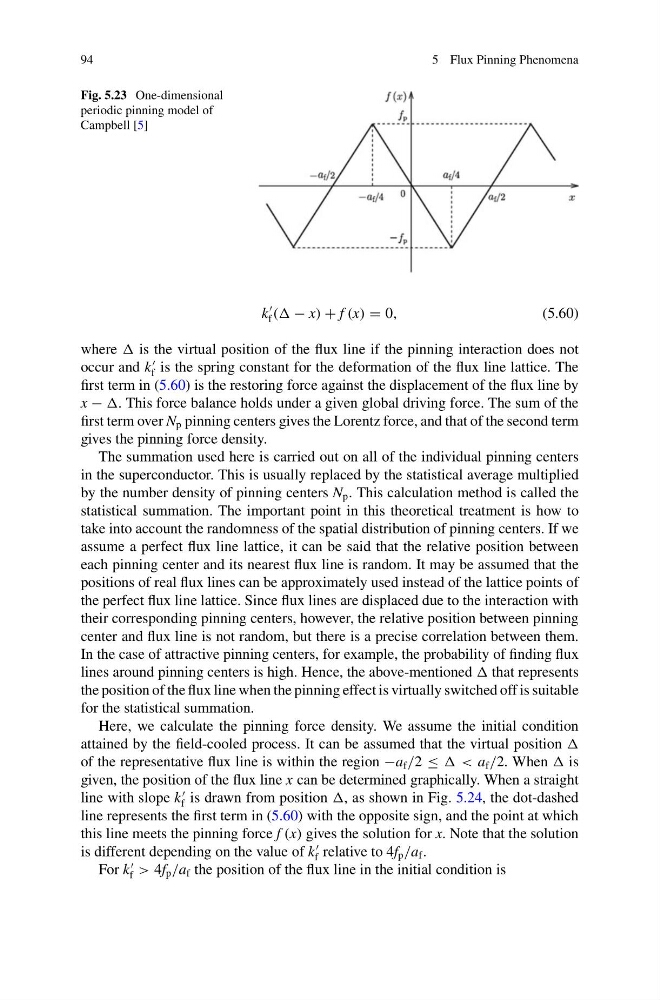
Fig. 5.23 One-dimensional
periodic pinning model of
Campbell [5]
k
f ( − x) + f (x) = 0,
(5.60)
where is the virtual position of the flux line if the pinning interaction does not
occur and k
f is the spring constant for the deformation of the flux line lattice. The
first term in (5.60) is the restoring force against the displacement of the flux line by
x − . This force balance holds under a given global driving force. The sum of the
first term over N p pinning centers gives the Lorentz force, and that of the second term
gives the pinning force density.
The summation used here is carried out on all of the individual pinning centers
in the superconductor. This is usually replaced by the statistical average multiplied
by the number density of pinning centers N p . This calculation method is called the
statistical summation. The important point in this theoretical treatment is how to
take into account the randomness of the spatial distribution of pinning centers. If we
assume a perfect flux line lattice, it can be said that the relative position between
each pinning center and its nearest flux line is random. It may be assumed that the
positions of real flux lines can be approximately used instead of the lattice points of
the perfect flux line lattice. Since flux lines are displaced due to the interaction with
their corresponding pinning centers, however, the relative position between pinning
center and flux line is not random, but there is a precise correlation between them.
In the case of attractive pinning centers, for example, the probability of finding flux
lines around pinning centers is high. Hence, the above-mentioned that represents
the position of the flux line when the pinning effect is virtually switched off is suitable
for the statistical summation.
Here, we calculate the pinning force density. We assume the initial condition
attained by the field-cooled process. It can be assumed that the virtual position
of the representative flux line is within the region −a f /2 ≤ < a f /2. When is
given, the position of the flux line x can be determined graphically. When a straight
line with slope k
f is drawn from position , as shown in Fig. 5.24, the dot-dashed
line represents the first term in (5.60) with the opposite sign, and the point at which
this line meets the pinning force f (x) gives the solution for x. Note that the solution
is different depending on the value of k
f relative to 4f p /a f .
For k
f > 4f p /a f the position of the flux line in the initial condition is
5 Flux Pinning Phenomena
Fig. 5.23 One-dimensional
periodic pinning model of
Campbell [5]
k
f ( − x) + f (x) = 0,
(5.60)
where is the virtual position of the flux line if the pinning interaction does not
occur and k
f is the spring constant for the deformation of the flux line lattice. The
first term in (5.60) is the restoring force against the displacement of the flux line by
x − . This force balance holds under a given global driving force. The sum of the
first term over N p pinning centers gives the Lorentz force, and that of the second term
gives the pinning force density.
The summation used here is carried out on all of the individual pinning centers
in the superconductor. This is usually replaced by the statistical average multiplied
by the number density of pinning centers N p . This calculation method is called the
statistical summation. The important point in this theoretical treatment is how to
take into account the randomness of the spatial distribution of pinning centers. If we
assume a perfect flux line lattice, it can be said that the relative position between
each pinning center and its nearest flux line is random. It may be assumed that the
positions of real flux lines can be approximately used instead of the lattice points of
the perfect flux line lattice. Since flux lines are displaced due to the interaction with
their corresponding pinning centers, however, the relative position between pinning
center and flux line is not random, but there is a precise correlation between them.
In the case of attractive pinning centers, for example, the probability of finding flux
lines around pinning centers is high. Hence, the above-mentioned that represents
the position of the flux line when the pinning effect is virtually switched off is suitable
for the statistical summation.
Here, we calculate the pinning force density. We assume the initial condition
attained by the field-cooled process. It can be assumed that the virtual position
of the representative flux line is within the region −a f /2 ≤ < a f /2. When is
given, the position of the flux line x can be determined graphically. When a straight
line with slope k
f is drawn from position , as shown in Fig. 5.24, the dot-dashed
line represents the first term in (5.60) with the opposite sign, and the point at which
this line meets the pinning force f (x) gives the solution for x. Note that the solution
is different depending on the value of k
f relative to 4f p /a f .
For k
f > 4f p /a f the position of the flux line in the initial condition is