

5.3 Reversible Flux Motion
93
reality, the area in which the energy dissipation occurs is fairly extended, as shown
in Fig. 5.15, and this factor approximately cancels the reduction in the loss energy
density. You will find much more details in Ref. [10]. The reason why the loss energy
density is kept small in very thin superconductors is that there is no extension of the
energy dissipating area.
5.4 Summation Problem and Irreversibility
In this section the theoretical treatment needed to solve the summation problem
explained in Sect. 5.1 is briefly introduced. Magnetic flux lines form a lattice under
the repulsive magnetic interaction that exists among them, and each flux line interacts
with pinning centers distributed randomly in the superconductor. Because of the
randomness of the distribution of pinning centers, the statistical calculation method
is employed. Namely, an interaction between one pinning center and a flux line near it
is treated representatively, and the pinning force density is estimated from an average
for similar N p interactions in a unit volume. For simplicity, we use a one-dimensional
approximation system along the direction of the Lorentz force. For the representative
interaction, we assume a pinning center with its center at x = 0. The position of the
flux line near the pinning center is denoted by x. The flux line spacing is denoted by
a f . Since the area of a unit cell of the triangular flux line lattice is
√
3/2
a
2
f , under
the magnetic flux density B, using the flux quantum φ 0 , we have
a f =
2φ 0
√
3B
1/2
.
(5.58)
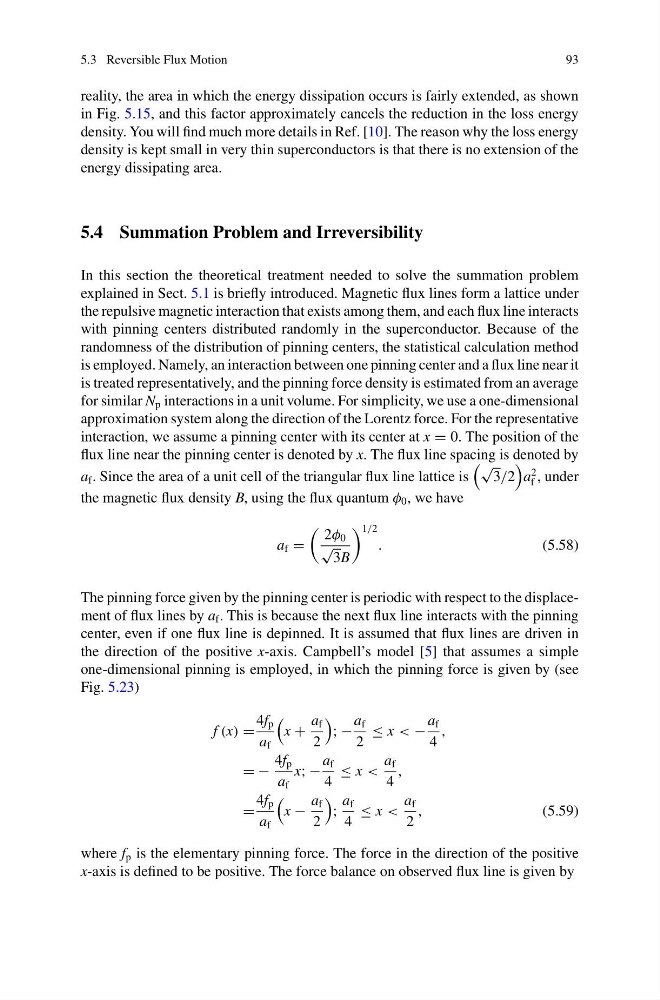
The pinning force given by the pinning center is periodic with respect to the displacement of flux lines by a f . This is because the next flux line interacts with the pinning
center, even if one flux line is depinned. It is assumed that flux lines are driven in
the direction of the positive x-axis. Campbell’s model [5] that assumes a simple
one-dimensional pinning is employed, in which the pinning force is given by (see
Fig. 5.23)
f (x) =
4f p
a f
x +
a f
2
; −
a f
2
≤ x < −
a f
4
,
= −
4f p
a f
x; −
a f
4
≤ x <
a f
4
,
=
4f p
a f
x −
a f
2
;
a f
4
≤ x <
a f
2
,
(5.59)
where f p is the elementary pinning force. The force in the direction of the positive
x-axis is defined to be positive. The force balance on observed flux line is given by
93
reality, the area in which the energy dissipation occurs is fairly extended, as shown
in Fig. 5.15, and this factor approximately cancels the reduction in the loss energy
density. You will find much more details in Ref. [10]. The reason why the loss energy
density is kept small in very thin superconductors is that there is no extension of the
energy dissipating area.
5.4 Summation Problem and Irreversibility
In this section the theoretical treatment needed to solve the summation problem
explained in Sect. 5.1 is briefly introduced. Magnetic flux lines form a lattice under
the repulsive magnetic interaction that exists among them, and each flux line interacts
with pinning centers distributed randomly in the superconductor. Because of the
randomness of the distribution of pinning centers, the statistical calculation method
is employed. Namely, an interaction between one pinning center and a flux line near it
is treated representatively, and the pinning force density is estimated from an average
for similar N p interactions in a unit volume. For simplicity, we use a one-dimensional
approximation system along the direction of the Lorentz force. For the representative
interaction, we assume a pinning center with its center at x = 0. The position of the
flux line near the pinning center is denoted by x. The flux line spacing is denoted by
a f . Since the area of a unit cell of the triangular flux line lattice is
√
3/2
a
2
f , under
the magnetic flux density B, using the flux quantum φ 0 , we have
a f =
2φ 0
√
3B
1/2
.
(5.58)
The pinning force given by the pinning center is periodic with respect to the displacement of flux lines by a f . This is because the next flux line interacts with the pinning
center, even if one flux line is depinned. It is assumed that flux lines are driven in
the direction of the positive x-axis. Campbell’s model [5] that assumes a simple
one-dimensional pinning is employed, in which the pinning force is given by (see
Fig. 5.23)
f (x) =
4f p
a f
x +
a f
2
; −
a f
2
≤ x < −
a f
4
,
= −
4f p
a f
x; −
a f
4
≤ x <
a f
4
,
=
4f p
a f
x −
a f
2
;
a f
4
≤ x <
a f
2
,
(5.59)
where f p is the elementary pinning force. The force in the direction of the positive
x-axis is defined to be positive. The force balance on observed flux line is given by