

78
S. B. Christensen et al.
plant dry weight [83]. Thus, this method with shoot regeneration from leaf explants
of T. garganica in temporary immersion bioreactors (TIBs) could represent a future
successful production of 1 until the missing knowledge of the enzymes involved can
provide a heterologous production of this sesquiterpenoid.
7.2 Synthesis of Thapsigargin
Total synthesis of thapsigargin (1) from easily available starting materials would, in
principle, enable access to several kg amounts provided that it is possible to scale up
the protocol. A number of successful syntheses have been published [84–86]. The
Ley approach involved 42 steps, making this route of limited value for producing 1 in
ton amounts. A major problem is the construction of the polyoxygenated sesquiterpene lactone nucleus with the correct stereochemistry. In the Baran approach, this
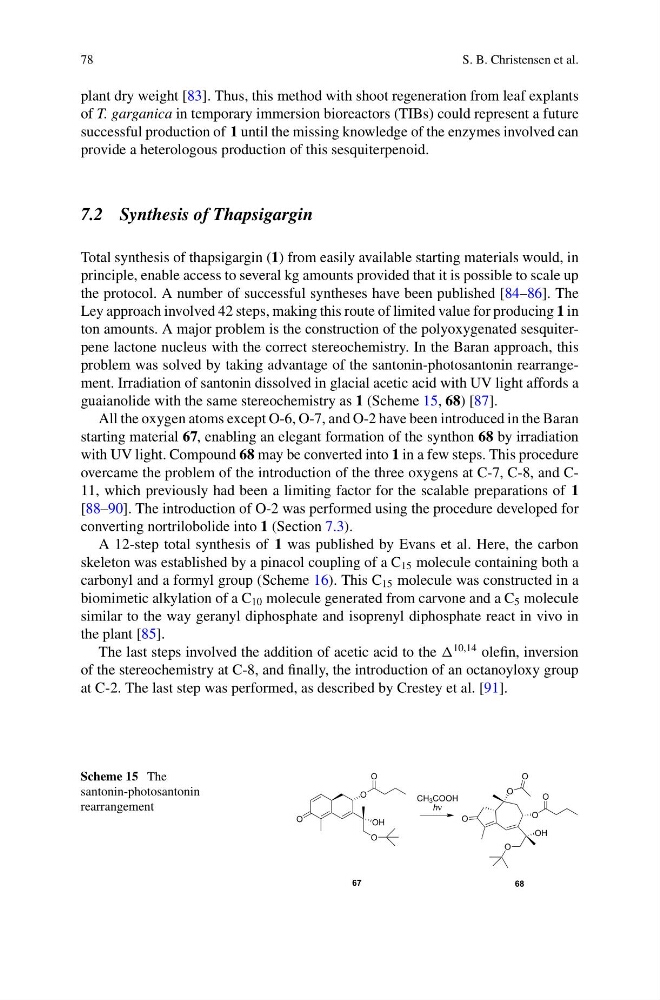
problem was solved by taking advantage of the santonin-photosantonin rearrangement. Irradiation of santonin dissolved in glacial acetic acid with UV light affords a
guaianolide with the same stereochemistry as 1 (Scheme 15, 68) [87].
All the oxygen atoms except O-6, O-7, and O-2 have been introduced in the Baran
starting material 67, enabling an elegant formation of the synthon 68 by irradiation
with UV light. Compound 68 may be converted into 1 in a few steps. This procedure
overcame the problem of the introduction of the three oxygens at C-7, C-8, and C11, which previously had been a limiting factor for the scalable preparations of 1
[88–90]. The introduction of O-2 was performed using the procedure developed for
converting nortrilobolide into 1 (Section 7.3).
A 12-step total synthesis of 1 was published by Evans et al. Here, the carbon
skeleton was established by a pinacol coupling of a C 15 molecule containing both a
carbonyl and a formyl group (Scheme 16). This C 15 molecule was constructed in a
biomimetic alkylation of a C 10 molecule generated from carvone and a C 5 molecule
similar to the way geranyl diphosphate and isoprenyl diphosphate react in vivo in
the plant [85].
The last steps involved the addition of acetic acid to the
10,14 olefin, inversion
of the stereochemistry at C-8, and finally, the introduction of an octanoyloxy group
at C-2. The last step was performed, as described by Crestey et al. [91].
Scheme 15 The
santonin-photosantonin
rearrangement
O
OH
O
O
O
O
O
O
O
OH
O
O
CH 3 COOH
hν
67
68
S. B. Christensen et al.
plant dry weight [83]. Thus, this method with shoot regeneration from leaf explants
of T. garganica in temporary immersion bioreactors (TIBs) could represent a future
successful production of 1 until the missing knowledge of the enzymes involved can
provide a heterologous production of this sesquiterpenoid.
7.2 Synthesis of Thapsigargin
Total synthesis of thapsigargin (1) from easily available starting materials would, in
principle, enable access to several kg amounts provided that it is possible to scale up
the protocol. A number of successful syntheses have been published [84–86]. The
Ley approach involved 42 steps, making this route of limited value for producing 1 in
ton amounts. A major problem is the construction of the polyoxygenated sesquiterpene lactone nucleus with the correct stereochemistry. In the Baran approach, this
problem was solved by taking advantage of the santonin-photosantonin rearrangement. Irradiation of santonin dissolved in glacial acetic acid with UV light affords a
guaianolide with the same stereochemistry as 1 (Scheme 15, 68) [87].
All the oxygen atoms except O-6, O-7, and O-2 have been introduced in the Baran
starting material 67, enabling an elegant formation of the synthon 68 by irradiation
with UV light. Compound 68 may be converted into 1 in a few steps. This procedure
overcame the problem of the introduction of the three oxygens at C-7, C-8, and C11, which previously had been a limiting factor for the scalable preparations of 1
[88–90]. The introduction of O-2 was performed using the procedure developed for
converting nortrilobolide into 1 (Section 7.3).
A 12-step total synthesis of 1 was published by Evans et al. Here, the carbon
skeleton was established by a pinacol coupling of a C 15 molecule containing both a
carbonyl and a formyl group (Scheme 16). This C 15 molecule was constructed in a
biomimetic alkylation of a C 10 molecule generated from carvone and a C 5 molecule
similar to the way geranyl diphosphate and isoprenyl diphosphate react in vivo in
the plant [85].
The last steps involved the addition of acetic acid to the
10,14 olefin, inversion
of the stereochemistry at C-8, and finally, the introduction of an octanoyloxy group
at C-2. The last step was performed, as described by Crestey et al. [91].
Scheme 15 The
santonin-photosantonin
rearrangement
O
OH
O
O
O
O
O
O
O
OH
O
O
CH 3 COOH
hν
67
68