

From Plant to Patient: Thapsigargin, a Tool for Understanding …
77
O
O
O
O
O
O
O
O
O
OH
OH
O
O
O
O
O
O
O
O
O
O
O
O
O
S
Cl
O
H
a
O
O
O
O
O
O
O
O
O
O
O
I
16
1
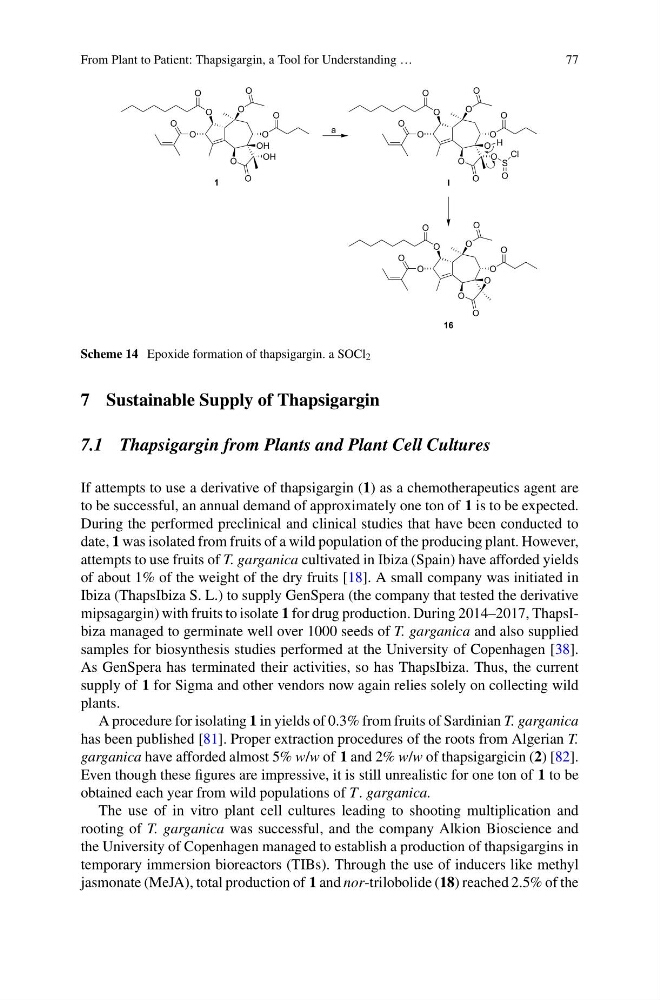
Scheme 14 Epoxide formation of thapsigargin. a SOCl 2
7 Sustainable Supply of Thapsigargin
7.1 Thapsigargin from Plants and Plant Cell Cultures
If attempts to use a derivative of thapsigargin (1) as a chemotherapeutics agent are
to be successful, an annual demand of approximately one ton of 1 is to be expected.
During the performed preclinical and clinical studies that have been conducted to
date, 1 was isolated from fruits of a wild population of the producing plant. However,
attempts to use fruits of T. garganica cultivated in Ibiza (Spain) have afforded yields
of about 1% of the weight of the dry fruits [18]. A small company was initiated in
Ibiza (ThapsIbiza S. L.) to supply GenSpera (the company that tested the derivative
mipsagargin) with fruits to isolate 1 for drug production. During 2014–2017, ThapsIbiza managed to germinate well over 1000 seeds of T. garganica and also supplied
samples for biosynthesis studies performed at the University of Copenhagen [38].
As GenSpera has terminated their activities, so has ThapsIbiza. Thus, the current
supply of 1 for Sigma and other vendors now again relies solely on collecting wild
plants.
A procedure for isolating 1 in yields of 0.3% from fruits of Sardinian T. garganica
has been published [81]. Proper extraction procedures of the roots from Algerian T.
garganica have afforded almost 5% w/w of 1 and 2% w/w of thapsigargicin (2) [82].
Even though these figures are impressive, it is still unrealistic for one ton of 1 to be
obtained each year from wild populations of T. garganica.
The use of in vitro plant cell cultures leading to shooting multiplication and
rooting of T. garganica was successful, and the company Alkion Bioscience and
the University of Copenhagen managed to establish a production of thapsigargins in
temporary immersion bioreactors (TIBs). Through the use of inducers like methyl
jasmonate (MeJA), total production of 1 and nor-trilobolide (18) reached 2.5% of the
77
O
O
O
O
O
O
O
O
O
OH
OH
O
O
O
O
O
O
O
O
O
O
O
O
O
S
Cl
O
H
a
O
O
O
O
O
O
O
O
O
O
O
I
16
1
Scheme 14 Epoxide formation of thapsigargin. a SOCl 2
7 Sustainable Supply of Thapsigargin
7.1 Thapsigargin from Plants and Plant Cell Cultures
If attempts to use a derivative of thapsigargin (1) as a chemotherapeutics agent are
to be successful, an annual demand of approximately one ton of 1 is to be expected.
During the performed preclinical and clinical studies that have been conducted to
date, 1 was isolated from fruits of a wild population of the producing plant. However,
attempts to use fruits of T. garganica cultivated in Ibiza (Spain) have afforded yields
of about 1% of the weight of the dry fruits [18]. A small company was initiated in
Ibiza (ThapsIbiza S. L.) to supply GenSpera (the company that tested the derivative
mipsagargin) with fruits to isolate 1 for drug production. During 2014–2017, ThapsIbiza managed to germinate well over 1000 seeds of T. garganica and also supplied
samples for biosynthesis studies performed at the University of Copenhagen [38].
As GenSpera has terminated their activities, so has ThapsIbiza. Thus, the current
supply of 1 for Sigma and other vendors now again relies solely on collecting wild
plants.
A procedure for isolating 1 in yields of 0.3% from fruits of Sardinian T. garganica
has been published [81]. Proper extraction procedures of the roots from Algerian T.
garganica have afforded almost 5% w/w of 1 and 2% w/w of thapsigargicin (2) [82].
Even though these figures are impressive, it is still unrealistic for one ton of 1 to be
obtained each year from wild populations of T. garganica.
The use of in vitro plant cell cultures leading to shooting multiplication and
rooting of T. garganica was successful, and the company Alkion Bioscience and
the University of Copenhagen managed to establish a production of thapsigargins in
temporary immersion bioreactors (TIBs). Through the use of inducers like methyl
jasmonate (MeJA), total production of 1 and nor-trilobolide (18) reached 2.5% of the