

76
S. B. Christensen et al.
analyses of 1 have revealed that the torsion angles between C-1—C-5, C-5—C-6,
and C-6—C-7 show very little variability whereas the remaining torsion angels in the
seven-membered ring may vary [78]. In the NMR spectra of 1, the coupling constants
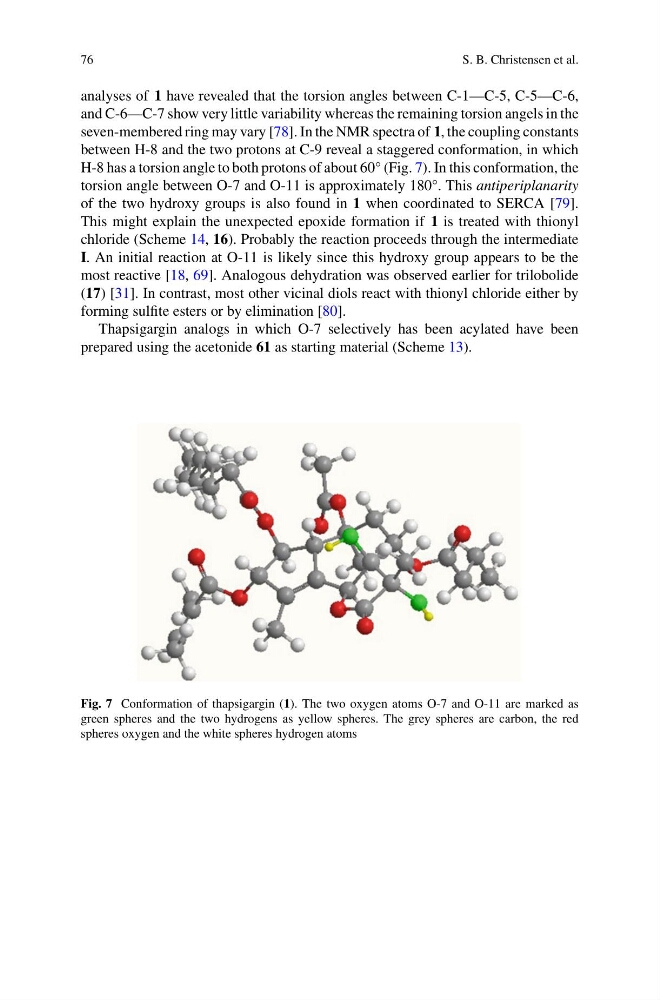
between H-8 and the two protons at C-9 reveal a staggered conformation, in which
H-8 has a torsion angle to both protons of about 60° (Fig. 7). In this conformation, the
torsion angle between O-7 and O-11 is approximately 180°. This antiperiplanarity
of the two hydroxy groups is also found in 1 when coordinated to SERCA [79].
This might explain the unexpected epoxide formation if 1 is treated with thionyl
chloride (Scheme 14, 16). Probably the reaction proceeds through the intermediate
I. An initial reaction at O-11 is likely since this hydroxy group appears to be the
most reactive [18, 69]. Analogous dehydration was observed earlier for trilobolide
(17) [31]. In contrast, most other vicinal diols react with thionyl chloride either by
forming sulfite esters or by elimination [80].
Thapsigargin analogs in which O-7 selectively has been acylated have been
prepared using the acetonide 61 as starting material (Scheme 13).
Fig. 7 Conformation of thapsigargin (1). The two oxygen atoms O-7 and O-11 are marked as
green spheres and the two hydrogens as yellow spheres. The grey spheres are carbon, the red
spheres oxygen and the white spheres hydrogen atoms
S. B. Christensen et al.
analyses of 1 have revealed that the torsion angles between C-1—C-5, C-5—C-6,
and C-6—C-7 show very little variability whereas the remaining torsion angels in the
seven-membered ring may vary [78]. In the NMR spectra of 1, the coupling constants
between H-8 and the two protons at C-9 reveal a staggered conformation, in which
H-8 has a torsion angle to both protons of about 60° (Fig. 7). In this conformation, the
torsion angle between O-7 and O-11 is approximately 180°. This antiperiplanarity
of the two hydroxy groups is also found in 1 when coordinated to SERCA [79].
This might explain the unexpected epoxide formation if 1 is treated with thionyl
chloride (Scheme 14, 16). Probably the reaction proceeds through the intermediate
I. An initial reaction at O-11 is likely since this hydroxy group appears to be the
most reactive [18, 69]. Analogous dehydration was observed earlier for trilobolide
(17) [31]. In contrast, most other vicinal diols react with thionyl chloride either by
forming sulfite esters or by elimination [80].
Thapsigargin analogs in which O-7 selectively has been acylated have been
prepared using the acetonide 61 as starting material (Scheme 13).
Fig. 7 Conformation of thapsigargin (1). The two oxygen atoms O-7 and O-11 are marked as
green spheres and the two hydrogens as yellow spheres. The grey spheres are carbon, the red
spheres oxygen and the white spheres hydrogen atoms