

From Plant to Patient: Thapsigargin, a Tool for Understanding …
65
3 Biosynthesis of Thapsigargin
If thapsigargin (1) should be produced by biotechnological techniques, an absolute
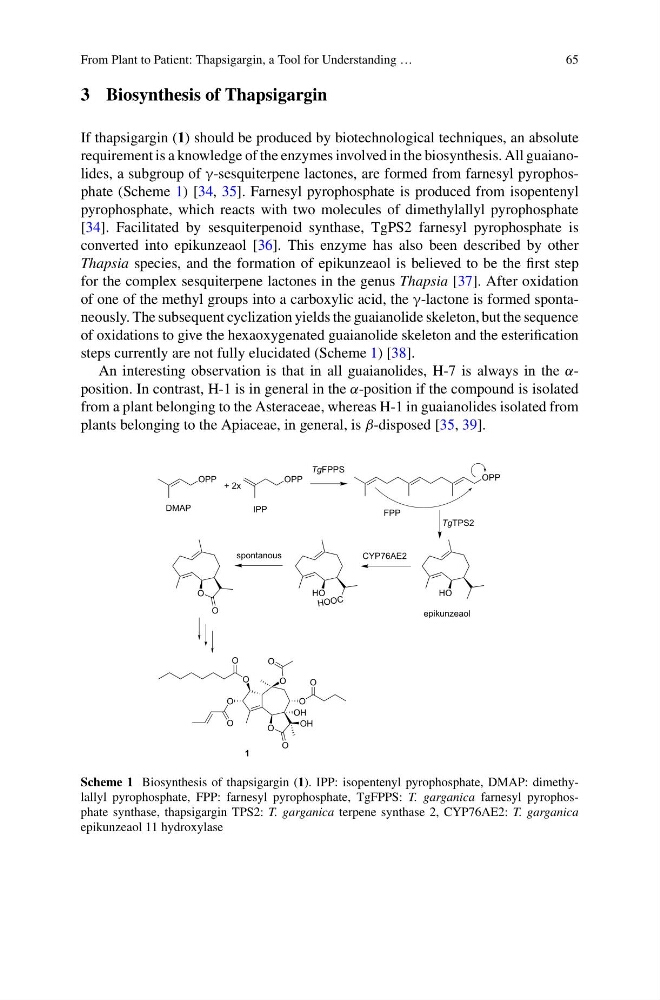
requirement is a knowledge of the enzymes involved in the biosynthesis. All guaianolides, a subgroup of γ-sesquiterpene lactones, are formed from farnesyl pyrophosphate (Scheme 1) [34, 35]. Farnesyl pyrophosphate is produced from isopentenyl
pyrophosphate, which reacts with two molecules of dimethylallyl pyrophosphate
[34]. Facilitated by sesquiterpenoid synthase, TgPS2 farnesyl pyrophosphate is
converted into epikunzeaol [36]. This enzyme has also been described by other
Thapsia species, and the formation of epikunzeaol is believed to be the first step
for the complex sesquiterpene lactones in the genus Thapsia [37]. After oxidation
of one of the methyl groups into a carboxylic acid, the γ-lactone is formed spontaneously. The subsequent cyclization yields the guaianolide skeleton, but the sequence
of oxidations to give the hexaoxygenated guaianolide skeleton and the esterification
steps currently are not fully elucidated (Scheme 1) [38].
An interesting observation is that in all guaianolides, H-7 is always in the αposition. In contrast, H-1 is in general in the α-position if the compound is isolated
from a plant belonging to the Asteraceae, whereas H-1 in guaianolides isolated from
plants belonging to the Apiaceae, in general, is β-disposed [35, 39].
OPP
OPP
DMAP
IPP
OPP
FPP
HO
O
OH
OH
O
O
O
O
O
O
O
O
O
O
O
1
+ 2x
TgFPPS
TgTPS2
HO OC
HO
CYP76AE2
spontanous
epikunzeaol
Scheme 1 Biosynthesis of thapsigargin (1). IPP: isopentenyl pyrophosphate, DMAP: dimethylallyl pyrophosphate, FPP: farnesyl pyrophosphate, TgFPPS: T. garganica farnesyl pyrophosphate synthase, thapsigargin TPS2: T. garganica terpene synthase 2, CYP76AE2: T. garganica
epikunzeaol 11 hydroxylase
65
3 Biosynthesis of Thapsigargin
If thapsigargin (1) should be produced by biotechnological techniques, an absolute
requirement is a knowledge of the enzymes involved in the biosynthesis. All guaianolides, a subgroup of γ-sesquiterpene lactones, are formed from farnesyl pyrophosphate (Scheme 1) [34, 35]. Farnesyl pyrophosphate is produced from isopentenyl
pyrophosphate, which reacts with two molecules of dimethylallyl pyrophosphate
[34]. Facilitated by sesquiterpenoid synthase, TgPS2 farnesyl pyrophosphate is
converted into epikunzeaol [36]. This enzyme has also been described by other
Thapsia species, and the formation of epikunzeaol is believed to be the first step
for the complex sesquiterpene lactones in the genus Thapsia [37]. After oxidation
of one of the methyl groups into a carboxylic acid, the γ-lactone is formed spontaneously. The subsequent cyclization yields the guaianolide skeleton, but the sequence
of oxidations to give the hexaoxygenated guaianolide skeleton and the esterification
steps currently are not fully elucidated (Scheme 1) [38].
An interesting observation is that in all guaianolides, H-7 is always in the αposition. In contrast, H-1 is in general in the α-position if the compound is isolated
from a plant belonging to the Asteraceae, whereas H-1 in guaianolides isolated from
plants belonging to the Apiaceae, in general, is β-disposed [35, 39].
OPP
OPP
DMAP
IPP
OPP
FPP
HO
O
OH
OH
O
O
O
O
O
O
O
O
O
O
O
1
+ 2x
TgFPPS
TgTPS2
HO OC
HO
CYP76AE2
spontanous
epikunzeaol
Scheme 1 Biosynthesis of thapsigargin (1). IPP: isopentenyl pyrophosphate, DMAP: dimethylallyl pyrophosphate, FPP: farnesyl pyrophosphate, TgFPPS: T. garganica farnesyl pyrophosphate synthase, thapsigargin TPS2: T. garganica terpene synthase 2, CYP76AE2: T. garganica
epikunzeaol 11 hydroxylase