

66
S. B. Christensen et al.
4 Taxonomy of the Genus Thapsia
The genus Thapsia belongs to the family Apiaceae. According to the “Flora Europaea
1968” [40], the genus encompasses three species: T. garganica L., T. maxima Mill.
and T. villosa L. In August 2019, these three species were the only accepted names
according to “The Plants List” (http://www.theplantlist.org/), but the taxonomy of
the genus Thapsia is still unresolved. Phytochemical studies and the morphological
appearance of the different varieties of the Thapsia species severely question the
present state of knowledge. In particular, the two different species of T. maxima and
T. villosa have very different morphologies, with some being about 0.5 m and others
being 1.5 m tall herbs [41]. Chemotaxonomic investigations revealed a surprising
regularity in that plants producing polyoxygenated guaianolides like thapsigargin (1)
(Fig. 2) and trilobolide (17) (Fig. 3) do not produce compounds possessing the unique
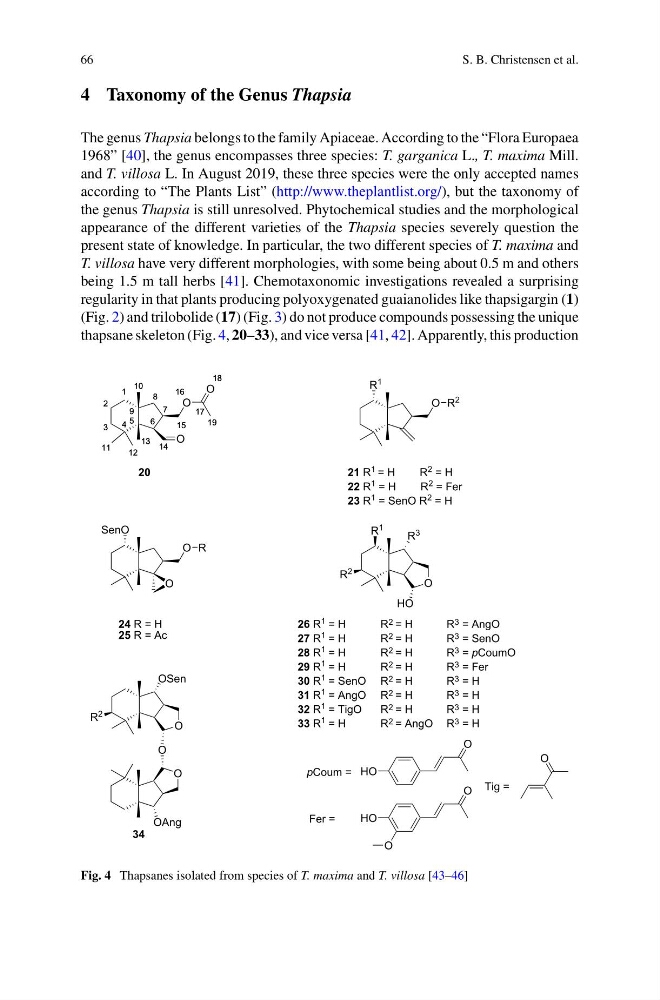
thapsane skeleton (Fig. 4, 20–33), and vice versa [41, 42]. Apparently, this production
2 2
3 3
4 4 5 5
9 9
1 1
6 6
7 7
8 8
10 10
13 13
11 11
12 12
15 15
14 14
O
16 16
17 17
O
18 18
19 19
20
O R
2
R
1
21 R
1 = H
R
2 = H
22 R
1 = H
R
2 = Fer
23 R
1 = SenO R
2 = H
O R
SenO
O
24 R = H
25 R = Ac
R
1
O
HO
R
2
R
3
26 R
1 = H
R 2 = H
R 3 = AngO
27 R
1 = H
R 2 = H
R 3 = SenO
28 R 1 = H
R 2 = H
R 3 = pCoumO
29 R
1 = H
R 2 = H
R 3 = Fer
30 R
1 = SenO R 2 = H
R 3 = H
31 R
1 = AngO R 2 = H
R 3 = H
32 R
1 = TigO
R 2 = H
R 3 = H
33 R 1 = H
R 2 = AngO R 3 = H
O
O
R
2
OSen
O
OAng
34
HO
O
pCoum =
HO
O
O
Fer =
Tig =
O
O
Fig. 4 Thapsanes isolated from species of T. maxima and T. villosa [43–46]
S. B. Christensen et al.
4 Taxonomy of the Genus Thapsia
The genus Thapsia belongs to the family Apiaceae. According to the “Flora Europaea
1968” [40], the genus encompasses three species: T. garganica L., T. maxima Mill.
and T. villosa L. In August 2019, these three species were the only accepted names
according to “The Plants List” (http://www.theplantlist.org/), but the taxonomy of
the genus Thapsia is still unresolved. Phytochemical studies and the morphological
appearance of the different varieties of the Thapsia species severely question the
present state of knowledge. In particular, the two different species of T. maxima and
T. villosa have very different morphologies, with some being about 0.5 m and others
being 1.5 m tall herbs [41]. Chemotaxonomic investigations revealed a surprising
regularity in that plants producing polyoxygenated guaianolides like thapsigargin (1)
(Fig. 2) and trilobolide (17) (Fig. 3) do not produce compounds possessing the unique
thapsane skeleton (Fig. 4, 20–33), and vice versa [41, 42]. Apparently, this production
2 2
3 3
4 4 5 5
9 9
1 1
6 6
7 7
8 8
10 10
13 13
11 11
12 12
15 15
14 14
O
16 16
17 17
O
18 18
19 19
20
O R
2
R
1
21 R
1 = H
R
2 = H
22 R
1 = H
R
2 = Fer
23 R
1 = SenO R
2 = H
O R
SenO
O
24 R = H
25 R = Ac
R
1
O
HO
R
2
R
3
26 R
1 = H
R 2 = H
R 3 = AngO
27 R
1 = H
R 2 = H
R 3 = SenO
28 R 1 = H
R 2 = H
R 3 = pCoumO
29 R
1 = H
R 2 = H
R 3 = Fer
30 R
1 = SenO R 2 = H
R 3 = H
31 R
1 = AngO R 2 = H
R 3 = H
32 R
1 = TigO
R 2 = H
R 3 = H
33 R 1 = H
R 2 = AngO R 3 = H
O
O
R
2
OSen
O
OAng
34
HO
O
pCoum =
HO
O
O
Fer =
Tig =
O
O
Fig. 4 Thapsanes isolated from species of T. maxima and T. villosa [43–46]