

64
S. B. Christensen et al.
2 Naturally Occurring Thapsigargins
Phytochemical studies on Thapsia garganica were initiated just after HPLC and highfield NMR spectroscopy (270 MHz) had become available in Copenhagen in the early
1970s. This enabled the separation of the very closely related thapsigargins from this
species and recording of their high-field NMR spectra. The structure elucidation of
thapsigargin was facilitated by comparison of its spectroscopic data with those of
trilobolide (compound 17) [22], enabling establishment of the molecular constitution
(Figs. 2 and 3) [23]. Even though thapsigargin (1) since its first isolation in 1978
[14] has been isolated several times and in gram amounts, the compound has never
been crystallized, preventing X-ray analysis to establish the relative and absolute
configurations. Instead, the crystalline epoxide 16 (Fig. 2) was prepared and an Xray structure revealed the relative configuration, albeit not at the two tertiary alcohol
carbons, C-7 and C-11 [15]. The absolute configuration was established by analyzing
exciton coupling between the allylic ester and the α,β-unsaturated angelic acid [17].
The absolute configuration at C-7 was the same as that of C-7 in the closely related
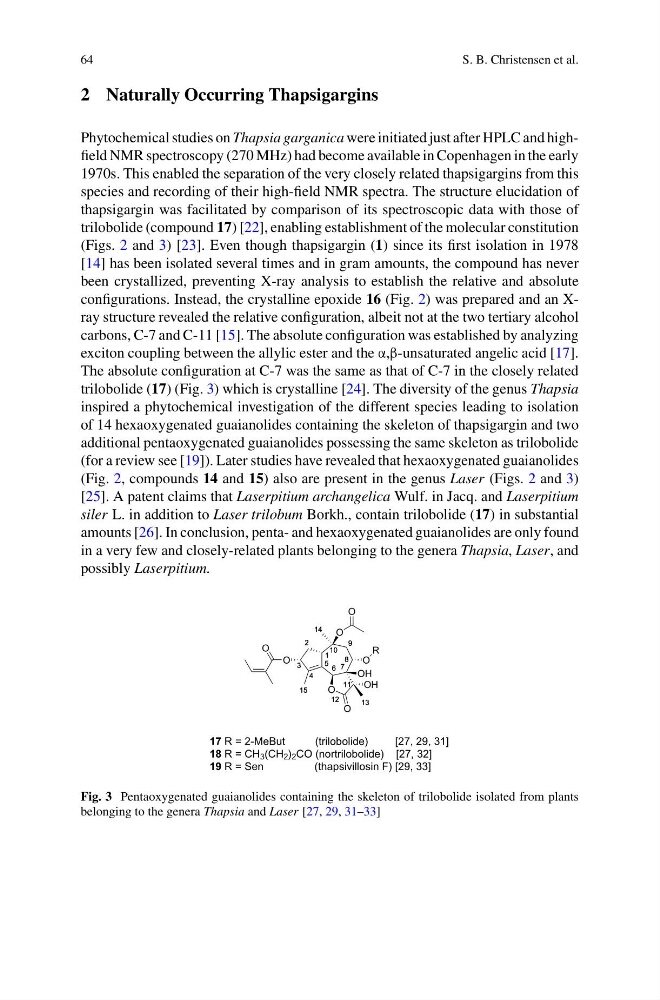
trilobolide (17) (Fig. 3) which is crystalline [24]. The diversity of the genus Thapsia
inspired a phytochemical investigation of the different species leading to isolation
of 14 hexaoxygenated guaianolides containing the skeleton of thapsigargin and two
additional pentaoxygenated guaianolides possessing the same skeleton as trilobolide
(for a review see [19]). Later studies have revealed that hexaoxygenated guaianolides
(Fig. 2, compounds 14 and 15) also are present in the genus Laser (Figs. 2 and 3)
[25]. A patent claims that Laserpitium archangelica Wulf. in Jacq. and Laserpitium
siler L. in addition to Laser trilobum Borkh., contain trilobolide (17) in substantial
amounts [26]. In conclusion, penta- and hexaoxygenated guaianolides are only found
in a very few and closely-related plants belonging to the genera Thapsia, Laser, and
possibly Laserpitium.
1 1
5 5 6 6 7 7
8 8
9 9
10 10
2 2
3 3
4 4
O
12 12
11 11
15 15
O
O
O
14 14
O
13 13
O
R
OH
OH
O
17 R = 2-MeBut
(trilobolide)
[27, 29, 31]
18 R = CH 3 (CH 2 ) 2 CO (nortrilobolide) [27, 32]
19 R = Sen
(thapsivillosin F) [29, 33]
Fig. 3 Pentaoxygenated guaianolides containing the skeleton of trilobolide isolated from plants
belonging to the genera Thapsia and Laser [27, 29, 31–33]
S. B. Christensen et al.
2 Naturally Occurring Thapsigargins
Phytochemical studies on Thapsia garganica were initiated just after HPLC and highfield NMR spectroscopy (270 MHz) had become available in Copenhagen in the early
1970s. This enabled the separation of the very closely related thapsigargins from this
species and recording of their high-field NMR spectra. The structure elucidation of
thapsigargin was facilitated by comparison of its spectroscopic data with those of
trilobolide (compound 17) [22], enabling establishment of the molecular constitution
(Figs. 2 and 3) [23]. Even though thapsigargin (1) since its first isolation in 1978
[14] has been isolated several times and in gram amounts, the compound has never
been crystallized, preventing X-ray analysis to establish the relative and absolute
configurations. Instead, the crystalline epoxide 16 (Fig. 2) was prepared and an Xray structure revealed the relative configuration, albeit not at the two tertiary alcohol
carbons, C-7 and C-11 [15]. The absolute configuration was established by analyzing
exciton coupling between the allylic ester and the α,β-unsaturated angelic acid [17].
The absolute configuration at C-7 was the same as that of C-7 in the closely related
trilobolide (17) (Fig. 3) which is crystalline [24]. The diversity of the genus Thapsia
inspired a phytochemical investigation of the different species leading to isolation
of 14 hexaoxygenated guaianolides containing the skeleton of thapsigargin and two
additional pentaoxygenated guaianolides possessing the same skeleton as trilobolide
(for a review see [19]). Later studies have revealed that hexaoxygenated guaianolides
(Fig. 2, compounds 14 and 15) also are present in the genus Laser (Figs. 2 and 3)
[25]. A patent claims that Laserpitium archangelica Wulf. in Jacq. and Laserpitium
siler L. in addition to Laser trilobum Borkh., contain trilobolide (17) in substantial
amounts [26]. In conclusion, penta- and hexaoxygenated guaianolides are only found
in a very few and closely-related plants belonging to the genera Thapsia, Laser, and
possibly Laserpitium.
1 1
5 5 6 6 7 7
8 8
9 9
10 10
2 2
3 3
4 4
O
12 12
11 11
15 15
O
O
O
14 14
O
13 13
O
R
OH
OH
O
17 R = 2-MeBut
(trilobolide)
[27, 29, 31]
18 R = CH 3 (CH 2 ) 2 CO (nortrilobolide) [27, 32]
19 R = Sen
(thapsivillosin F) [29, 33]
Fig. 3 Pentaoxygenated guaianolides containing the skeleton of trilobolide isolated from plants
belonging to the genera Thapsia and Laser [27, 29, 31–33]