

The Role of Total Synthesis in Structure …
47
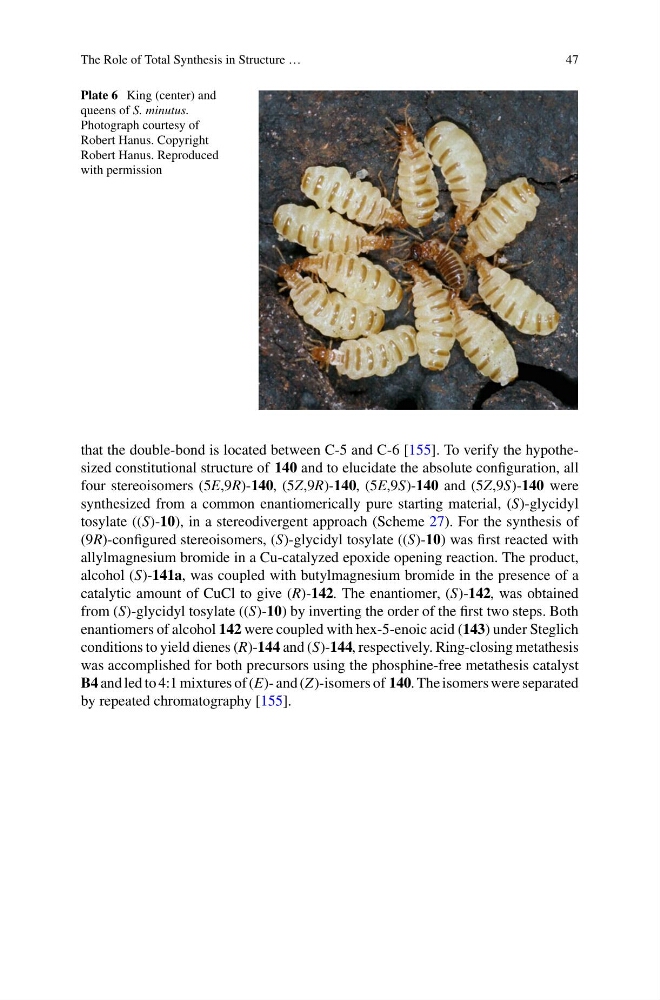
Plate 6 King (center) and
queens of S. minutus.
Photograph courtesy of
Robert Hanus. Copyright
Robert Hanus. Reproduced
with permission
that the double-bond is located between C-5 and C-6 [155]. To verify the hypothesized constitutional structure of 140 and to elucidate the absolute configuration, all
four stereoisomers (5E,9R)-140, (5Z,9R)-140, (5E,9S)-140 and (5Z,9S)-140 were
synthesized from a common enantiomerically pure starting material, (S)-glycidyl
tosylate ((S)-10), in a stereodivergent approach (Scheme 27). For the synthesis of
(9R)-configured stereoisomers, (S)-glycidyl tosylate ((S)-10) was first reacted with
allylmagnesium bromide in a Cu-catalyzed epoxide opening reaction. The product,
alcohol (S)-141a, was coupled with butylmagnesium bromide in the presence of a
catalytic amount of CuCl to give (R)-142. The enantiomer, (S)-142, was obtained
from (S)-glycidyl tosylate ((S)-10) by inverting the order of the first two steps. Both
enantiomers of alcohol 142 were coupled with hex-5-enoic acid (143) under Steglich
conditions to yield dienes (R)-144 and (S)-144, respectively. Ring-closing metathesis
was accomplished for both precursors using the phosphine-free metathesis catalyst
B4 and led to 4:1 mixtures of (E)- and (Z)-isomers of 140. The isomers were separated
by repeated chromatography [155].
47
Plate 6 King (center) and
queens of S. minutus.
Photograph courtesy of
Robert Hanus. Copyright
Robert Hanus. Reproduced
with permission
that the double-bond is located between C-5 and C-6 [155]. To verify the hypothesized constitutional structure of 140 and to elucidate the absolute configuration, all
four stereoisomers (5E,9R)-140, (5Z,9R)-140, (5E,9S)-140 and (5Z,9S)-140 were
synthesized from a common enantiomerically pure starting material, (S)-glycidyl
tosylate ((S)-10), in a stereodivergent approach (Scheme 27). For the synthesis of
(9R)-configured stereoisomers, (S)-glycidyl tosylate ((S)-10) was first reacted with
allylmagnesium bromide in a Cu-catalyzed epoxide opening reaction. The product,
alcohol (S)-141a, was coupled with butylmagnesium bromide in the presence of a
catalytic amount of CuCl to give (R)-142. The enantiomer, (S)-142, was obtained
from (S)-glycidyl tosylate ((S)-10) by inverting the order of the first two steps. Both
enantiomers of alcohol 142 were coupled with hex-5-enoic acid (143) under Steglich
conditions to yield dienes (R)-144 and (S)-144, respectively. Ring-closing metathesis
was accomplished for both precursors using the phosphine-free metathesis catalyst
B4 and led to 4:1 mixtures of (E)- and (Z)-isomers of 140. The isomers were separated
by repeated chromatography [155].