

46
B. Schmidt
3.5 A Potential Pheromone from the Queen of the Termite
Silvestritermes minutus
Approximately 3000 species of termites are known to date and new species are
discovered each year. Termite colonies can consist of up to seven million individuals, but they have normally only one pair of fertile members, named the queen and
king. Communication within a colony is of utmost importance and is accomplished
through semiochemicals. The cuticular hydrocarbons (CHCs) are a well-investigated
group of pheromones, but low-molecular weight alcohols also do play a significant role. In a comprehensive review article on the chemistry of secondary termite
metabolites recently published in this series [153], macrolactones (macrolides) are
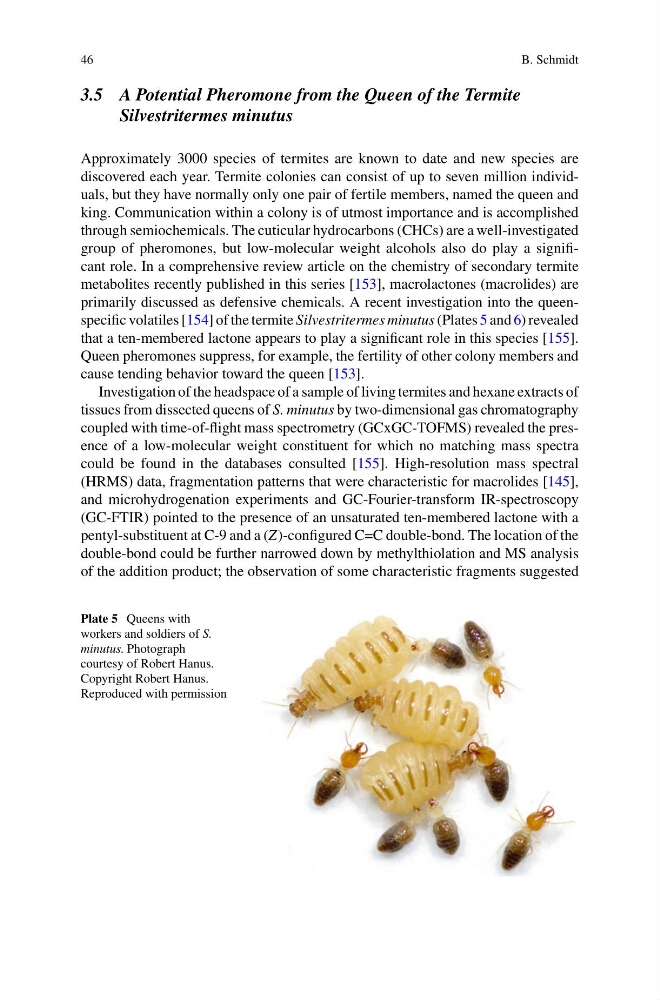
primarily discussed as defensive chemicals. A recent investigation into the queenspecific volatiles [154] of the termite Silvestritermes minutus (Plates 5 and 6) revealed
that a ten-membered lactone appears to play a significant role in this species [155].
Queen pheromones suppress, for example, the fertility of other colony members and
cause tending behavior toward the queen [153].
Investigation of the headspace of a sample of living termites and hexane extracts of
tissues from dissected queens of S. minutus by two-dimensional gas chromatography
coupled with time-of-flight mass spectrometry (GCxGC-TOFMS) revealed the presence of a low-molecular weight constituent for which no matching mass spectra
could be found in the databases consulted [155]. High-resolution mass spectral
(HRMS) data, fragmentation patterns that were characteristic for macrolides [145],
and microhydrogenation experiments and GC-Fourier-transform IR-spectroscopy
(GC-FTIR) pointed to the presence of an unsaturated ten-membered lactone with a
pentyl-substituent at C-9 and a (Z)-configured C=C double-bond. The location of the
double-bond could be further narrowed down by methylthiolation and MS analysis
of the addition product; the observation of some characteristic fragments suggested
Plate 5 Queens with
workers and soldiers of S.
minutus. Photograph
courtesy of Robert Hanus.
Copyright Robert Hanus.
Reproduced with permission
B. Schmidt
3.5 A Potential Pheromone from the Queen of the Termite
Silvestritermes minutus
Approximately 3000 species of termites are known to date and new species are
discovered each year. Termite colonies can consist of up to seven million individuals, but they have normally only one pair of fertile members, named the queen and
king. Communication within a colony is of utmost importance and is accomplished
through semiochemicals. The cuticular hydrocarbons (CHCs) are a well-investigated
group of pheromones, but low-molecular weight alcohols also do play a significant role. In a comprehensive review article on the chemistry of secondary termite
metabolites recently published in this series [153], macrolactones (macrolides) are
primarily discussed as defensive chemicals. A recent investigation into the queenspecific volatiles [154] of the termite Silvestritermes minutus (Plates 5 and 6) revealed
that a ten-membered lactone appears to play a significant role in this species [155].
Queen pheromones suppress, for example, the fertility of other colony members and
cause tending behavior toward the queen [153].
Investigation of the headspace of a sample of living termites and hexane extracts of
tissues from dissected queens of S. minutus by two-dimensional gas chromatography
coupled with time-of-flight mass spectrometry (GCxGC-TOFMS) revealed the presence of a low-molecular weight constituent for which no matching mass spectra
could be found in the databases consulted [155]. High-resolution mass spectral
(HRMS) data, fragmentation patterns that were characteristic for macrolides [145],
and microhydrogenation experiments and GC-Fourier-transform IR-spectroscopy
(GC-FTIR) pointed to the presence of an unsaturated ten-membered lactone with a
pentyl-substituent at C-9 and a (Z)-configured C=C double-bond. The location of the
double-bond could be further narrowed down by methylthiolation and MS analysis
of the addition product; the observation of some characteristic fragments suggested
Plate 5 Queens with
workers and soldiers of S.
minutus. Photograph
courtesy of Robert Hanus.
Copyright Robert Hanus.
Reproduced with permission