

The Role of Total Synthesis in Structure …
45
isolated from Madagascan frogs an all-cis-configuration of the three substituents
appeared to be the most likely and therefore (4R,8S,9S)-134 and its enantiomer
(4S,8R,9R)-134, were synthesized first. For the synthesis of (4R,8S,9S)-134 the
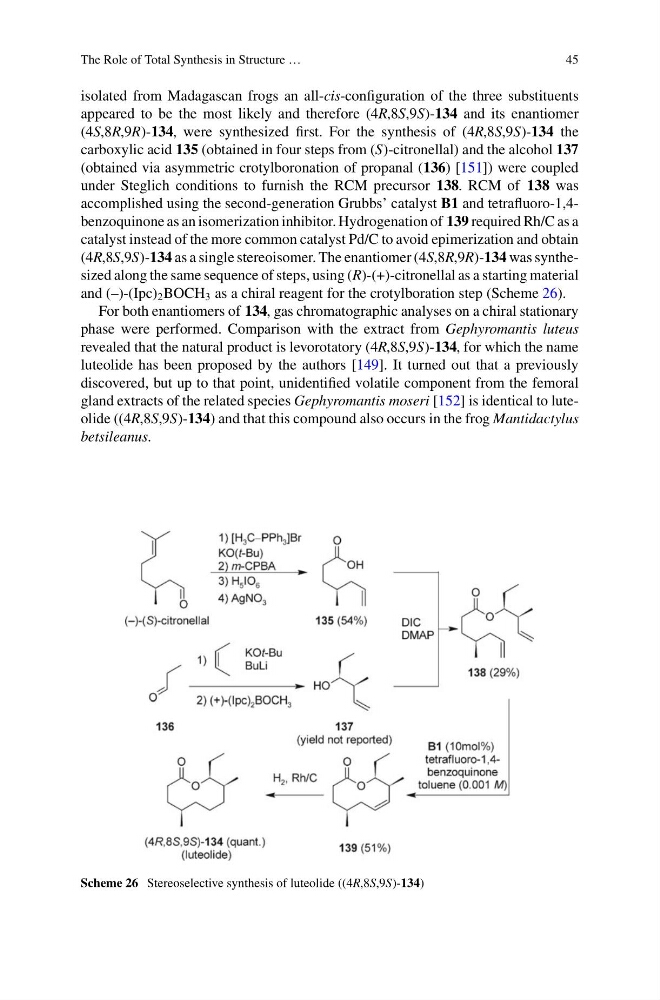
carboxylic acid 135 (obtained in four steps from (S)-citronellal) and the alcohol 137
(obtained via asymmetric crotylboronation of propanal (136) [151]) were coupled
under Steglich conditions to furnish the RCM precursor 138. RCM of 138 was
accomplished using the second-generation Grubbs’ catalyst B1 and tetrafluoro-1,4benzoquinone as an isomerization inhibitor. Hydrogenation of 139 required Rh/C as a
catalyst instead of the more common catalyst Pd/C to avoid epimerization and obtain
(4R,8S,9S)-134 as a single stereoisomer. The enantiomer (4S,8R,9R)-134 was synthesized along the same sequence of steps, using (R)-(+)-citronellal as a starting material
and (–)-(Ipc) 2 BOCH 3 as a chiral reagent for the crotylboration step (Scheme 26).
For both enantiomers of 134, gas chromatographic analyses on a chiral stationary
phase were performed. Comparison with the extract from Gephyromantis luteus
revealed that the natural product is levorotatory (4R,8S,9S)-134, for which the name
luteolide has been proposed by the authors [149]. It turned out that a previously
discovered, but up to that point, unidentified volatile component from the femoral
gland extracts of the related species Gephyromantis moseri [152] is identical to luteolide ((4R,8S,9S)-134) and that this compound also occurs in the frog Mantidactylus
betsileanus.
Scheme 26 Stereoselective synthesis of luteolide ((4R,8S,9S)-134)
45
isolated from Madagascan frogs an all-cis-configuration of the three substituents
appeared to be the most likely and therefore (4R,8S,9S)-134 and its enantiomer
(4S,8R,9R)-134, were synthesized first. For the synthesis of (4R,8S,9S)-134 the
carboxylic acid 135 (obtained in four steps from (S)-citronellal) and the alcohol 137
(obtained via asymmetric crotylboronation of propanal (136) [151]) were coupled
under Steglich conditions to furnish the RCM precursor 138. RCM of 138 was
accomplished using the second-generation Grubbs’ catalyst B1 and tetrafluoro-1,4benzoquinone as an isomerization inhibitor. Hydrogenation of 139 required Rh/C as a
catalyst instead of the more common catalyst Pd/C to avoid epimerization and obtain
(4R,8S,9S)-134 as a single stereoisomer. The enantiomer (4S,8R,9R)-134 was synthesized along the same sequence of steps, using (R)-(+)-citronellal as a starting material
and (–)-(Ipc) 2 BOCH 3 as a chiral reagent for the crotylboration step (Scheme 26).
For both enantiomers of 134, gas chromatographic analyses on a chiral stationary
phase were performed. Comparison with the extract from Gephyromantis luteus
revealed that the natural product is levorotatory (4R,8S,9S)-134, for which the name
luteolide has been proposed by the authors [149]. It turned out that a previously
discovered, but up to that point, unidentified volatile component from the femoral
gland extracts of the related species Gephyromantis moseri [152] is identical to luteolide ((4R,8S,9S)-134) and that this compound also occurs in the frog Mantidactylus
betsileanus.
Scheme 26 Stereoselective synthesis of luteolide ((4R,8S,9S)-134)