

The Role of Total Synthesis in Structure …
21
siamensis (CMUGE015) [76] and its relative configuration confirmed by singlecrystal X-ray diffraction [77], from the plant pathogenic fungus Stagonospora cirsii
(together with stagonolides G–I) [78], from the marine fungus Curvularia sp. [67,
79, 80], from the soft coral-derived marine fungus Lophiostoma sp. [81] and from
the marine endophytic fungus Paraconiothyrium sp. [82].
The exciton chirality method (ECM) used for the determination of the absolute
configurations at C-4 and C-7 in modiolide A (61) requires that several prerequisites are carefully met [72]. Recent literature reports reveal that configurational
assignments based on this method are sometimes incorrect because the method
is inappropriately applied [83]. For these reasons, independent assignment of the
absolute configuration through total synthesis can be a useful supplement. The first
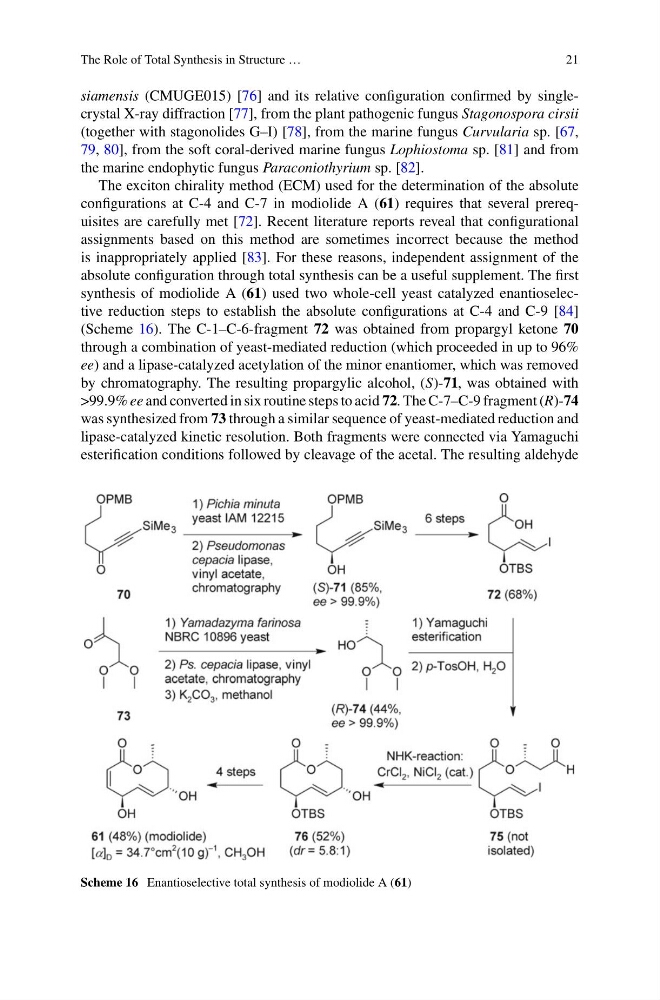
synthesis of modiolide A (61) used two whole-cell yeast catalyzed enantioselective reduction steps to establish the absolute configurations at C-4 and C-9 [84]
(Scheme 16). The C-1–C-6-fragment 72 was obtained from propargyl ketone 70
through a combination of yeast-mediated reduction (which proceeded in up to 96%
ee) and a lipase-catalyzed acetylation of the minor enantiomer, which was removed
by chromatography. The resulting propargylic alcohol, (S)-71, was obtained with
>99.9% ee and converted in six routine steps to acid 72. The C-7–C-9 fragment (R)-74
was synthesized from 73 through a similar sequence of yeast-mediated reduction and
lipase-catalyzed kinetic resolution. Both fragments were connected via Yamaguchi
esterification conditions followed by cleavage of the acetal. The resulting aldehyde
Scheme 16 Enantioselective total synthesis of modiolide A (61)
21
siamensis (CMUGE015) [76] and its relative configuration confirmed by singlecrystal X-ray diffraction [77], from the plant pathogenic fungus Stagonospora cirsii
(together with stagonolides G–I) [78], from the marine fungus Curvularia sp. [67,
79, 80], from the soft coral-derived marine fungus Lophiostoma sp. [81] and from
the marine endophytic fungus Paraconiothyrium sp. [82].
The exciton chirality method (ECM) used for the determination of the absolute
configurations at C-4 and C-7 in modiolide A (61) requires that several prerequisites are carefully met [72]. Recent literature reports reveal that configurational
assignments based on this method are sometimes incorrect because the method
is inappropriately applied [83]. For these reasons, independent assignment of the
absolute configuration through total synthesis can be a useful supplement. The first
synthesis of modiolide A (61) used two whole-cell yeast catalyzed enantioselective reduction steps to establish the absolute configurations at C-4 and C-9 [84]
(Scheme 16). The C-1–C-6-fragment 72 was obtained from propargyl ketone 70
through a combination of yeast-mediated reduction (which proceeded in up to 96%
ee) and a lipase-catalyzed acetylation of the minor enantiomer, which was removed
by chromatography. The resulting propargylic alcohol, (S)-71, was obtained with
>99.9% ee and converted in six routine steps to acid 72. The C-7–C-9 fragment (R)-74
was synthesized from 73 through a similar sequence of yeast-mediated reduction and
lipase-catalyzed kinetic resolution. Both fragments were connected via Yamaguchi
esterification conditions followed by cleavage of the acetal. The resulting aldehyde
Scheme 16 Enantioselective total synthesis of modiolide A (61)