

20
B. Schmidt
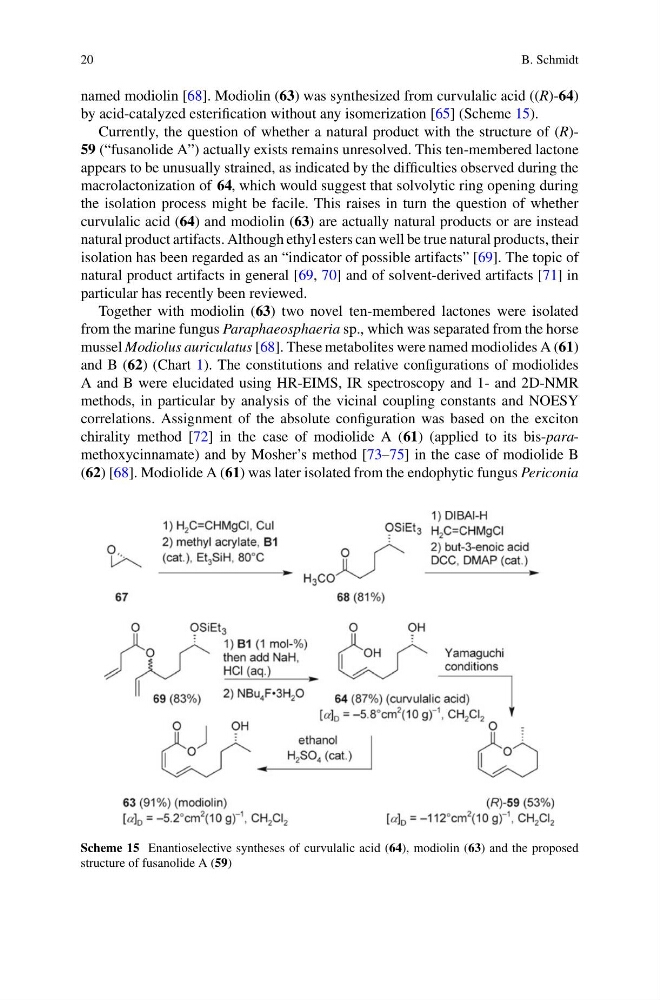
named modiolin [68]. Modiolin (63) was synthesized from curvulalic acid ((R)-64)
by acid-catalyzed esterification without any isomerization [65] (Scheme 15).
Currently, the question of whether a natural product with the structure of (R)59 (“fusanolide A”) actually exists remains unresolved. This ten-membered lactone
appears to be unusually strained, as indicated by the difficulties observed during the
macrolactonization of 64, which would suggest that solvolytic ring opening during
the isolation process might be facile. This raises in turn the question of whether
curvulalic acid (64) and modiolin (63) are actually natural products or are instead
natural product artifacts. Although ethyl esters can well be true natural products, their
isolation has been regarded as an “indicator of possible artifacts” [69]. The topic of
natural product artifacts in general [69, 70] and of solvent-derived artifacts [71] in
particular has recently been reviewed.
Together with modiolin (63) two novel ten-membered lactones were isolated
from the marine fungus Paraphaeosphaeria sp., which was separated from the horse
mussel Modiolus auriculatus [68]. These metabolites were named modiolides A (61)
and B (62) (Chart 1). The constitutions and relative configurations of modiolides
A and B were elucidated using HR-EIMS, IR spectroscopy and 1- and 2D-NMR
methods, in particular by analysis of the vicinal coupling constants and NOESY
correlations. Assignment of the absolute configuration was based on the exciton
chirality method [72] in the case of modiolide A (61) (applied to its bis-paramethoxycinnamate) and by Mosher’s method [73–75] in the case of modiolide B
(62) [68]. Modiolide A (61) was later isolated from the endophytic fungus Periconia
Scheme 15 Enantioselective syntheses of curvulalic acid (64), modiolin (63) and the proposed
structure of fusanolide A (59)
B. Schmidt
named modiolin [68]. Modiolin (63) was synthesized from curvulalic acid ((R)-64)
by acid-catalyzed esterification without any isomerization [65] (Scheme 15).
Currently, the question of whether a natural product with the structure of (R)59 (“fusanolide A”) actually exists remains unresolved. This ten-membered lactone
appears to be unusually strained, as indicated by the difficulties observed during the
macrolactonization of 64, which would suggest that solvolytic ring opening during
the isolation process might be facile. This raises in turn the question of whether
curvulalic acid (64) and modiolin (63) are actually natural products or are instead
natural product artifacts. Although ethyl esters can well be true natural products, their
isolation has been regarded as an “indicator of possible artifacts” [69]. The topic of
natural product artifacts in general [69, 70] and of solvent-derived artifacts [71] in
particular has recently been reviewed.
Together with modiolin (63) two novel ten-membered lactones were isolated
from the marine fungus Paraphaeosphaeria sp., which was separated from the horse
mussel Modiolus auriculatus [68]. These metabolites were named modiolides A (61)
and B (62) (Chart 1). The constitutions and relative configurations of modiolides
A and B were elucidated using HR-EIMS, IR spectroscopy and 1- and 2D-NMR
methods, in particular by analysis of the vicinal coupling constants and NOESY
correlations. Assignment of the absolute configuration was based on the exciton
chirality method [72] in the case of modiolide A (61) (applied to its bis-paramethoxycinnamate) and by Mosher’s method [73–75] in the case of modiolide B
(62) [68]. Modiolide A (61) was later isolated from the endophytic fungus Periconia
Scheme 15 Enantioselective syntheses of curvulalic acid (64), modiolin (63) and the proposed
structure of fusanolide A (59)