

22
B. Schmidt
75 was used in an intramolecular Nozaki–Hiyama–Kishi (NHK) coupling [85] which
proceeded with fair diastereoselectivity to give 76. Removal of the minor diastereomer, the C-7-epimer, was accomplished by chromatography. Introduction of the
C-2=C-3 double-bond (via phenylselenylation and elimination) and removal of the
protecting groups completed the first enantioselective total synthesis of modiolide A
(61). The absolute configurations of the two enantiomerically pure key fragments,
(S)-71 and (R)-74, were secured by comparison of their specific rotations with previously reported literature values. All analytical data of synthetic modiolide A (61)
matched those reported for the natural product, including the sign of specific rotation, which confirmed the absolute configuration originally assigned via the exciton
chirality method.
In a formal total synthesis of modiolide A (61) the absolute configuration at C-9
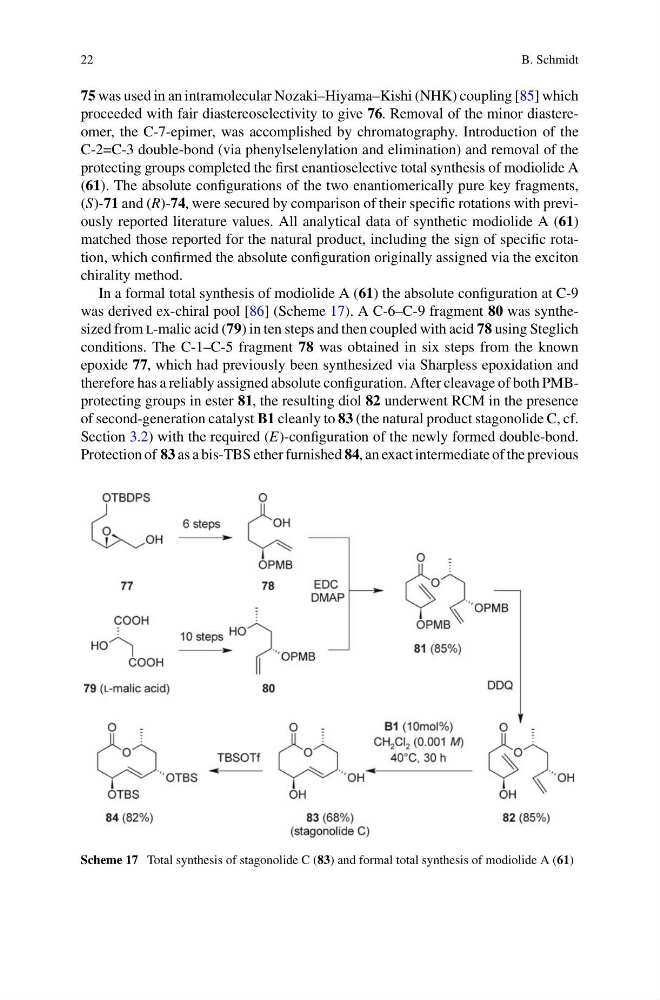
was derived ex-chiral pool [86] (Scheme 17). A C-6–C-9 fragment 80 was synthesized from l-malic acid (79) in ten steps and then coupled with acid 78 using Steglich
conditions. The C-1–C-5 fragment 78 was obtained in six steps from the known
epoxide 77, which had previously been synthesized via Sharpless epoxidation and
therefore has a reliably assigned absolute configuration. After cleavage of both PMBprotecting groups in ester 81, the resulting diol 82 underwent RCM in the presence
of second-generation catalyst B1 cleanly to 83 (the natural product stagonolide C, cf.
Section 3.2) with the required (E)-configuration of the newly formed double-bond.
Protection of 83 as a bis-TBS ether furnished 84, an exact intermediate of the previous
Scheme 17 Total synthesis of stagonolide C (83) and formal total synthesis of modiolide A (61)
B. Schmidt
75 was used in an intramolecular Nozaki–Hiyama–Kishi (NHK) coupling [85] which
proceeded with fair diastereoselectivity to give 76. Removal of the minor diastereomer, the C-7-epimer, was accomplished by chromatography. Introduction of the
C-2=C-3 double-bond (via phenylselenylation and elimination) and removal of the
protecting groups completed the first enantioselective total synthesis of modiolide A
(61). The absolute configurations of the two enantiomerically pure key fragments,
(S)-71 and (R)-74, were secured by comparison of their specific rotations with previously reported literature values. All analytical data of synthetic modiolide A (61)
matched those reported for the natural product, including the sign of specific rotation, which confirmed the absolute configuration originally assigned via the exciton
chirality method.
In a formal total synthesis of modiolide A (61) the absolute configuration at C-9
was derived ex-chiral pool [86] (Scheme 17). A C-6–C-9 fragment 80 was synthesized from l-malic acid (79) in ten steps and then coupled with acid 78 using Steglich
conditions. The C-1–C-5 fragment 78 was obtained in six steps from the known
epoxide 77, which had previously been synthesized via Sharpless epoxidation and
therefore has a reliably assigned absolute configuration. After cleavage of both PMBprotecting groups in ester 81, the resulting diol 82 underwent RCM in the presence
of second-generation catalyst B1 cleanly to 83 (the natural product stagonolide C, cf.
Section 3.2) with the required (E)-configuration of the newly formed double-bond.
Protection of 83 as a bis-TBS ether furnished 84, an exact intermediate of the previous
Scheme 17 Total synthesis of stagonolide C (83) and formal total synthesis of modiolide A (61)