

18
B. Schmidt
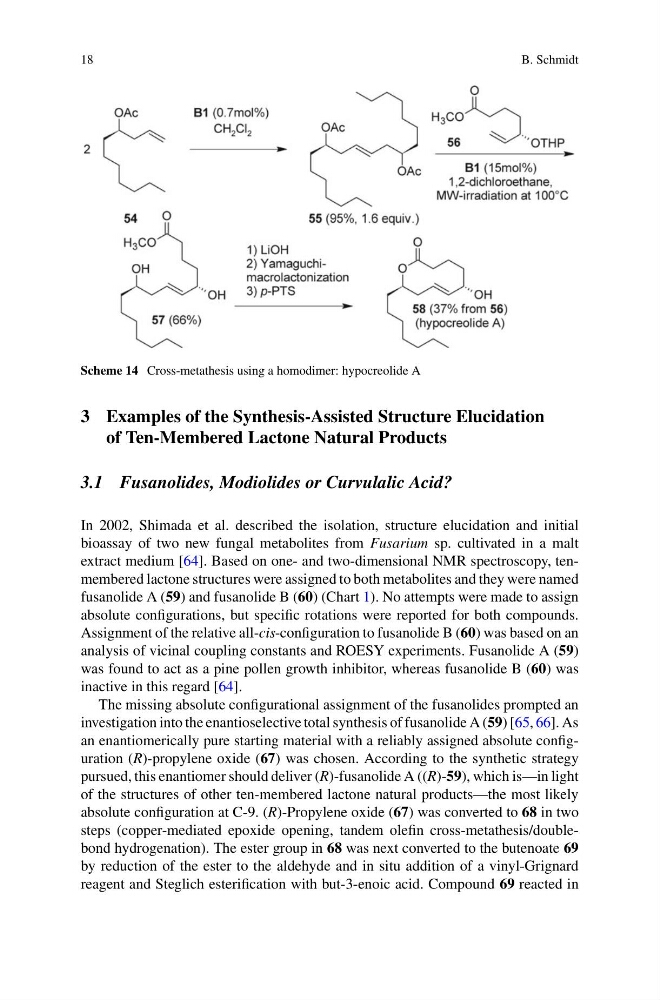
Scheme 14 Cross-metathesis using a homodimer: hypocreolide A
3 Examples of the Synthesis-Assisted Structure Elucidation
of Ten-Membered Lactone Natural Products
3.1 Fusanolides, Modiolides or Curvulalic Acid?
In 2002, Shimada et al. described the isolation, structure elucidation and initial
bioassay of two new fungal metabolites from Fusarium sp. cultivated in a malt
extract medium [64]. Based on one- and two-dimensional NMR spectroscopy, tenmembered lactone structures were assigned to both metabolites and they were named
fusanolide A (59) and fusanolide B (60) (Chart 1). No attempts were made to assign
absolute configurations, but specific rotations were reported for both compounds.
Assignment of the relative all-cis-configuration to fusanolide B (60) was based on an
analysis of vicinal coupling constants and ROESY experiments. Fusanolide A (59)
was found to act as a pine pollen growth inhibitor, whereas fusanolide B (60) was
inactive in this regard [64].
The missing absolute configurational assignment of the fusanolides prompted an
investigation into the enantioselective total synthesis of fusanolide A (59) [65, 66]. As
an enantiomerically pure starting material with a reliably assigned absolute configuration (R)-propylene oxide (67) was chosen. According to the synthetic strategy
pursued, this enantiomer should deliver (R)-fusanolide A ((R)-59), which is—in light
of the structures of other ten-membered lactone natural products—the most likely
absolute configuration at C-9. (R)-Propylene oxide (67) was converted to 68 in two
steps (copper-mediated epoxide opening, tandem olefin cross-metathesis/doublebond hydrogenation). The ester group in 68 was next converted to the butenoate 69
by reduction of the ester to the aldehyde and in situ addition of a vinyl-Grignard
reagent and Steglich esterification with but-3-enoic acid. Compound 69 reacted in
B. Schmidt
Scheme 14 Cross-metathesis using a homodimer: hypocreolide A
3 Examples of the Synthesis-Assisted Structure Elucidation
of Ten-Membered Lactone Natural Products
3.1 Fusanolides, Modiolides or Curvulalic Acid?
In 2002, Shimada et al. described the isolation, structure elucidation and initial
bioassay of two new fungal metabolites from Fusarium sp. cultivated in a malt
extract medium [64]. Based on one- and two-dimensional NMR spectroscopy, tenmembered lactone structures were assigned to both metabolites and they were named
fusanolide A (59) and fusanolide B (60) (Chart 1). No attempts were made to assign
absolute configurations, but specific rotations were reported for both compounds.
Assignment of the relative all-cis-configuration to fusanolide B (60) was based on an
analysis of vicinal coupling constants and ROESY experiments. Fusanolide A (59)
was found to act as a pine pollen growth inhibitor, whereas fusanolide B (60) was
inactive in this regard [64].
The missing absolute configurational assignment of the fusanolides prompted an
investigation into the enantioselective total synthesis of fusanolide A (59) [65, 66]. As
an enantiomerically pure starting material with a reliably assigned absolute configuration (R)-propylene oxide (67) was chosen. According to the synthetic strategy
pursued, this enantiomer should deliver (R)-fusanolide A ((R)-59), which is—in light
of the structures of other ten-membered lactone natural products—the most likely
absolute configuration at C-9. (R)-Propylene oxide (67) was converted to 68 in two
steps (copper-mediated epoxide opening, tandem olefin cross-metathesis/doublebond hydrogenation). The ester group in 68 was next converted to the butenoate 69
by reduction of the ester to the aldehyde and in situ addition of a vinyl-Grignard
reagent and Steglich esterification with but-3-enoic acid. Compound 69 reacted in