

The Role of Total Synthesis in Structure …
17
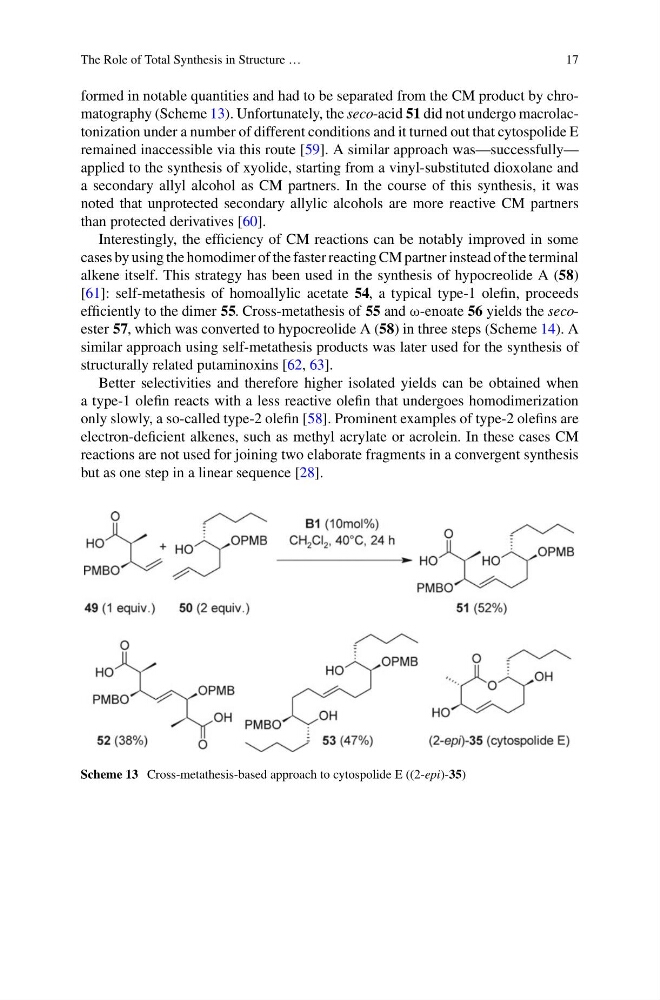
formed in notable quantities and had to be separated from the CM product by chromatography (Scheme 13). Unfortunately, the seco-acid 51 did not undergo macrolactonization under a number of different conditions and it turned out that cytospolide E
remained inaccessible via this route [59]. A similar approach was—successfully—
applied to the synthesis of xyolide, starting from a vinyl-substituted dioxolane and
a secondary allyl alcohol as CM partners. In the course of this synthesis, it was
noted that unprotected secondary allylic alcohols are more reactive CM partners
than protected derivatives [60].
Interestingly, the efficiency of CM reactions can be notably improved in some
cases by using the homodimer of the faster reacting CM partner instead of the terminal
alkene itself. This strategy has been used in the synthesis of hypocreolide A (58)
[61]: self-metathesis of homoallylic acetate 54, a typical type-1 olefin, proceeds
efficiently to the dimer 55. Cross-metathesis of 55 and ω-enoate 56 yields the secoester 57, which was converted to hypocreolide A (58) in three steps (Scheme 14). A
similar approach using self-metathesis products was later used for the synthesis of
structurally related putaminoxins [62, 63].
Better selectivities and therefore higher isolated yields can be obtained when
a type-1 olefin reacts with a less reactive olefin that undergoes homodimerization
only slowly, a so-called type-2 olefin [58]. Prominent examples of type-2 olefins are
electron-deficient alkenes, such as methyl acrylate or acrolein. In these cases CM
reactions are not used for joining two elaborate fragments in a convergent synthesis
but as one step in a linear sequence [28].
Scheme 13 Cross-metathesis-based approach to cytospolide E ((2-epi)-35)
17
formed in notable quantities and had to be separated from the CM product by chromatography (Scheme 13). Unfortunately, the seco-acid 51 did not undergo macrolactonization under a number of different conditions and it turned out that cytospolide E
remained inaccessible via this route [59]. A similar approach was—successfully—
applied to the synthesis of xyolide, starting from a vinyl-substituted dioxolane and
a secondary allyl alcohol as CM partners. In the course of this synthesis, it was
noted that unprotected secondary allylic alcohols are more reactive CM partners
than protected derivatives [60].
Interestingly, the efficiency of CM reactions can be notably improved in some
cases by using the homodimer of the faster reacting CM partner instead of the terminal
alkene itself. This strategy has been used in the synthesis of hypocreolide A (58)
[61]: self-metathesis of homoallylic acetate 54, a typical type-1 olefin, proceeds
efficiently to the dimer 55. Cross-metathesis of 55 and ω-enoate 56 yields the secoester 57, which was converted to hypocreolide A (58) in three steps (Scheme 14). A
similar approach using self-metathesis products was later used for the synthesis of
structurally related putaminoxins [62, 63].
Better selectivities and therefore higher isolated yields can be obtained when
a type-1 olefin reacts with a less reactive olefin that undergoes homodimerization
only slowly, a so-called type-2 olefin [58]. Prominent examples of type-2 olefins are
electron-deficient alkenes, such as methyl acrylate or acrolein. In these cases CM
reactions are not used for joining two elaborate fragments in a convergent synthesis
but as one step in a linear sequence [28].
Scheme 13 Cross-metathesis-based approach to cytospolide E ((2-epi)-35)