

184
S. D. Shnyder and C. W. Wright
N
H
35
N
R 1
R 3
R 2
OTf
N
H
34
N
R 1
R 3
R 2
N
H
32
H 2 N
R 2
R 3
O
R 1
33
+
InBr 3 , (5mol%),
PhCl or o-C 6 H 4 Cl 2
MeOTf, solvent, 30–50°C, 24 h
OAc
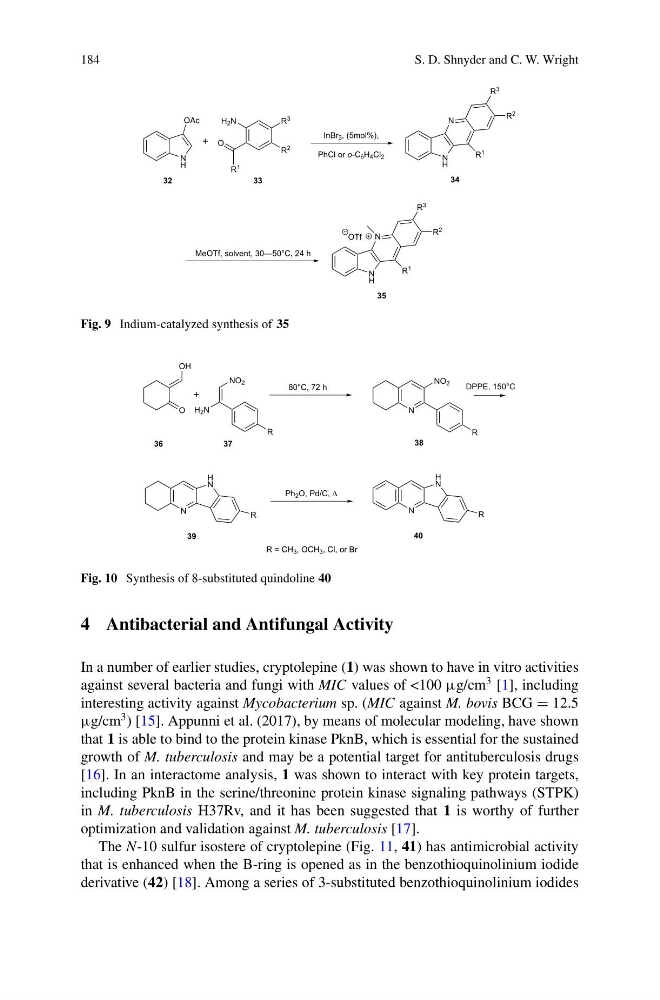
Fig. 9 Indium-catalyzed synthesis of 35
38
36
37
+
OH
O
NO 2
H 2 N
NO 2
N
R
R
39
N
H
N
R
40
N
H
N
R
R = CH 3 , OCH 3 , Cl, or Br
Ph 2 O, Pd/C, Δ
80°C, 72 h
DPPE, 150°C
Fig. 10 Synthesis of 8-substituted quindoline 40
4 Antibacterial and Antifungal Activity
In a number of earlier studies, cryptolepine (1) was shown to have in vitro activities
against several bacteria and fungi with MIC values of <100 μg/cm
3 [1], including
interesting activity against Mycobacterium sp. (MIC against M. bovis BCG = 12.5
μg/cm
3 ) [15]. Appunni et al. (2017), by means of molecular modeling, have shown
that 1 is able to bind to the protein kinase PknB, which is essential for the sustained
growth of M. tuberculosis and may be a potential target for antituberculosis drugs
[16]. In an interactome analysis, 1 was shown to interact with key protein targets,
including PknB in the serine/threonine protein kinase signaling pathways (STPK)
in M. tuberculosis H37Rv, and it has been suggested that 1 is worthy of further
optimization and validation against M. tuberculosis [17].
The N-10 sulfur isostere of cryptolepine (Fig. 11, 41) has antimicrobial activity
that is enhanced when the B-ring is opened as in the benzothioquinolinium iodide
derivative (42) [18]. Among a series of 3-substituted benzothioquinolinium iodides
S. D. Shnyder and C. W. Wright
N
H
35
N
R 1
R 3
R 2
OTf
N
H
34
N
R 1
R 3
R 2
N
H
32
H 2 N
R 2
R 3
O
R 1
33
+
InBr 3 , (5mol%),
PhCl or o-C 6 H 4 Cl 2
MeOTf, solvent, 30–50°C, 24 h
OAc
Fig. 9 Indium-catalyzed synthesis of 35
38
36
37
+
OH
O
NO 2
H 2 N
NO 2
N
R
R
39
N
H
N
R
40
N
H
N
R
R = CH 3 , OCH 3 , Cl, or Br
Ph 2 O, Pd/C, Δ
80°C, 72 h
DPPE, 150°C
Fig. 10 Synthesis of 8-substituted quindoline 40
4 Antibacterial and Antifungal Activity
In a number of earlier studies, cryptolepine (1) was shown to have in vitro activities
against several bacteria and fungi with MIC values of <100 μg/cm
3 [1], including
interesting activity against Mycobacterium sp. (MIC against M. bovis BCG = 12.5
μg/cm
3 ) [15]. Appunni et al. (2017), by means of molecular modeling, have shown
that 1 is able to bind to the protein kinase PknB, which is essential for the sustained
growth of M. tuberculosis and may be a potential target for antituberculosis drugs
[16]. In an interactome analysis, 1 was shown to interact with key protein targets,
including PknB in the serine/threonine protein kinase signaling pathways (STPK)
in M. tuberculosis H37Rv, and it has been suggested that 1 is worthy of further
optimization and validation against M. tuberculosis [17].
The N-10 sulfur isostere of cryptolepine (Fig. 11, 41) has antimicrobial activity
that is enhanced when the B-ring is opened as in the benzothioquinolinium iodide
derivative (42) [18]. Among a series of 3-substituted benzothioquinolinium iodides