

Recent Advances in the Chemistry and Pharmacology of Cryptolepine
185
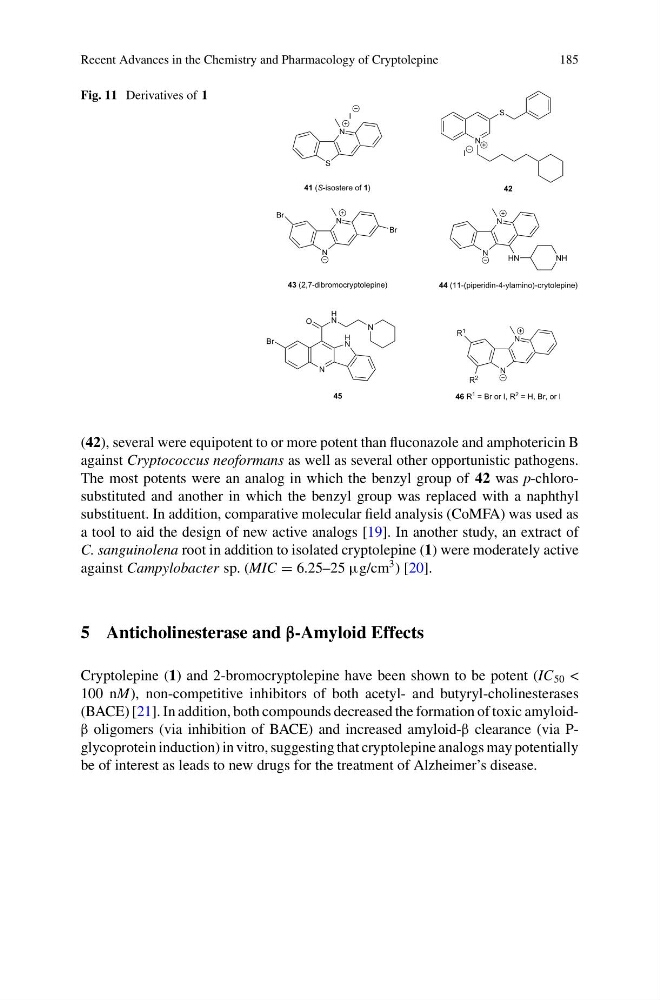
Fig. 11 Derivatives of 1
S
N
41 (S-isostere of 1)
I
N
S
I
42
N
N
43 (2,7-dibromocryptolepine)
Br
Br
N
N
44 (11-(piperidin-4-ylamino)-crytolepine)
HN
NH
45
N
H
N
Br
H
N
O
N
N
R 1
R 2
N
46 R 1 = Br or I, R 2 = H, Br, or I
(42), several were equipotent to or more potent than fluconazole and amphotericin B
against Cryptococcus neoformans as well as several other opportunistic pathogens.
The most potents were an analog in which the benzyl group of 42 was p-chlorosubstituted and another in which the benzyl group was replaced with a naphthyl
substituent. In addition, comparative molecular field analysis (CoMFA) was used as
a tool to aid the design of new active analogs [19]. In another study, an extract of
C. sanguinolena root in addition to isolated cryptolepine (1) were moderately active
against Campylobacter sp. (MIC = 6.25–25 μg/cm
3 ) [20].
5 Anticholinesterase and β-Amyloid Effects
Cryptolepine (1) and 2-bromocryptolepine have been shown to be potent (IC 50 <
100 nM), non-competitive inhibitors of both acetyl- and butyryl-cholinesterases
(BACE) [21]. In addition, both compounds decreased the formation of toxic amyloidβ oligomers (via inhibition of BACE) and increased amyloid-β clearance (via Pglycoprotein induction) in vitro, suggesting that cryptolepine analogs may potentially
be of interest as leads to new drugs for the treatment of Alzheimer’s disease.
185
Fig. 11 Derivatives of 1
S
N
41 (S-isostere of 1)
I
N
S
I
42
N
N
43 (2,7-dibromocryptolepine)
Br
Br
N
N
44 (11-(piperidin-4-ylamino)-crytolepine)
HN
NH
45
N
H
N
Br
H
N
O
N
N
R 1
R 2
N
46 R 1 = Br or I, R 2 = H, Br, or I
(42), several were equipotent to or more potent than fluconazole and amphotericin B
against Cryptococcus neoformans as well as several other opportunistic pathogens.
The most potents were an analog in which the benzyl group of 42 was p-chlorosubstituted and another in which the benzyl group was replaced with a naphthyl
substituent. In addition, comparative molecular field analysis (CoMFA) was used as
a tool to aid the design of new active analogs [19]. In another study, an extract of
C. sanguinolena root in addition to isolated cryptolepine (1) were moderately active
against Campylobacter sp. (MIC = 6.25–25 μg/cm
3 ) [20].
5 Anticholinesterase and β-Amyloid Effects
Cryptolepine (1) and 2-bromocryptolepine have been shown to be potent (IC 50 <
100 nM), non-competitive inhibitors of both acetyl- and butyryl-cholinesterases
(BACE) [21]. In addition, both compounds decreased the formation of toxic amyloidβ oligomers (via inhibition of BACE) and increased amyloid-β clearance (via Pglycoprotein induction) in vitro, suggesting that cryptolepine analogs may potentially
be of interest as leads to new drugs for the treatment of Alzheimer’s disease.