

Recent Advances in the Chemistry and Pharmacology of Cryptolepine
183
Fig. 7 Palladium-catalyzed
synthesis of 16
N
I
Br
28
aniline, Pd(OAc2)2, Xantphos,
CsCO3, toluene 120°C, Mw
N
H
N
Br
29
PdCl2(PPh3)2, NaOAc,
DMA, 150°C, Mw
N
16 (quindoline)
H
N
of novel syntheses of the four indoloquinoline skeletons 1–4 [11]. The synthesis of
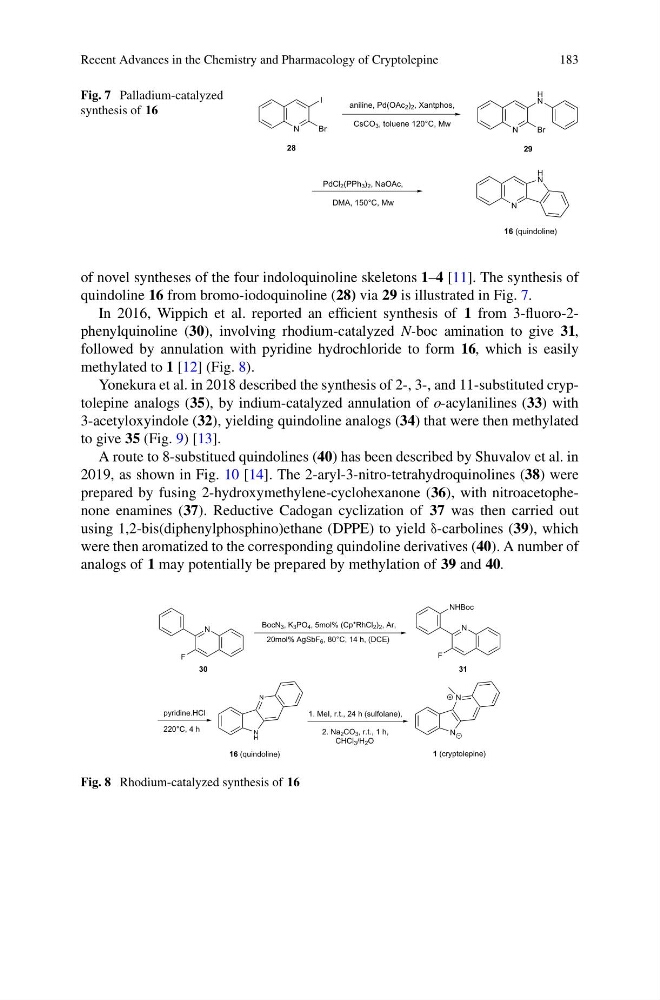
quindoline 16 from bromo-iodoquinoline (28) via 29 is illustrated in Fig. 7.
In 2016, Wippich et al. reported an efficient synthesis of 1 from 3-fluoro-2phenylquinoline (30), involving rhodium-catalyzed N-boc amination to give 31,
followed by annulation with pyridine hydrochloride to form 16, which is easily
methylated to 1 [12] (Fig. 8).
Yonekura et al. in 2018 described the synthesis of 2-, 3-, and 11-substituted cryptolepine analogs (35), by indium-catalyzed annulation of o-acylanilines (33) with
3-acetyloxyindole (32), yielding quindoline analogs (34) that were then methylated
to give 35 (Fig. 9) [13].
A route to 8-substitued quindolines (40) has been described by Shuvalov et al. in
2019, as shown in Fig. 10 [14]. The 2-aryl-3-nitro-tetrahydroquinolines (38) were
prepared by fusing 2-hydroxymethylene-cyclohexanone (36), with nitroacetophenone enamines (37). Reductive Cadogan cyclization of 37 was then carried out
using 1,2-bis(diphenylphosphino)ethane (DPPE) to yield δ-carbolines (39), which
were then aromatized to the corresponding quindoline derivatives (40). A number of
analogs of 1 may potentially be prepared by methylation of 39 and 40.
N
F
N
F
NHBoc
BocN3, K3PO4, 5mol% (Cp*RhCl2)2, Ar,
20mol% AgSbF6, 80°C, 14 h, (DCE)
pyridine.HCl
220°C, 4 h
N
1 (cryptolepine)
N
N
H
16 (quindoline)
N
1. MeI, r.t., 24 h (sulfolane),
2. Na2CO3, r.t., 1 h,
CHCl3/H 2O
30
31
Fig. 8 Rhodium-catalyzed synthesis of 16
183
Fig. 7 Palladium-catalyzed
synthesis of 16
N
I
Br
28
aniline, Pd(OAc2)2, Xantphos,
CsCO3, toluene 120°C, Mw
N
H
N
Br
29
PdCl2(PPh3)2, NaOAc,
DMA, 150°C, Mw
N
16 (quindoline)
H
N
of novel syntheses of the four indoloquinoline skeletons 1–4 [11]. The synthesis of
quindoline 16 from bromo-iodoquinoline (28) via 29 is illustrated in Fig. 7.
In 2016, Wippich et al. reported an efficient synthesis of 1 from 3-fluoro-2phenylquinoline (30), involving rhodium-catalyzed N-boc amination to give 31,
followed by annulation with pyridine hydrochloride to form 16, which is easily
methylated to 1 [12] (Fig. 8).
Yonekura et al. in 2018 described the synthesis of 2-, 3-, and 11-substituted cryptolepine analogs (35), by indium-catalyzed annulation of o-acylanilines (33) with
3-acetyloxyindole (32), yielding quindoline analogs (34) that were then methylated
to give 35 (Fig. 9) [13].
A route to 8-substitued quindolines (40) has been described by Shuvalov et al. in
2019, as shown in Fig. 10 [14]. The 2-aryl-3-nitro-tetrahydroquinolines (38) were
prepared by fusing 2-hydroxymethylene-cyclohexanone (36), with nitroacetophenone enamines (37). Reductive Cadogan cyclization of 37 was then carried out
using 1,2-bis(diphenylphosphino)ethane (DPPE) to yield δ-carbolines (39), which
were then aromatized to the corresponding quindoline derivatives (40). A number of
analogs of 1 may potentially be prepared by methylation of 39 and 40.
N
F
N
F
NHBoc
BocN3, K3PO4, 5mol% (Cp*RhCl2)2, Ar,
20mol% AgSbF6, 80°C, 14 h, (DCE)
pyridine.HCl
220°C, 4 h
N
1 (cryptolepine)
N
N
H
16 (quindoline)
N
1. MeI, r.t., 24 h (sulfolane),
2. Na2CO3, r.t., 1 h,
CHCl3/H 2O
30
31
Fig. 8 Rhodium-catalyzed synthesis of 16