

180
S. D. Shnyder and C. W. Wright
Fig. 3 Biosynthesis of 1;
adapted from [5]
10 (anthranilic acid)
H2N
8 (indoxyl)
N
H
O
O
OH
+
imine formation
N
H
NH
O
OH
11
N
H
NH
O
SCoA
12
HSCoA
intramolecular
cyclization
N
H
13
N
O
N
H
14 (quindolinone)
HN
O
SAM
N
H
15 (cryptolepine-11-one)
N
O
N
H
16 (quindoline)
N
NADPH reduction
and dehydration
SAM
N
1 (cryptolepine)
N
N-methylation
phosphate, (6), leads to indole (7), the precursor of indoxyl (8) and isatin (9), from
which anthranilic acid (10) is derived (Fig. 2).
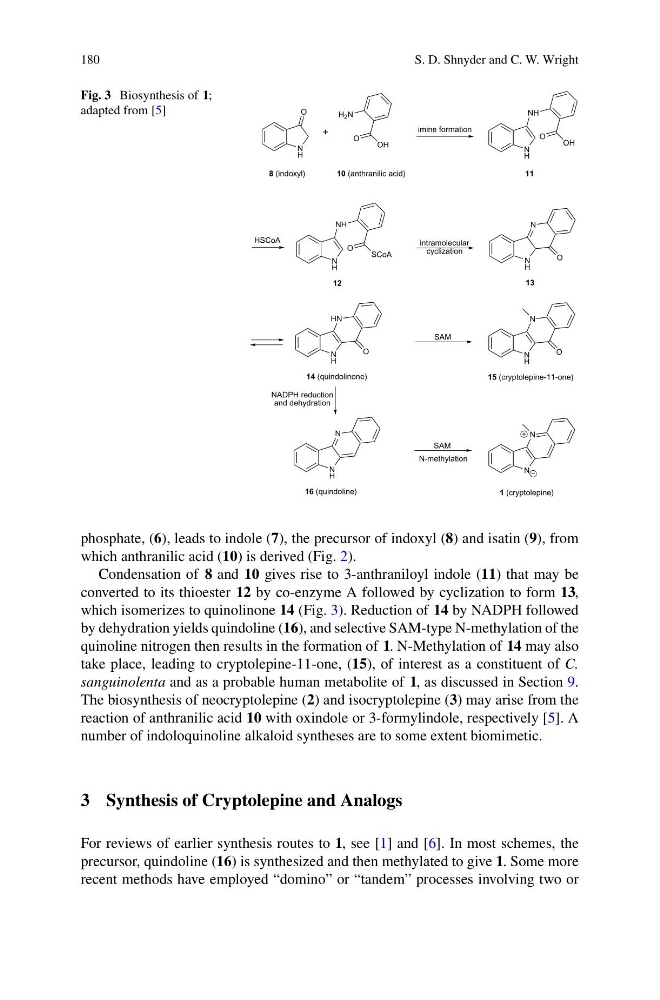
Condensation of 8 and 10 gives rise to 3-anthraniloyl indole (11) that may be
converted to its thioester 12 by co-enzyme A followed by cyclization to form 13,
which isomerizes to quinolinone 14 (Fig. 3). Reduction of 14 by NADPH followed
by dehydration yields quindoline (16), and selective SAM-type N-methylation of the
quinoline nitrogen then results in the formation of 1. N-Methylation of 14 may also
take place, leading to cryptolepine-11-one, (15), of interest as a constituent of C.
sanguinolenta and as a probable human metabolite of 1, as discussed in Section 9.
The biosynthesis of neocryptolepine (2) and isocryptolepine (3) may arise from the
reaction of anthranilic acid 10 with oxindole or 3-formylindole, respectively [5]. A
number of indoloquinoline alkaloid syntheses are to some extent biomimetic.
3 Synthesis of Cryptolepine and Analogs
For reviews of earlier synthesis routes to 1, see [1] and [6]. In most schemes, the
precursor, quindoline (16) is synthesized and then methylated to give 1. Some more
recent methods have employed “domino” or “tandem” processes involving two or
S. D. Shnyder and C. W. Wright
Fig. 3 Biosynthesis of 1;
adapted from [5]
10 (anthranilic acid)
H2N
8 (indoxyl)
N
H
O
O
OH
+
imine formation
N
H
NH
O
OH
11
N
H
NH
O
SCoA
12
HSCoA
intramolecular
cyclization
N
H
13
N
O
N
H
14 (quindolinone)
HN
O
SAM
N
H
15 (cryptolepine-11-one)
N
O
N
H
16 (quindoline)
N
NADPH reduction
and dehydration
SAM
N
1 (cryptolepine)
N
N-methylation
phosphate, (6), leads to indole (7), the precursor of indoxyl (8) and isatin (9), from
which anthranilic acid (10) is derived (Fig. 2).
Condensation of 8 and 10 gives rise to 3-anthraniloyl indole (11) that may be
converted to its thioester 12 by co-enzyme A followed by cyclization to form 13,
which isomerizes to quinolinone 14 (Fig. 3). Reduction of 14 by NADPH followed
by dehydration yields quindoline (16), and selective SAM-type N-methylation of the
quinoline nitrogen then results in the formation of 1. N-Methylation of 14 may also
take place, leading to cryptolepine-11-one, (15), of interest as a constituent of C.
sanguinolenta and as a probable human metabolite of 1, as discussed in Section 9.
The biosynthesis of neocryptolepine (2) and isocryptolepine (3) may arise from the
reaction of anthranilic acid 10 with oxindole or 3-formylindole, respectively [5]. A
number of indoloquinoline alkaloid syntheses are to some extent biomimetic.
3 Synthesis of Cryptolepine and Analogs
For reviews of earlier synthesis routes to 1, see [1] and [6]. In most schemes, the
precursor, quindoline (16) is synthesized and then methylated to give 1. Some more
recent methods have employed “domino” or “tandem” processes involving two or