

Recent Advances in the Chemistry and Pharmacology of Cryptolepine
181
more bond formations under identical reaction conditions [5, 7, 8], although it should
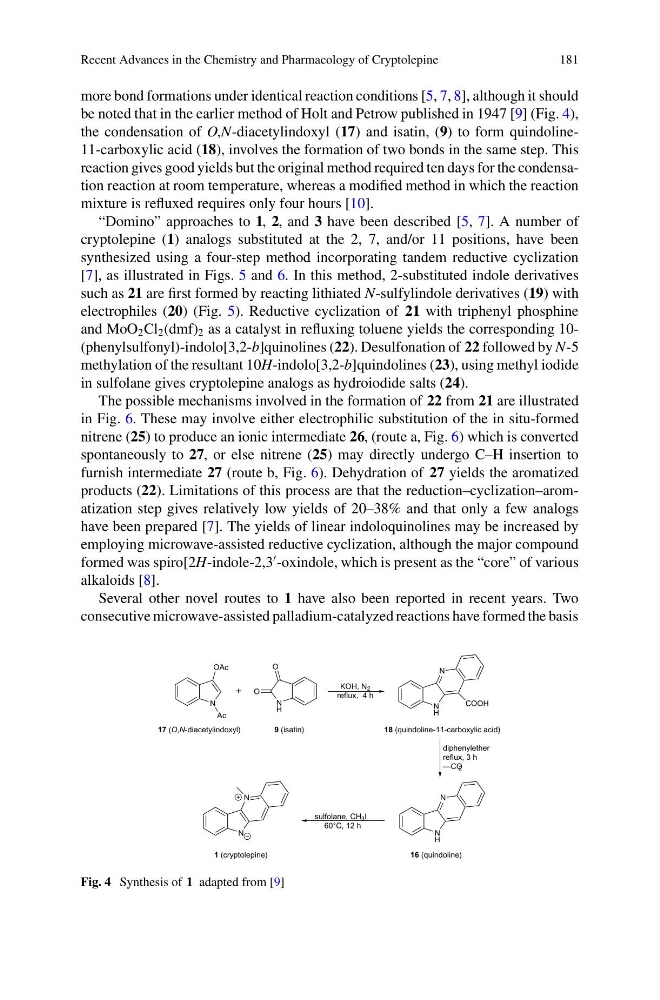
be noted that in the earlier method of Holt and Petrow published in 1947 [9] (Fig. 4),
the condensation of O,N-diacetylindoxyl (17) and isatin, (9) to form quindoline11-carboxylic acid (18), involves the formation of two bonds in the same step. This
reaction gives good yields but the original method required ten days for the condensation reaction at room temperature, whereas a modified method in which the reaction
mixture is refluxed requires only four hours [10].
“Domino” approaches to 1, 2, and 3 have been described [5, 7]. A number of
cryptolepine (1) analogs substituted at the 2, 7, and/or 11 positions, have been
synthesized using a four-step method incorporating tandem reductive cyclization
[7], as illustrated in Figs. 5 and 6. In this method, 2-substituted indole derivatives
such as 21 are first formed by reacting lithiated N-sulfylindole derivatives (19) with
electrophiles (20) (Fig. 5). Reductive cyclization of 21 with triphenyl phosphine
and MoO 2 Cl 2 (dmf) 2 as a catalyst in refluxing toluene yields the corresponding 10(phenylsulfonyl)-indolo[3,2-b]quinolines (22). Desulfonation of 22 followed by N-5
methylation of the resultant 10H-indolo[3,2-b]quindolines (23), using methyl iodide
in sulfolane gives cryptolepine analogs as hydroiodide salts (24).
The possible mechanisms involved in the formation of 22 from 21 are illustrated
in Fig. 6. These may involve either electrophilic substitution of the in situ-formed
nitrene (25) to produce an ionic intermediate 26, (route a, Fig. 6) which is converted
spontaneously to 27, or else nitrene (25) may directly undergo C–H insertion to
furnish intermediate 27 (route b, Fig. 6). Dehydration of 27 yields the aromatized
products (22). Limitations of this process are that the reduction–cyclization–aromatization step gives relatively low yields of 20–38% and that only a few analogs
have been prepared [7]. The yields of linear indoloquinolines may be increased by
employing microwave-assisted reductive cyclization, although the major compound
formed was spiro[2H-indole-2,3
-oxindole, which is present as the “core” of various
alkaloids [8].
Several other novel routes to 1 have also been reported in recent years. Two
consecutive microwave-assisted palladium-catalyzed reactions have formed the basis
17 (O,N-diacetylindoxyl)
N
OAc
+
KOH, N2
reflux, 4 h
Ac
9 (isatin)
N
H
O
O
N
H
18 (quindoline-11-carboxylic acid)
N
COOH
N
H
16 (quindoline)
N
diphenylether
reflux, 3 h
—CO 2
N
1 (cryptolepine)
N
sulfolane, CH3I
60°C, 12 h
Fig. 4 Synthesis of 1 adapted from [9]
181
more bond formations under identical reaction conditions [5, 7, 8], although it should
be noted that in the earlier method of Holt and Petrow published in 1947 [9] (Fig. 4),
the condensation of O,N-diacetylindoxyl (17) and isatin, (9) to form quindoline11-carboxylic acid (18), involves the formation of two bonds in the same step. This
reaction gives good yields but the original method required ten days for the condensation reaction at room temperature, whereas a modified method in which the reaction
mixture is refluxed requires only four hours [10].
“Domino” approaches to 1, 2, and 3 have been described [5, 7]. A number of
cryptolepine (1) analogs substituted at the 2, 7, and/or 11 positions, have been
synthesized using a four-step method incorporating tandem reductive cyclization
[7], as illustrated in Figs. 5 and 6. In this method, 2-substituted indole derivatives
such as 21 are first formed by reacting lithiated N-sulfylindole derivatives (19) with
electrophiles (20) (Fig. 5). Reductive cyclization of 21 with triphenyl phosphine
and MoO 2 Cl 2 (dmf) 2 as a catalyst in refluxing toluene yields the corresponding 10(phenylsulfonyl)-indolo[3,2-b]quinolines (22). Desulfonation of 22 followed by N-5
methylation of the resultant 10H-indolo[3,2-b]quindolines (23), using methyl iodide
in sulfolane gives cryptolepine analogs as hydroiodide salts (24).
The possible mechanisms involved in the formation of 22 from 21 are illustrated
in Fig. 6. These may involve either electrophilic substitution of the in situ-formed
nitrene (25) to produce an ionic intermediate 26, (route a, Fig. 6) which is converted
spontaneously to 27, or else nitrene (25) may directly undergo C–H insertion to
furnish intermediate 27 (route b, Fig. 6). Dehydration of 27 yields the aromatized
products (22). Limitations of this process are that the reduction–cyclization–aromatization step gives relatively low yields of 20–38% and that only a few analogs
have been prepared [7]. The yields of linear indoloquinolines may be increased by
employing microwave-assisted reductive cyclization, although the major compound
formed was spiro[2H-indole-2,3
-oxindole, which is present as the “core” of various
alkaloids [8].
Several other novel routes to 1 have also been reported in recent years. Two
consecutive microwave-assisted palladium-catalyzed reactions have formed the basis
17 (O,N-diacetylindoxyl)
N
OAc
+
KOH, N2
reflux, 4 h
Ac
9 (isatin)
N
H
O
O
N
H
18 (quindoline-11-carboxylic acid)
N
COOH
N
H
16 (quindoline)
N
diphenylether
reflux, 3 h
—CO 2
N
1 (cryptolepine)
N
sulfolane, CH3I
60°C, 12 h
Fig. 4 Synthesis of 1 adapted from [9]