

Recent Advances in the Chemistry and Pharmacology of Cryptolepine
179
In the literature, the structure of cryptolepine is depicted in two resonance forms,
1 and 1a. Structure 1, in which N-5 is quaternary, is preferred by the authors because
cryptolepine has only one protonatable nitrogen (N-10) and one pK a ; the quaternary
nature of N-5 is also supported by the large downfield shift of the N-methyl group
signal in the
1 H-NMR spectrum (δ 4.7 ppm in CDCl 3 ) [1]. The single protonatable
nitrogen in 1 has implications for the antiplasmodial potency of this compound and
its analogs, as discussed in Sect. 8.3. In addition to 1, about 14 minor alkaloids
have been isolated from C. sanguinolenta, including the indoloquinoline isomers,
neocryptolepine (2), and isocryptolepine (3) (Fig. 1) [1]. A fourth member of this
series, isoneocryptolepine (4) (Fig. 1), has not been found in Nature but has been
synthesized [4].
The dried roots of C. sanguinolenta are widely used in West African traditional
medicine as a decoction for the treatment of many non-infectious and infectious
diseases including malaria [1]. The chemistry and biology of 1 were reviewed previously in 2008 [1], and the aim of this chapter is to discuss progress made over the
last decade especially with respect to the therapeutic potential of 1 and its semisynthetic and synthetic analogs. To date, the main interest has been the development
of novel antimalarials (Section 8.3), reflecting the widespread traditional use of C.
sanguinolenta for the treatment of malaria.
2 Biosynthesis of Indoloquinoline Alkaloids
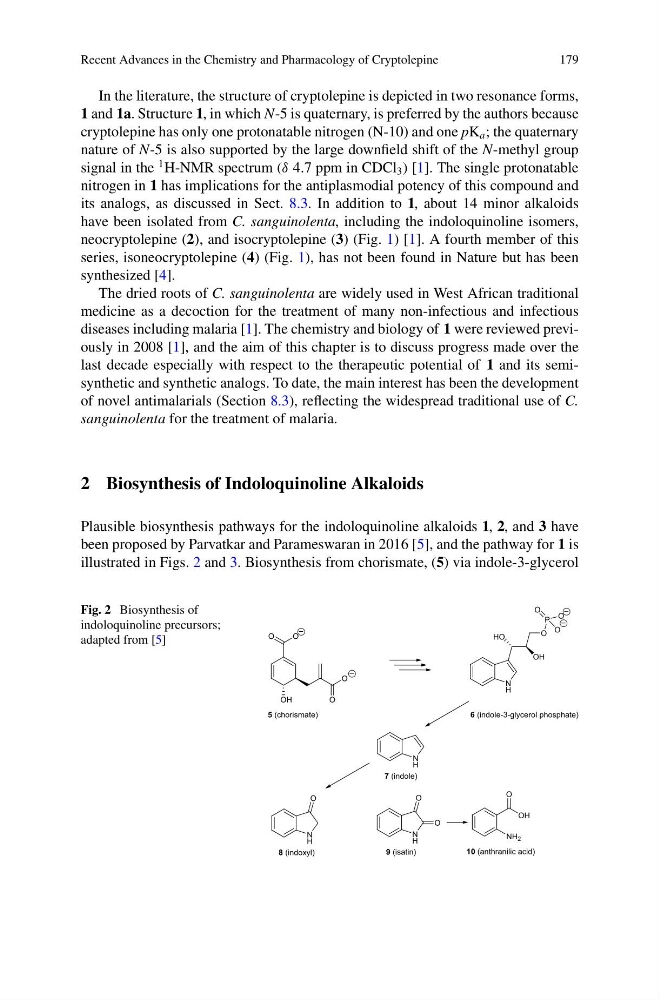
Plausible biosynthesis pathways for the indoloquinoline alkaloids 1, 2, and 3 have
been proposed by Parvatkar and Parameswaran in 2016 [5], and the pathway for 1 is
illustrated in Figs. 2 and 3. Biosynthesis from chorismate, (5) via indole-3-glycerol
Fig. 2 Biosynthesis of
indoloquinoline precursors;
adapted from [5]
5 (chorismate)
6 (indole-3-glycerol phosphate)
O
O
O
O
OH
N
H
O
HO
OH
P
O
O
O
7 (indole)
N
H
9 (isatin)
N
H
10 (anthranilic acid)
NH 2
8 (indoxyl)
N
H
O
O
O
O
OH
179
In the literature, the structure of cryptolepine is depicted in two resonance forms,
1 and 1a. Structure 1, in which N-5 is quaternary, is preferred by the authors because
cryptolepine has only one protonatable nitrogen (N-10) and one pK a ; the quaternary
nature of N-5 is also supported by the large downfield shift of the N-methyl group
signal in the
1 H-NMR spectrum (δ 4.7 ppm in CDCl 3 ) [1]. The single protonatable
nitrogen in 1 has implications for the antiplasmodial potency of this compound and
its analogs, as discussed in Sect. 8.3. In addition to 1, about 14 minor alkaloids
have been isolated from C. sanguinolenta, including the indoloquinoline isomers,
neocryptolepine (2), and isocryptolepine (3) (Fig. 1) [1]. A fourth member of this
series, isoneocryptolepine (4) (Fig. 1), has not been found in Nature but has been
synthesized [4].
The dried roots of C. sanguinolenta are widely used in West African traditional
medicine as a decoction for the treatment of many non-infectious and infectious
diseases including malaria [1]. The chemistry and biology of 1 were reviewed previously in 2008 [1], and the aim of this chapter is to discuss progress made over the
last decade especially with respect to the therapeutic potential of 1 and its semisynthetic and synthetic analogs. To date, the main interest has been the development
of novel antimalarials (Section 8.3), reflecting the widespread traditional use of C.
sanguinolenta for the treatment of malaria.
2 Biosynthesis of Indoloquinoline Alkaloids
Plausible biosynthesis pathways for the indoloquinoline alkaloids 1, 2, and 3 have
been proposed by Parvatkar and Parameswaran in 2016 [5], and the pathway for 1 is
illustrated in Figs. 2 and 3. Biosynthesis from chorismate, (5) via indole-3-glycerol
Fig. 2 Biosynthesis of
indoloquinoline precursors;
adapted from [5]
5 (chorismate)
6 (indole-3-glycerol phosphate)
O
O
O
O
OH
N
H
O
HO
OH
P
O
O
O
7 (indole)
N
H
9 (isatin)
N
H
10 (anthranilic acid)
NH 2
8 (indoxyl)
N
H
O
O
O
O
OH