

10
B. Schmidt
to intermolecular esterifications, high- or pseudo-high dilution conditions have to
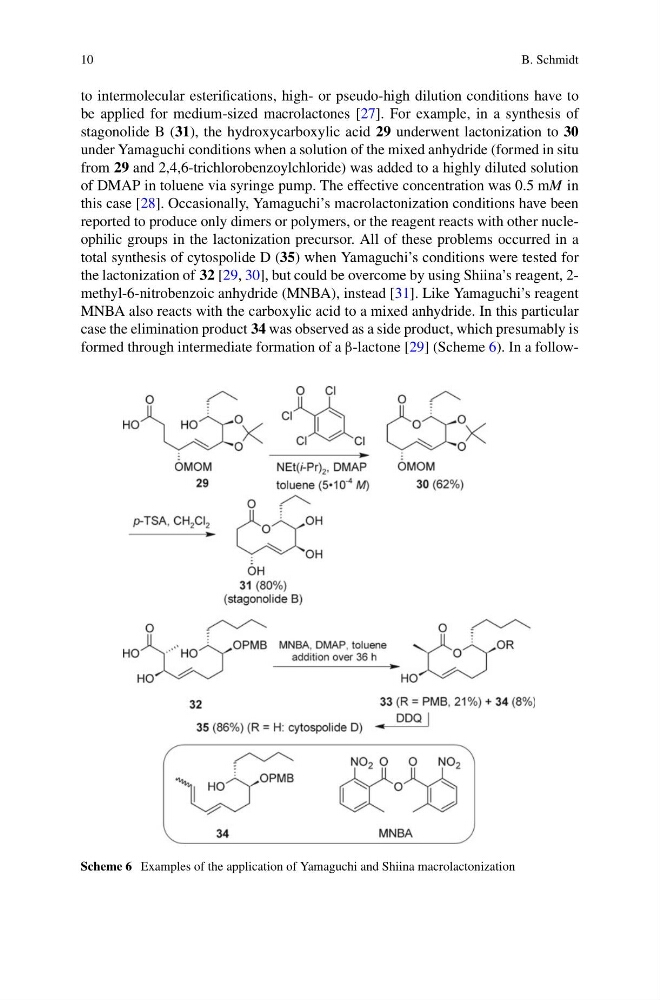
be applied for medium-sized macrolactones [27]. For example, in a synthesis of
stagonolide B (31), the hydroxycarboxylic acid 29 underwent lactonization to 30
under Yamaguchi conditions when a solution of the mixed anhydride (formed in situ
from 29 and 2,4,6-trichlorobenzoylchloride) was added to a highly diluted solution
of DMAP in toluene via syringe pump. The effective concentration was 0.5 mM in
this case [28]. Occasionally, Yamaguchi’s macrolactonization conditions have been
reported to produce only dimers or polymers, or the reagent reacts with other nucleophilic groups in the lactonization precursor. All of these problems occurred in a
total synthesis of cytospolide D (35) when Yamaguchi’s conditions were tested for
the lactonization of 32 [29, 30], but could be overcome by using Shiina’s reagent, 2methyl-6-nitrobenzoic anhydride (MNBA), instead [31]. Like Yamaguchi’s reagent
MNBA also reacts with the carboxylic acid to a mixed anhydride. In this particular
case the elimination product 34 was observed as a side product, which presumably is
formed through intermediate formation of a β-lactone [29] (Scheme 6). In a followScheme 6 Examples of the application of Yamaguchi and Shiina macrolactonization
B. Schmidt
to intermolecular esterifications, high- or pseudo-high dilution conditions have to
be applied for medium-sized macrolactones [27]. For example, in a synthesis of
stagonolide B (31), the hydroxycarboxylic acid 29 underwent lactonization to 30
under Yamaguchi conditions when a solution of the mixed anhydride (formed in situ
from 29 and 2,4,6-trichlorobenzoylchloride) was added to a highly diluted solution
of DMAP in toluene via syringe pump. The effective concentration was 0.5 mM in
this case [28]. Occasionally, Yamaguchi’s macrolactonization conditions have been
reported to produce only dimers or polymers, or the reagent reacts with other nucleophilic groups in the lactonization precursor. All of these problems occurred in a
total synthesis of cytospolide D (35) when Yamaguchi’s conditions were tested for
the lactonization of 32 [29, 30], but could be overcome by using Shiina’s reagent, 2methyl-6-nitrobenzoic anhydride (MNBA), instead [31]. Like Yamaguchi’s reagent
MNBA also reacts with the carboxylic acid to a mixed anhydride. In this particular
case the elimination product 34 was observed as a side product, which presumably is
formed through intermediate formation of a β-lactone [29] (Scheme 6). In a followScheme 6 Examples of the application of Yamaguchi and Shiina macrolactonization