

The Role of Total Synthesis in Structure …
11
up study on the synthesis of cytospolide D analogs, it was discovered that small
differences in the structures of the precursors can be crucial for the success of a
macrolactonization. If, for instance, the C-3 hydroxy group of 32 is protected as a
TBS ether and/or if the C-2 epimer of 32 is used, the lactonization fails completely,
even under optimized Shiina conditions [30].
Contemporary methods for ester coupling reactions, their mechanisms and representative applications in the synthesis of complex natural products have been
reviewed [27].
2.2 Ring-Closing Olefin Metathesis
Ring-closing olefin metathesis (RCM) has emerged as one of the most versatile
C–C-bond forming reactions used in the synthesis of carbo- and heterocyclic target
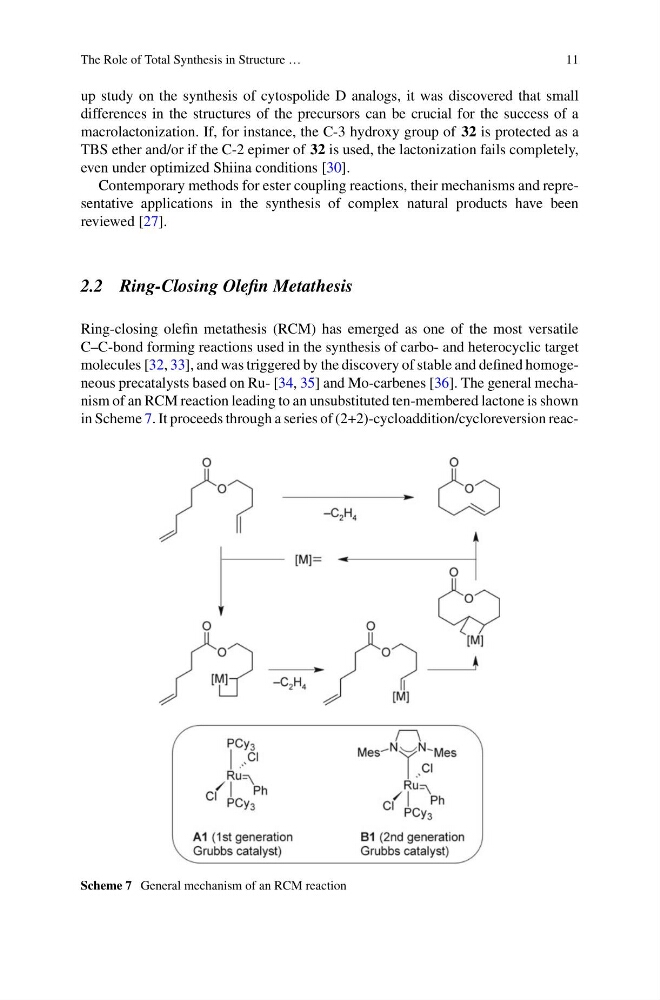
molecules [32, 33], and was triggered by the discovery of stable and defined homogeneous precatalysts based on Ru- [34, 35] and Mo-carbenes [36]. The general mechanism of an RCM reaction leading to an unsubstituted ten-membered lactone is shown
in Scheme 7. It proceeds through a series of (2+2)-cycloaddition/cycloreversion reacScheme 7 General mechanism of an RCM reaction
11
up study on the synthesis of cytospolide D analogs, it was discovered that small
differences in the structures of the precursors can be crucial for the success of a
macrolactonization. If, for instance, the C-3 hydroxy group of 32 is protected as a
TBS ether and/or if the C-2 epimer of 32 is used, the lactonization fails completely,
even under optimized Shiina conditions [30].
Contemporary methods for ester coupling reactions, their mechanisms and representative applications in the synthesis of complex natural products have been
reviewed [27].
2.2 Ring-Closing Olefin Metathesis
Ring-closing olefin metathesis (RCM) has emerged as one of the most versatile
C–C-bond forming reactions used in the synthesis of carbo- and heterocyclic target
molecules [32, 33], and was triggered by the discovery of stable and defined homogeneous precatalysts based on Ru- [34, 35] and Mo-carbenes [36]. The general mechanism of an RCM reaction leading to an unsubstituted ten-membered lactone is shown
in Scheme 7. It proceeds through a series of (2+2)-cycloaddition/cycloreversion reacScheme 7 General mechanism of an RCM reaction