

The Role of Total Synthesis in Structure …
9
2.1 Esterification and Macrolactonization Reactions
Steglich’s reaction [19] is the most commonly used esterification method in decanolide total synthesis. The method relies on the use of dicyclohexylcarbodiimide (DCC)
in combination with a catalytic amount of N,N-dimethylaminopyridine (DMAP) in
a moderately polar aprotic solvent, such as dichloromethane.
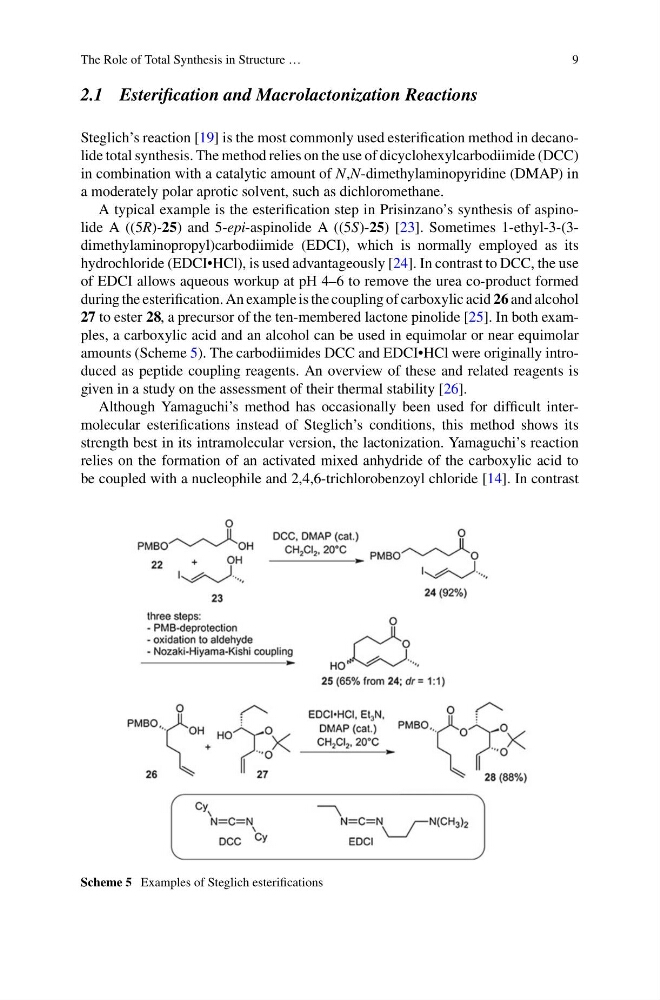
A typical example is the esterification step in Prisinzano’s synthesis of aspinolide A ((5R)-25) and 5-epi-aspinolide A ((5S)-25) [23]. Sometimes 1-ethyl-3-(3dimethylaminopropyl)carbodiimide (EDCI), which is normally employed as its
hydrochloride (EDCI•HCl), is used advantageously [24]. In contrast to DCC, the use
of EDCI allows aqueous workup at pH 4–6 to remove the urea co-product formed
during the esterification. An example is the coupling of carboxylic acid 26 and alcohol
27 to ester 28, a precursor of the ten-membered lactone pinolide [25]. In both examples, a carboxylic acid and an alcohol can be used in equimolar or near equimolar
amounts (Scheme 5). The carbodiimides DCC and EDCI•HCl were originally introduced as peptide coupling reagents. An overview of these and related reagents is
given in a study on the assessment of their thermal stability [26].
Although Yamaguchi’s method has occasionally been used for difficult intermolecular esterifications instead of Steglich’s conditions, this method shows its
strength best in its intramolecular version, the lactonization. Yamaguchi’s reaction
relies on the formation of an activated mixed anhydride of the carboxylic acid to
be coupled with a nucleophile and 2,4,6-trichlorobenzoyl chloride [14]. In contrast
Scheme 5 Examples of Steglich esterifications
9
2.1 Esterification and Macrolactonization Reactions
Steglich’s reaction [19] is the most commonly used esterification method in decanolide total synthesis. The method relies on the use of dicyclohexylcarbodiimide (DCC)
in combination with a catalytic amount of N,N-dimethylaminopyridine (DMAP) in
a moderately polar aprotic solvent, such as dichloromethane.
A typical example is the esterification step in Prisinzano’s synthesis of aspinolide A ((5R)-25) and 5-epi-aspinolide A ((5S)-25) [23]. Sometimes 1-ethyl-3-(3dimethylaminopropyl)carbodiimide (EDCI), which is normally employed as its
hydrochloride (EDCI•HCl), is used advantageously [24]. In contrast to DCC, the use
of EDCI allows aqueous workup at pH 4–6 to remove the urea co-product formed
during the esterification. An example is the coupling of carboxylic acid 26 and alcohol
27 to ester 28, a precursor of the ten-membered lactone pinolide [25]. In both examples, a carboxylic acid and an alcohol can be used in equimolar or near equimolar
amounts (Scheme 5). The carbodiimides DCC and EDCI•HCl were originally introduced as peptide coupling reagents. An overview of these and related reagents is
given in a study on the assessment of their thermal stability [26].
Although Yamaguchi’s method has occasionally been used for difficult intermolecular esterifications instead of Steglich’s conditions, this method shows its
strength best in its intramolecular version, the lactonization. Yamaguchi’s reaction
relies on the formation of an activated mixed anhydride of the carboxylic acid to
be coupled with a nucleophile and 2,4,6-trichlorobenzoyl chloride [14]. In contrast
Scheme 5 Examples of Steglich esterifications