

8
B. Schmidt
The methods for ring closure by C–C-bond formation used at that time were Pdcatalyzed allylic substitutions, SmI 2 -mediated Reformatsky reactions or intramolecular radical additions to C=C double-bonds. These methods, as well as the oxidative fragmentation of annulated decanolides, no longer play a significant role in the
total synthesis of ten-membered lactones due to the development of efficient olefin
metathesis catalysts starting in the mid-1990s. Comparison of the review on decanolides in general by Sun et al. from 2012 [12] and with Ishigami’s review on the
synthesis of selected ten-membered lactone natural products from 2009 [13] reveals
how olefin metathesis has revolutionized the total synthesis of decanolides. However,
macrolactonization remains a method of constant importance over the decades;
in particular, Yamaguchi’s method has been, and is, used routinely in decanolide
synthesis [14]. As a notable example for the efficient use of an oxidative ring expansion strategy [15] in contemporary decanolide total synthesis, the cephalosporolides
should be mentioned [16–18].
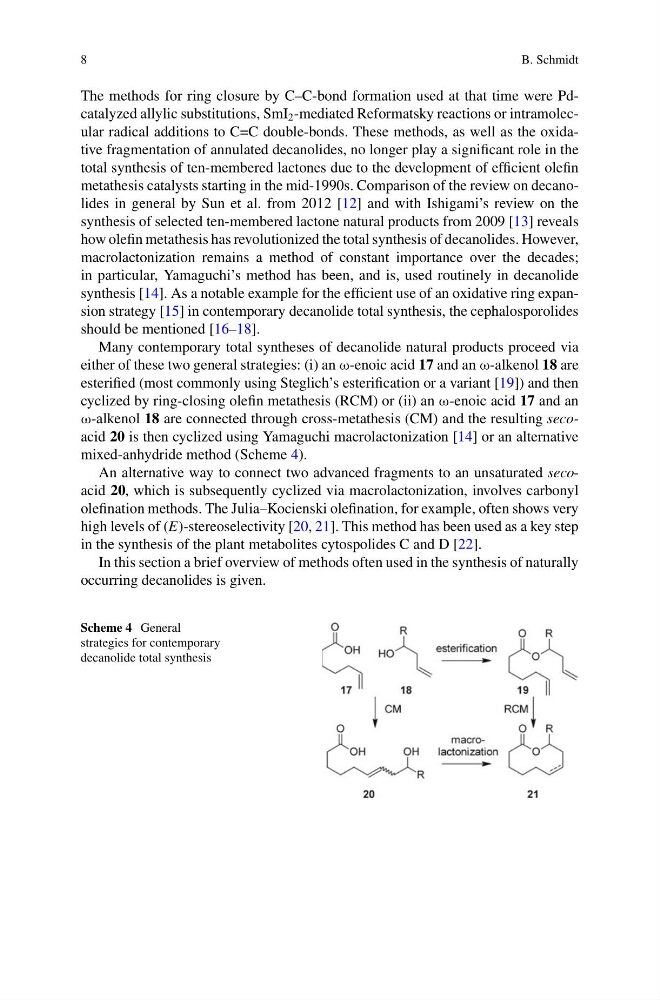
Many contemporary total syntheses of decanolide natural products proceed via
either of these two general strategies: (i) an ω-enoic acid 17 and an ω-alkenol 18 are
esterified (most commonly using Steglich’s esterification or a variant [19]) and then
cyclized by ring-closing olefin metathesis (RCM) or (ii) an ω-enoic acid 17 and an
ω-alkenol 18 are connected through cross-metathesis (CM) and the resulting secoacid 20 is then cyclized using Yamaguchi macrolactonization [14] or an alternative
mixed-anhydride method (Scheme 4).
An alternative way to connect two advanced fragments to an unsaturated secoacid 20, which is subsequently cyclized via macrolactonization, involves carbonyl
olefination methods. The Julia–Kocienski olefination, for example, often shows very
high levels of (E)-stereoselectivity [20, 21]. This method has been used as a key step
in the synthesis of the plant metabolites cytospolides C and D [22].
In this section a brief overview of methods often used in the synthesis of naturally
occurring decanolides is given.
Scheme 4 General
strategies for contemporary
decanolide total synthesis
B. Schmidt
The methods for ring closure by C–C-bond formation used at that time were Pdcatalyzed allylic substitutions, SmI 2 -mediated Reformatsky reactions or intramolecular radical additions to C=C double-bonds. These methods, as well as the oxidative fragmentation of annulated decanolides, no longer play a significant role in the
total synthesis of ten-membered lactones due to the development of efficient olefin
metathesis catalysts starting in the mid-1990s. Comparison of the review on decanolides in general by Sun et al. from 2012 [12] and with Ishigami’s review on the
synthesis of selected ten-membered lactone natural products from 2009 [13] reveals
how olefin metathesis has revolutionized the total synthesis of decanolides. However,
macrolactonization remains a method of constant importance over the decades;
in particular, Yamaguchi’s method has been, and is, used routinely in decanolide
synthesis [14]. As a notable example for the efficient use of an oxidative ring expansion strategy [15] in contemporary decanolide total synthesis, the cephalosporolides
should be mentioned [16–18].
Many contemporary total syntheses of decanolide natural products proceed via
either of these two general strategies: (i) an ω-enoic acid 17 and an ω-alkenol 18 are
esterified (most commonly using Steglich’s esterification or a variant [19]) and then
cyclized by ring-closing olefin metathesis (RCM) or (ii) an ω-enoic acid 17 and an
ω-alkenol 18 are connected through cross-metathesis (CM) and the resulting secoacid 20 is then cyclized using Yamaguchi macrolactonization [14] or an alternative
mixed-anhydride method (Scheme 4).
An alternative way to connect two advanced fragments to an unsaturated secoacid 20, which is subsequently cyclized via macrolactonization, involves carbonyl
olefination methods. The Julia–Kocienski olefination, for example, often shows very
high levels of (E)-stereoselectivity [20, 21]. This method has been used as a key step
in the synthesis of the plant metabolites cytospolides C and D [22].
In this section a brief overview of methods often used in the synthesis of naturally
occurring decanolides is given.
Scheme 4 General
strategies for contemporary
decanolide total synthesis