

Antileishmanial Activity of Lignans, Neolignans …
149
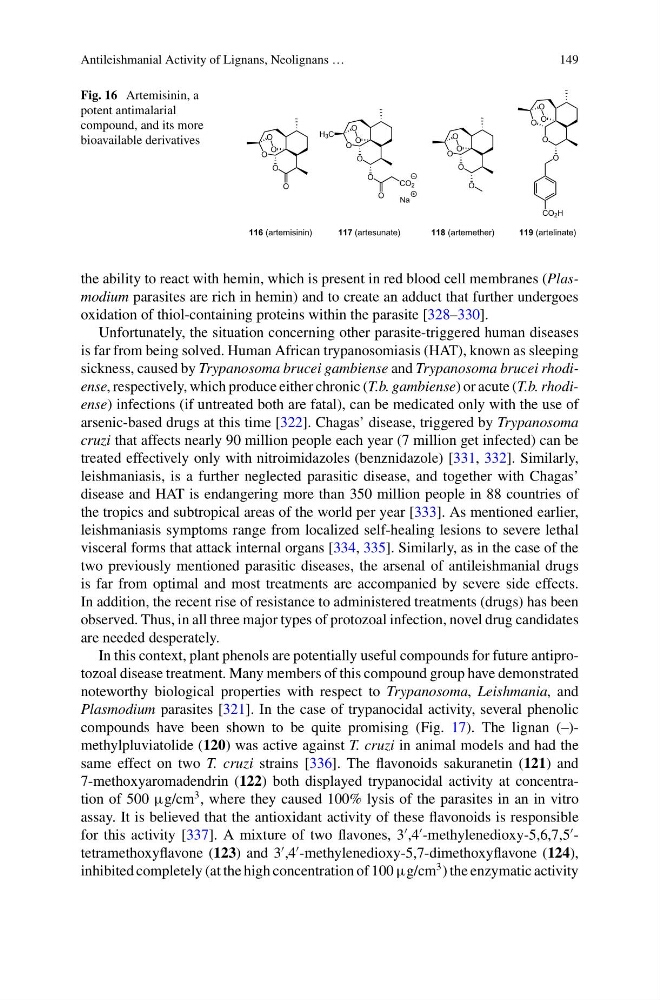
Fig. 16 Artemisinin, a
potent antimalarial
compound, and its more
bioavailable derivatives
O
O
O
O
O
116 (artemisinin)
O
O
O
O
O
O
O
O
H3C
O
118 (artemether)
Na
O
O
CO2
117 (artesunate)
CO2H
O
O
O
O
O
119 (artelinate)
the ability to react with hemin, which is present in red blood cell membranes (Plasmodium parasites are rich in hemin) and to create an adduct that further undergoes
oxidation of thiol-containing proteins within the parasite [328–330].
Unfortunately, the situation concerning other parasite-triggered human diseases
is far from being solved. Human African trypanosomiasis (HAT), known as sleeping
sickness, caused by Trypanosoma brucei gambiense and Trypanosoma brucei rhodiense, respectively, which produce either chronic (T.b. gambiense) or acute (T.b. rhodiense) infections (if untreated both are fatal), can be medicated only with the use of
arsenic-based drugs at this time [322]. Chagas’ disease, triggered by Trypanosoma
cruzi that affects nearly 90 million people each year (7 million get infected) can be
treated effectively only with nitroimidazoles (benznidazole) [331, 332]. Similarly,
leishmaniasis, is a further neglected parasitic disease, and together with Chagas’
disease and HAT is endangering more than 350 million people in 88 countries of
the tropics and subtropical areas of the world per year [333]. As mentioned earlier,
leishmaniasis symptoms range from localized self-healing lesions to severe lethal
visceral forms that attack internal organs [334, 335]. Similarly, as in the case of the
two previously mentioned parasitic diseases, the arsenal of antileishmanial drugs
is far from optimal and most treatments are accompanied by severe side effects.
In addition, the recent rise of resistance to administered treatments (drugs) has been
observed. Thus, in all three major types of protozoal infection, novel drug candidates
are needed desperately.
In this context, plant phenols are potentially useful compounds for future antiprotozoal disease treatment. Many members of this compound group have demonstrated
noteworthy biological properties with respect to Trypanosoma, Leishmania, and
Plasmodium parasites [321]. In the case of trypanocidal activity, several phenolic
compounds have been shown to be quite promising (Fig. 17). The lignan (–)methylpluviatolide (120) was active against T. cruzi in animal models and had the
same effect on two T. cruzi strains [336]. The flavonoids sakuranetin (121) and
7-methoxyaromadendrin (122) both displayed trypanocidal activity at concentration of 500 μg/cm
3 , where they caused 100% lysis of the parasites in an in vitro
assay. It is believed that the antioxidant activity of these flavonoids is responsible
for this activity [337]. A mixture of two flavones, 3
,4
-methylenedioxy-5,6,7,5
-
tetramethoxyflavone (123) and 3
,4
-methylenedioxy-5,7-dimethoxyflavone (124),
inhibited completely (at the high concentration of 100 μg/cm
3 ) the enzymatic activity
149
Fig. 16 Artemisinin, a
potent antimalarial
compound, and its more
bioavailable derivatives
O
O
O
O
O
116 (artemisinin)
O
O
O
O
O
O
O
O
H3C
O
118 (artemether)
Na
O
O
CO2
117 (artesunate)
CO2H
O
O
O
O
O
119 (artelinate)
the ability to react with hemin, which is present in red blood cell membranes (Plasmodium parasites are rich in hemin) and to create an adduct that further undergoes
oxidation of thiol-containing proteins within the parasite [328–330].
Unfortunately, the situation concerning other parasite-triggered human diseases
is far from being solved. Human African trypanosomiasis (HAT), known as sleeping
sickness, caused by Trypanosoma brucei gambiense and Trypanosoma brucei rhodiense, respectively, which produce either chronic (T.b. gambiense) or acute (T.b. rhodiense) infections (if untreated both are fatal), can be medicated only with the use of
arsenic-based drugs at this time [322]. Chagas’ disease, triggered by Trypanosoma
cruzi that affects nearly 90 million people each year (7 million get infected) can be
treated effectively only with nitroimidazoles (benznidazole) [331, 332]. Similarly,
leishmaniasis, is a further neglected parasitic disease, and together with Chagas’
disease and HAT is endangering more than 350 million people in 88 countries of
the tropics and subtropical areas of the world per year [333]. As mentioned earlier,
leishmaniasis symptoms range from localized self-healing lesions to severe lethal
visceral forms that attack internal organs [334, 335]. Similarly, as in the case of the
two previously mentioned parasitic diseases, the arsenal of antileishmanial drugs
is far from optimal and most treatments are accompanied by severe side effects.
In addition, the recent rise of resistance to administered treatments (drugs) has been
observed. Thus, in all three major types of protozoal infection, novel drug candidates
are needed desperately.
In this context, plant phenols are potentially useful compounds for future antiprotozoal disease treatment. Many members of this compound group have demonstrated
noteworthy biological properties with respect to Trypanosoma, Leishmania, and
Plasmodium parasites [321]. In the case of trypanocidal activity, several phenolic
compounds have been shown to be quite promising (Fig. 17). The lignan (–)methylpluviatolide (120) was active against T. cruzi in animal models and had the
same effect on two T. cruzi strains [336]. The flavonoids sakuranetin (121) and
7-methoxyaromadendrin (122) both displayed trypanocidal activity at concentration of 500 μg/cm
3 , where they caused 100% lysis of the parasites in an in vitro
assay. It is believed that the antioxidant activity of these flavonoids is responsible
for this activity [337]. A mixture of two flavones, 3
,4
-methylenedioxy-5,6,7,5
-
tetramethoxyflavone (123) and 3
,4
-methylenedioxy-5,7-dimethoxyflavone (124),
inhibited completely (at the high concentration of 100 μg/cm
3 ) the enzymatic activity