

98
S. B. Christensen et al.
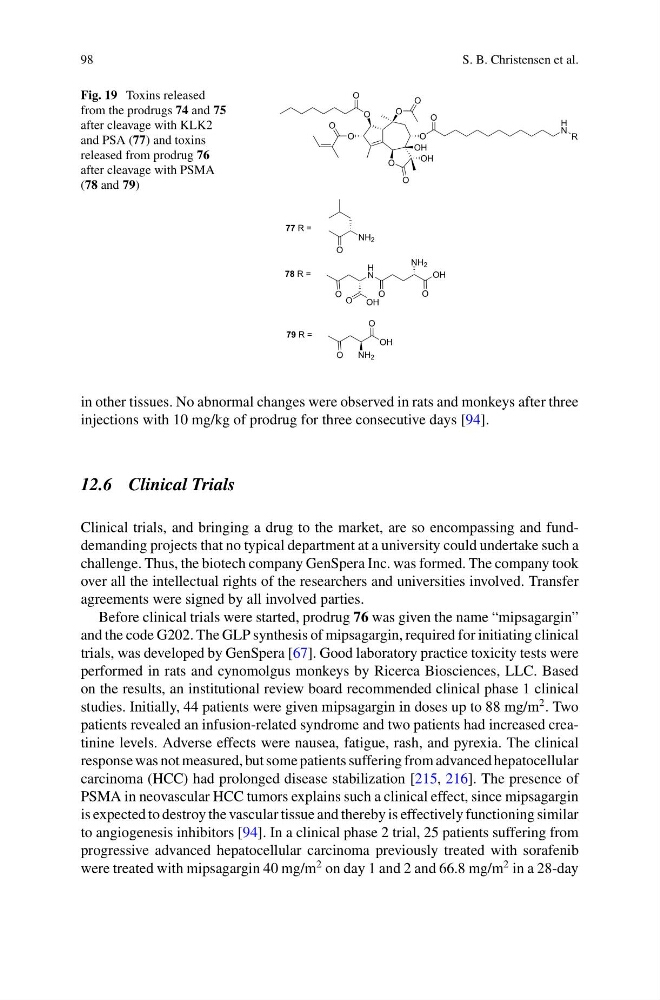
Fig. 19 Toxins released
from the prodrugs 74 and 75
after cleavage with KLK2
and PSA (77) and toxins
released from prodrug 76
after cleavage with PSMA
(78 and 79)
O
O
O
O
O
O
O
OH
OH
O
H
N
O
O
R
NH 2
O
OH
O
O
NH 2
77 R =
79 R =
H
N
O
78 R =
O
OH
O
OH
O
NH 2
in other tissues. No abnormal changes were observed in rats and monkeys after three
injections with 10 mg/kg of prodrug for three consecutive days [94].
12.6 Clinical Trials
Clinical trials, and bringing a drug to the market, are so encompassing and funddemanding projects that no typical department at a university could undertake such a
challenge. Thus, the biotech company GenSpera Inc. was formed. The company took
over all the intellectual rights of the researchers and universities involved. Transfer
agreements were signed by all involved parties.
Before clinical trials were started, prodrug 76 was given the name “mipsagargin”
and the code G202. The GLP synthesis of mipsagargin, required for initiating clinical
trials, was developed by GenSpera [67]. Good laboratory practice toxicity tests were
performed in rats and cynomolgus monkeys by Ricerca Biosciences, LLC. Based
on the results, an institutional review board recommended clinical phase 1 clinical
studies. Initially, 44 patients were given mipsagargin in doses up to 88 mg/m
2 . Two
patients revealed an infusion-related syndrome and two patients had increased creatinine levels. Adverse effects were nausea, fatigue, rash, and pyrexia. The clinical
response was not measured, but some patients suffering from advanced hepatocellular
carcinoma (HCC) had prolonged disease stabilization [215, 216]. The presence of
PSMA in neovascular HCC tumors explains such a clinical effect, since mipsagargin
is expected to destroy the vascular tissue and thereby is effectively functioning similar
to angiogenesis inhibitors [94]. In a clinical phase 2 trial, 25 patients suffering from
progressive advanced hepatocellular carcinoma previously treated with sorafenib
were treated with mipsagargin 40 mg/m
2 on day 1 and 2 and 66.8 mg/m
2 in a 28-day
S. B. Christensen et al.
Fig. 19 Toxins released
from the prodrugs 74 and 75
after cleavage with KLK2
and PSA (77) and toxins
released from prodrug 76
after cleavage with PSMA
(78 and 79)
O
O
O
O
O
O
O
OH
OH
O
H
N
O
O
R
NH 2
O
OH
O
O
NH 2
77 R =
79 R =
H
N
O
78 R =
O
OH
O
OH
O
NH 2
in other tissues. No abnormal changes were observed in rats and monkeys after three
injections with 10 mg/kg of prodrug for three consecutive days [94].
12.6 Clinical Trials
Clinical trials, and bringing a drug to the market, are so encompassing and funddemanding projects that no typical department at a university could undertake such a
challenge. Thus, the biotech company GenSpera Inc. was formed. The company took
over all the intellectual rights of the researchers and universities involved. Transfer
agreements were signed by all involved parties.
Before clinical trials were started, prodrug 76 was given the name “mipsagargin”
and the code G202. The GLP synthesis of mipsagargin, required for initiating clinical
trials, was developed by GenSpera [67]. Good laboratory practice toxicity tests were
performed in rats and cynomolgus monkeys by Ricerca Biosciences, LLC. Based
on the results, an institutional review board recommended clinical phase 1 clinical
studies. Initially, 44 patients were given mipsagargin in doses up to 88 mg/m
2 . Two
patients revealed an infusion-related syndrome and two patients had increased creatinine levels. Adverse effects were nausea, fatigue, rash, and pyrexia. The clinical
response was not measured, but some patients suffering from advanced hepatocellular
carcinoma (HCC) had prolonged disease stabilization [215, 216]. The presence of
PSMA in neovascular HCC tumors explains such a clinical effect, since mipsagargin
is expected to destroy the vascular tissue and thereby is effectively functioning similar
to angiogenesis inhibitors [94]. In a clinical phase 2 trial, 25 patients suffering from
progressive advanced hepatocellular carcinoma previously treated with sorafenib
were treated with mipsagargin 40 mg/m
2 on day 1 and 2 and 66.8 mg/m
2 in a 28-day