

From Plant to Patient: Thapsigargin, a Tool for Understanding …
99
cycle. Of 25 treated patients, 19 were evaluable for efficacy, 12 had the best response
for stable disease and 12 showed radiologic progression, and seven were censored.
A phase 2 clinical trial revealed that mipsagargin was relatively well tolerated and
increased the period of disease stabilization in patients with HCC that had advanced
during treatment with sorafenib [217].
Unfortunately, these results did not show sufficient efficacy for continued support
to enable GenSpera to perform a phase 3 clinical trial needed for the potential registration of mipsagargin. Later, the company changed its name to Inspyr Therapeutics,
Inc., but no further development of the drug has been performed.
No attempts have been made to treat patients with higher doses. Probably this
would cause general toxic effects in the body of the patient since, at high concentrations, mipsagargin in spite of the hydrophilic peptide moiety, appears to be able
to penetrate cell membranes and consequently block the SERCA pump not only in
cancer cells but also in benign tissue [94, 159].
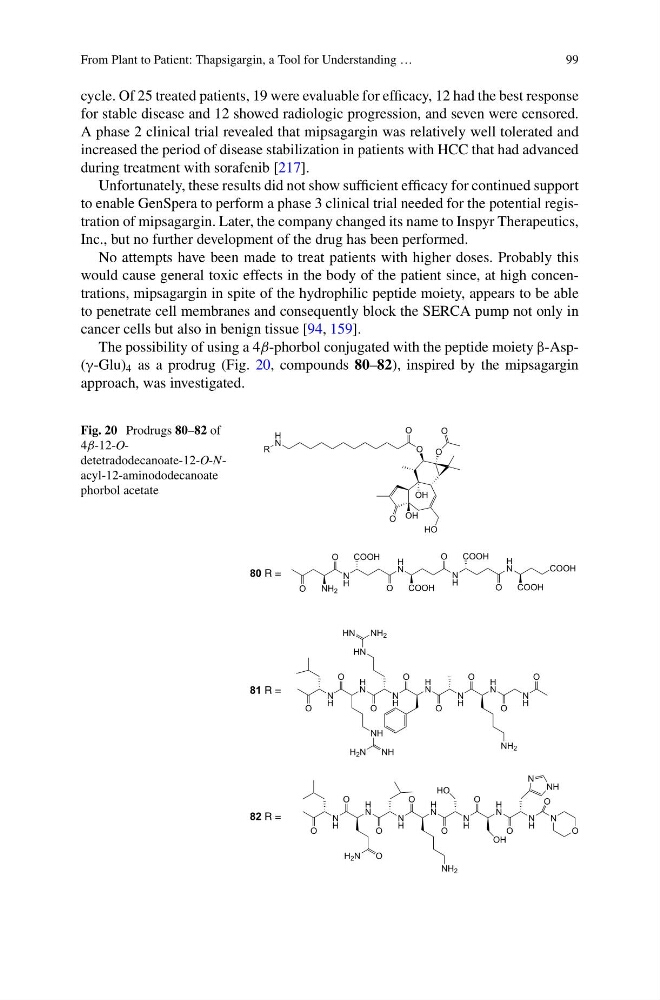
The possibility of using a 4β-phorbol conjugated with the peptide moiety β-Asp(γ-Glu) 4 as a prodrug (Fig. 20, compounds 80–82), inspired by the mipsagargin
approach, was investigated.
Fig. 20 Prodrugs 80–82 of
detetradodecanoate-12-O-Nacyl-12-aminododecanoate
phorbol acetate
O
O
OH
O OH
HO
H
N
O
R
N
H
H
N
N
H
H
N
O
O
NH 2
COOH
COOH
COOH
COOH
COOH
O
O
O
80 R =
O
O
N
H
H 2 N
NH
NH
O
H
N
NH 2
HN
HN
O
N
H
O
H
N
O
N
H
NH 2
H
N
O
N
H
O
81 R =
82 R =
O
N
H
O
O
H 2 N
H
N
O
N
H
O
H
N
O
NH 2
N
H
HO
O
H
N
OH
O
N
H
NH
N
N
O
O
O
99
cycle. Of 25 treated patients, 19 were evaluable for efficacy, 12 had the best response
for stable disease and 12 showed radiologic progression, and seven were censored.
A phase 2 clinical trial revealed that mipsagargin was relatively well tolerated and
increased the period of disease stabilization in patients with HCC that had advanced
during treatment with sorafenib [217].
Unfortunately, these results did not show sufficient efficacy for continued support
to enable GenSpera to perform a phase 3 clinical trial needed for the potential registration of mipsagargin. Later, the company changed its name to Inspyr Therapeutics,
Inc., but no further development of the drug has been performed.
No attempts have been made to treat patients with higher doses. Probably this
would cause general toxic effects in the body of the patient since, at high concentrations, mipsagargin in spite of the hydrophilic peptide moiety, appears to be able
to penetrate cell membranes and consequently block the SERCA pump not only in
cancer cells but also in benign tissue [94, 159].
The possibility of using a 4β-phorbol conjugated with the peptide moiety β-Asp(γ-Glu) 4 as a prodrug (Fig. 20, compounds 80–82), inspired by the mipsagargin
approach, was investigated.
Fig. 20 Prodrugs 80–82 of
detetradodecanoate-12-O-Nacyl-12-aminododecanoate
phorbol acetate
O
O
OH
O OH
HO
H
N
O
R
N
H
H
N
N
H
H
N
O
O
NH 2
COOH
COOH
COOH
COOH
COOH
O
O
O
80 R =
O
O
N
H
H 2 N
NH
NH
O
H
N
NH 2
HN
HN
O
N
H
O
H
N
O
N
H
NH 2
H
N
O
N
H
O
81 R =
82 R =
O
N
H
O
O
H 2 N
H
N
O
N
H
O
H
N
O
NH 2
N
H
HO
O
H
N
OH
O
N
H
NH
N
N
O
O
O