

From Plant to Patient: Thapsigargin, a Tool for Understanding …
97
O
O
O
O
O
O
O
OH
OH
O
H
N
O
O
73 R = H
R
N
H
H
N
N
H
H
N
N
H
H
N
O
H 2 N
O
O
O
NH 2
O
HO
O
HO
O
N
H
N
NH
N
O
O
O
Leu
Gln
Leu
Lys
Ser
His
N
H
H
N
N
H
H
N
N
H
H
N
O
O
HN
O
O
O
O
O
N
H
O
H 2 N
NH
HN
HN
NH 2
NH 2
Leu
Arg
Arg
Phe
Ala
Lys
Gly
N
H
H
N
N
H
H
N
O
O
COOH
COOH
COOH
COOH
COOH
O
O
O
βAsp
γGlu
γGlu
γGlu
γGlu
74 R =
75 R =
76 R =
NH 2
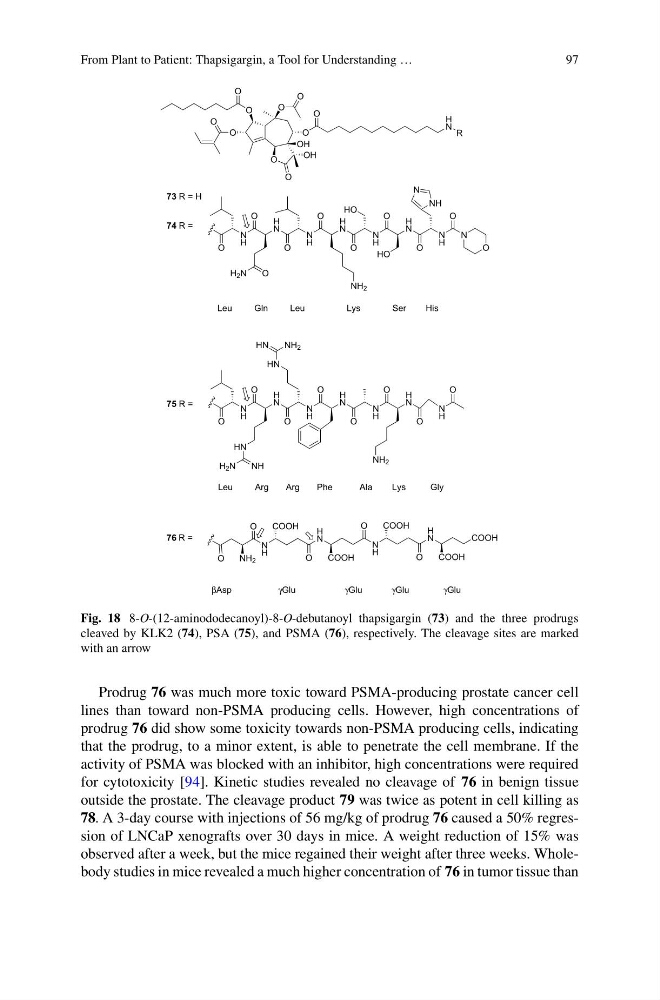
Fig. 18 8-O-(12-aminododecanoyl)-8-O-debutanoyl thapsigargin (73) and the three prodrugs
cleaved by KLK2 (74), PSA (75), and PSMA (76), respectively. The cleavage sites are marked
with an arrow
Prodrug 76 was much more toxic toward PSMA-producing prostate cancer cell
lines than toward non-PSMA producing cells. However, high concentrations of
prodrug 76 did show some toxicity towards non-PSMA producing cells, indicating
that the prodrug, to a minor extent, is able to penetrate the cell membrane. If the
activity of PSMA was blocked with an inhibitor, high concentrations were required
for cytotoxicity [94]. Kinetic studies revealed no cleavage of 76 in benign tissue
outside the prostate. The cleavage product 79 was twice as potent in cell killing as
78. A 3-day course with injections of 56 mg/kg of prodrug 76 caused a 50% regression of LNCaP xenografts over 30 days in mice. A weight reduction of 15% was
observed after a week, but the mice regained their weight after three weeks. Wholebody studies in mice revealed a much higher concentration of 76 in tumor tissue than
97
O
O
O
O
O
O
O
OH
OH
O
H
N
O
O
73 R = H
R
N
H
H
N
N
H
H
N
N
H
H
N
O
H 2 N
O
O
O
NH 2
O
HO
O
HO
O
N
H
N
NH
N
O
O
O
Leu
Gln
Leu
Lys
Ser
His
N
H
H
N
N
H
H
N
N
H
H
N
O
O
HN
O
O
O
O
O
N
H
O
H 2 N
NH
HN
HN
NH 2
NH 2
Leu
Arg
Arg
Phe
Ala
Lys
Gly
N
H
H
N
N
H
H
N
O
O
COOH
COOH
COOH
COOH
COOH
O
O
O
βAsp
γGlu
γGlu
γGlu
γGlu
74 R =
75 R =
76 R =
NH 2
Fig. 18 8-O-(12-aminododecanoyl)-8-O-debutanoyl thapsigargin (73) and the three prodrugs
cleaved by KLK2 (74), PSA (75), and PSMA (76), respectively. The cleavage sites are marked
with an arrow
Prodrug 76 was much more toxic toward PSMA-producing prostate cancer cell
lines than toward non-PSMA producing cells. However, high concentrations of
prodrug 76 did show some toxicity towards non-PSMA producing cells, indicating
that the prodrug, to a minor extent, is able to penetrate the cell membrane. If the
activity of PSMA was blocked with an inhibitor, high concentrations were required
for cytotoxicity [94]. Kinetic studies revealed no cleavage of 76 in benign tissue
outside the prostate. The cleavage product 79 was twice as potent in cell killing as
78. A 3-day course with injections of 56 mg/kg of prodrug 76 caused a 50% regression of LNCaP xenografts over 30 days in mice. A weight reduction of 15% was
observed after a week, but the mice regained their weight after three weeks. Wholebody studies in mice revealed a much higher concentration of 76 in tumor tissue than