

32 3 Surfaces in Nanomaterials
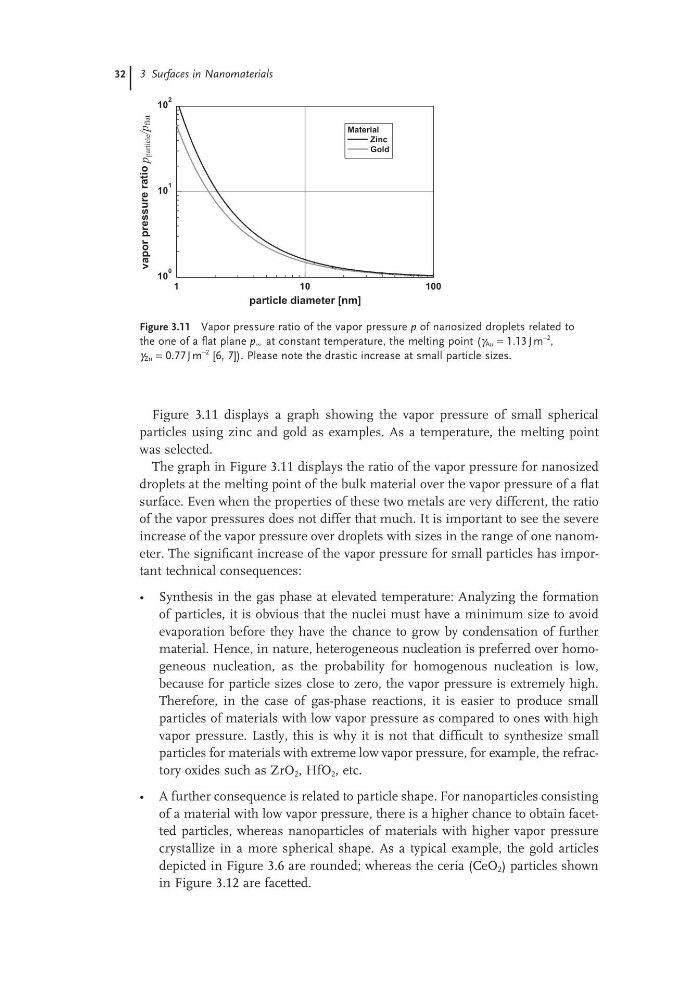
Figure 3.11 Vapor pressure ratio of the vapor pressure p of nanosized droplets related to
the one of a flat plane p ∞ at constant temperature, the melting point (γ Au = 1.13 J m
−2 ,
γ Zn = 0.77 J m
−2 [6, 7]). Please note the drastic increase at small particle sizes.
1
10
100
particle diameter [nm]
10
0
10
1
10
2
vapor
pressure
ratio
p particle
/p flat
Material
Zinc
Gold
Figure 3.11 displays a graph showing the vapor pressure of small spherical
particles using zinc and gold as examples. As a temperature, the melting point
was selected.
The graph in Figure 3.11 displays the ratio of the vapor pressure for nanosized
droplets at the melting point of the bulk material over the vapor pressure of a flat
surface. Even when the properties of these two metals are very different, the ratio
of the vapor pressures does not differ that much. It is important to see the severe
increase of the vapor pressure over droplets with sizes in the range of one nanometer. The significant increase of the vapor pressure for small particles has important technical consequences:
• Synthesis in the gas phase at elevated temperature: Analyzing the formation
of particles, it is obvious that the nuclei must have a minimum size to avoid
evaporation before they have the chance to grow by condensation of further
material. Hence, in nature, heterogeneous nucleation is preferred over homogeneous nucleation, as the probability for homogenous nucleation is low,
because for particle sizes close to zero, the vapor pressure is extremely high.
Therefore, in the case of gas-phase reactions, it is easier to produce small
particles of materials with low vapor pressure as compared to ones with high
vapor pressure. Lastly, this is why it is not that difficult to synthesize small
particles for materials with extreme low vapor pressure, for example, the refractory oxides such as ZrO 2 , HfO 2 , etc.
• A further consequence is related to particle shape. For nanoparticles consisting
of a material with low vapor pressure, there is a higher chance to obtain facetted particles, whereas nanoparticles of materials with higher vapor pressure
crystallize in a more spherical shape. As a typical example, the gold articles
depicted in Figure 3.6 are rounded; whereas the ceria (CeO 2 ) particles shown
in Figure 3.12 are facetted.
Figure 3.11 Vapor pressure ratio of the vapor pressure p of nanosized droplets related to
the one of a flat plane p ∞ at constant temperature, the melting point (γ Au = 1.13 J m
−2 ,
γ Zn = 0.77 J m
−2 [6, 7]). Please note the drastic increase at small particle sizes.
1
10
100
particle diameter [nm]
10
0
10
1
10
2
vapor
pressure
ratio
p particle
/p flat
Material
Zinc
Gold
Figure 3.11 displays a graph showing the vapor pressure of small spherical
particles using zinc and gold as examples. As a temperature, the melting point
was selected.
The graph in Figure 3.11 displays the ratio of the vapor pressure for nanosized
droplets at the melting point of the bulk material over the vapor pressure of a flat
surface. Even when the properties of these two metals are very different, the ratio
of the vapor pressures does not differ that much. It is important to see the severe
increase of the vapor pressure over droplets with sizes in the range of one nanometer. The significant increase of the vapor pressure for small particles has important technical consequences:
• Synthesis in the gas phase at elevated temperature: Analyzing the formation
of particles, it is obvious that the nuclei must have a minimum size to avoid
evaporation before they have the chance to grow by condensation of further
material. Hence, in nature, heterogeneous nucleation is preferred over homogeneous nucleation, as the probability for homogenous nucleation is low,
because for particle sizes close to zero, the vapor pressure is extremely high.
Therefore, in the case of gas-phase reactions, it is easier to produce small
particles of materials with low vapor pressure as compared to ones with high
vapor pressure. Lastly, this is why it is not that difficult to synthesize small
particles for materials with extreme low vapor pressure, for example, the refractory oxides such as ZrO 2 , HfO 2 , etc.
• A further consequence is related to particle shape. For nanoparticles consisting
of a material with low vapor pressure, there is a higher chance to obtain facetted particles, whereas nanoparticles of materials with higher vapor pressure
crystallize in a more spherical shape. As a typical example, the gold articles
depicted in Figure 3.6 are rounded; whereas the ceria (CeO 2 ) particles shown
in Figure 3.12 are facetted.