

3.3 Vapor Pressure of Small Particles 33
Certainly, the formation of particle shapes is not monocausal. There are more
phenomena influencing the shape of particles. It is well known that different
crystallographic planes have different surface energies, for example, in cubic
systems, the planes forming a cube have the lowest surface energy. Additionally,
in the case of oxides, the termination changes the surface energy of different
crystallographic planes differently. Both phenomena may give a tendency for the
formation of facetted particles. However, experimentally, small particles, especially metallic ones, are usually spherical or close to a sphere. This finding is
compatible with the relationships for the vapor pressure, which increases with
the curvature. In most cases, sharp edges or tips are energetically not favorable;
they are removed by evaporation and condensation processes. These processes
will not be dominant in material with an extremely low vapor pressure; therefore
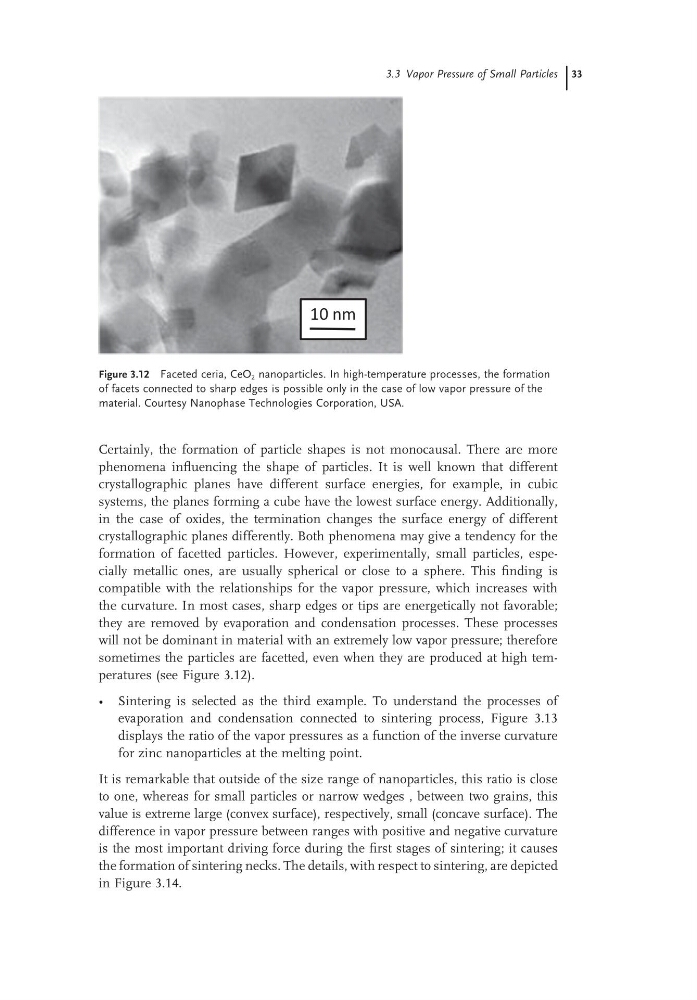
sometimes the particles are facetted, even when they are produced at high temperatures (see Figure 3.12).
• Sintering is selected as the third example. To understand the processes of
evaporation and condensation connected to sintering process, Figure 3.13
displays the ratio of the vapor pressures as a function of the inverse curvature
for zinc nanoparticles at the melting point.
It is remarkable that outside of the size range of nanoparticles, this ratio is close
to one, whereas for small particles or narrow wedges , between two grains, this
value is extreme large (convex surface), respectively, small (concave surface). The
difference in vapor pressure between ranges with positive and negative curvature
is the most important driving force during the first stages of sintering; it causes
the formation of sintering necks. The details, with respect to sintering, are depicted
in Figure 3.14.
Figure 3.12 Faceted ceria, CeO 2 nanoparticles. In high-temperature processes, the formation
of facets connected to sharp edges is possible only in the case of low vapor pressure of the
material. Courtesy Nanophase Technologies Corporation, USA.
10 nm
10 nm
Certainly, the formation of particle shapes is not monocausal. There are more
phenomena influencing the shape of particles. It is well known that different
crystallographic planes have different surface energies, for example, in cubic
systems, the planes forming a cube have the lowest surface energy. Additionally,
in the case of oxides, the termination changes the surface energy of different
crystallographic planes differently. Both phenomena may give a tendency for the
formation of facetted particles. However, experimentally, small particles, especially metallic ones, are usually spherical or close to a sphere. This finding is
compatible with the relationships for the vapor pressure, which increases with
the curvature. In most cases, sharp edges or tips are energetically not favorable;
they are removed by evaporation and condensation processes. These processes
will not be dominant in material with an extremely low vapor pressure; therefore
sometimes the particles are facetted, even when they are produced at high temperatures (see Figure 3.12).
• Sintering is selected as the third example. To understand the processes of
evaporation and condensation connected to sintering process, Figure 3.13
displays the ratio of the vapor pressures as a function of the inverse curvature
for zinc nanoparticles at the melting point.
It is remarkable that outside of the size range of nanoparticles, this ratio is close
to one, whereas for small particles or narrow wedges , between two grains, this
value is extreme large (convex surface), respectively, small (concave surface). The
difference in vapor pressure between ranges with positive and negative curvature
is the most important driving force during the first stages of sintering; it causes
the formation of sintering necks. The details, with respect to sintering, are depicted
in Figure 3.14.
Figure 3.12 Faceted ceria, CeO 2 nanoparticles. In high-temperature processes, the formation
of facets connected to sharp edges is possible only in the case of low vapor pressure of the
material. Courtesy Nanophase Technologies Corporation, USA.
10 nm
10 nm