

286 12 Characterization of Nanomaterials
not show any diffraction line, just a very small broad peak around 25 to 30
degrees. This diffraction pattern suggests that the specimen is amorphous. This
is different in Figure 12.5c, where the electron diffraction pattern is depicted.
Even when the diffraction lines are weak, the material is unequivocally identified
as anatase.
A further problem connected to line broadening due to small particle size is the
insufficient separation of directly adjacent lines, how they appear, for example, in
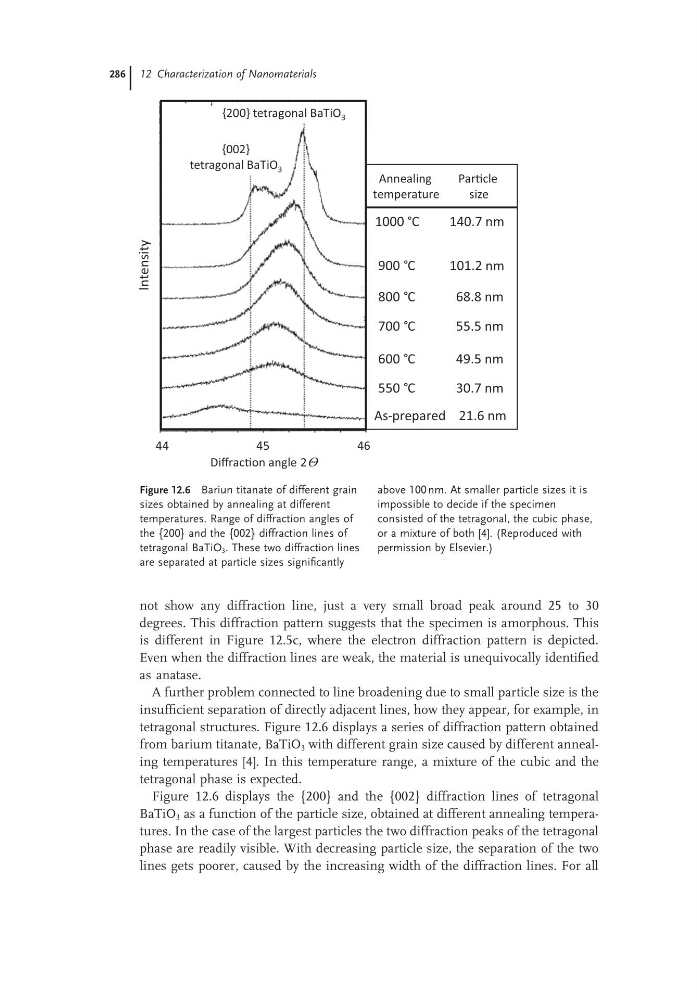
tetragonal structures. Figure 12.6 displays a series of diffraction pattern obtained
from barium titanate, BaTiO 3 with different grain size caused by different annealing temperatures [4]. In this temperature range, a mixture of the cubic and the
tetragonal phase is expected.
Figure 12.6 displays the {200} and the {002} diffraction lines of tetragonal
BaTiO 3 as a function of the particle size, obtained at different annealing temperatures. In the case of the largest particles the two diffraction peaks of the tetragonal
phase are readily visible. With decreasing particle size, the separation of the two
lines gets poorer, caused by the increasing width of the diffraction lines. For all
Figure 12.6 Bariun titanate of different grain
sizes obtained by annealing at different
temperatures. Range of diffraction angles of
the {200} and the {002} diffraction lines of
tetragonal BaTiO 3 . These two diffraction lines
are separated at particle sizes significantly
above 100 nm. At smaller particle sizes it is
impossible to decide if the specimen
consisted of the tetragonal, the cubic phase,
or a mixture of both [4]. (Reproduced with
permission by Elsevier.)
Intensity
44
45
46
DiffracƟon angle 2Θ
{200} tetragonal BaTiO 3
{002}
tetragonal BaTiO 3
nm
nm
nm
nm
nm
C
140.7
C
101.2
C
68.8
C
55.5
C
49.5
1000 °
900 °
800 °
700 °
600 °
550 °C
30.7 nm
As- prepared 21.6 nm
Annealing
ParƟcle
temperature
size
not show any diffraction line, just a very small broad peak around 25 to 30
degrees. This diffraction pattern suggests that the specimen is amorphous. This
is different in Figure 12.5c, where the electron diffraction pattern is depicted.
Even when the diffraction lines are weak, the material is unequivocally identified
as anatase.
A further problem connected to line broadening due to small particle size is the
insufficient separation of directly adjacent lines, how they appear, for example, in
tetragonal structures. Figure 12.6 displays a series of diffraction pattern obtained
from barium titanate, BaTiO 3 with different grain size caused by different annealing temperatures [4]. In this temperature range, a mixture of the cubic and the
tetragonal phase is expected.
Figure 12.6 displays the {200} and the {002} diffraction lines of tetragonal
BaTiO 3 as a function of the particle size, obtained at different annealing temperatures. In the case of the largest particles the two diffraction peaks of the tetragonal
phase are readily visible. With decreasing particle size, the separation of the two
lines gets poorer, caused by the increasing width of the diffraction lines. For all
Figure 12.6 Bariun titanate of different grain
sizes obtained by annealing at different
temperatures. Range of diffraction angles of
the {200} and the {002} diffraction lines of
tetragonal BaTiO 3 . These two diffraction lines
are separated at particle sizes significantly
above 100 nm. At smaller particle sizes it is
impossible to decide if the specimen
consisted of the tetragonal, the cubic phase,
or a mixture of both [4]. (Reproduced with
permission by Elsevier.)
Intensity
44
45
46
DiffracƟon angle 2Θ
{200} tetragonal BaTiO 3
{002}
tetragonal BaTiO 3
nm
nm
nm
nm
nm
C
140.7
C
101.2
C
68.8
C
55.5
C
49.5
1000 °
900 °
800 °
700 °
600 °
550 °C
30.7 nm
As- prepared 21.6 nm
Annealing
ParƟcle
temperature
size