

12.1 Specific Surface Area 281
method, called the BET method, (According to the first letters of the inventors
(Brunauer, Emmett, and Teller) is now the standard method to measure specific
surfaces, which are called BET surfaces. The specific surface is calculated using
the BET function
BET function
ads
ads
mono
=
−
=
−
=
p
p
V
p
p
V
p
p
p
p cV
0
0
0
0
1
1
1
1 + +
1
V mono
.
(12.3)
In Eq. (12.3) the quantity p stands for the gas pressure during the measurement
and p 0 for the saturation pressure of the adsorbate at the measuring temperature,
V ads stands for the volume of the adsorbed gas determined experimentally; V mono
stands for the volume of one monolayer at the specimen and c, the BET constant,
is a material-dependent constant value, depending on the ratio between the
enthalpy of adsorption and the enthalpy of vaporization of the adsorbate. (For
details of the lengthy derivation of this formula, please consult a textbook on physical chemistry.) To evaluate BET experiments, one plots the BET function versus
p
p 0
. This plot gives a straight line. Figure 12.3 demonstrates this.
The intercept of the straight line defined by Eq. (12.3) with the abscissa
p
p 0
0
= ,
gives
1
V mono
, the amount of gas adsorbed at the surface, the slope
1
cV mono
may be
used to calculate the missing BET constant c.
The BET experiment delivers the amount of gas adsorbed at the surface. The
surface area of the material is calculated from the number of gas molecules in a
monolayer at the surface
N
V
V
N
S
S
M
A
=
,
(12.4)
where V S is the gas volume adsorbed at the surface and V M the volume of one
mol of gas, both under standard temperature and pressure conditions, and N A
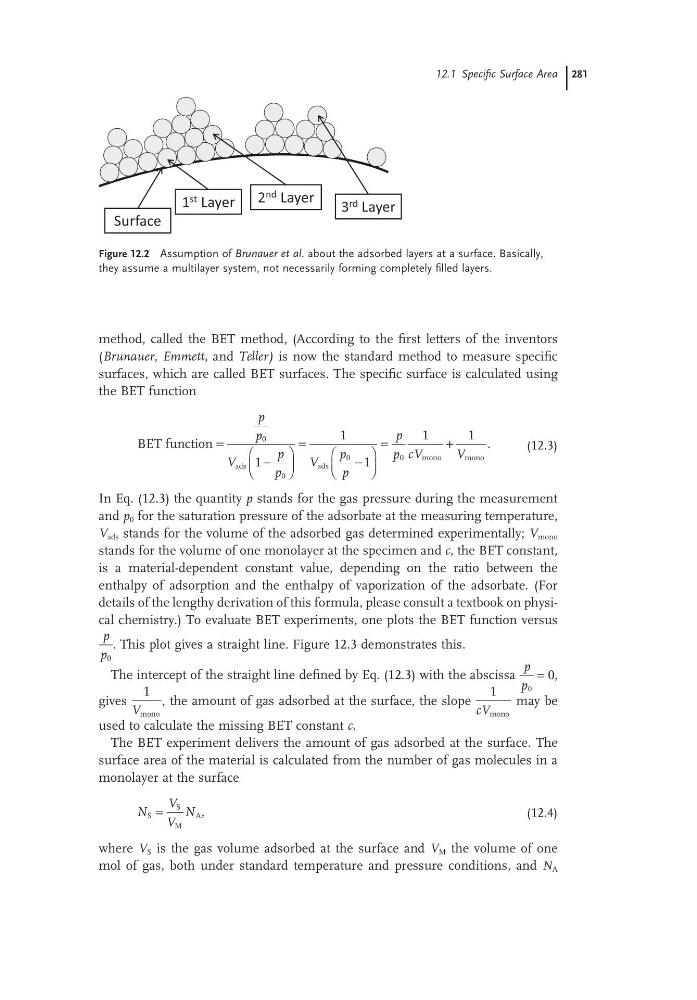
Figure 12.2 Assumption of Brunauer et al. about the adsorbed layers at a surface. Basically,
they assume a multilayer system, not necessarily forming completely filled layers.
Surface
1 st Layer 2 nd Layer
3 rd Layer
method, called the BET method, (According to the first letters of the inventors
(Brunauer, Emmett, and Teller) is now the standard method to measure specific
surfaces, which are called BET surfaces. The specific surface is calculated using
the BET function
BET function
ads
ads
mono
=
−
=
−
=
p
p
V
p
p
V
p
p
p
p cV
0
0
0
0
1
1
1
1 + +
1
V mono
.
(12.3)
In Eq. (12.3) the quantity p stands for the gas pressure during the measurement
and p 0 for the saturation pressure of the adsorbate at the measuring temperature,
V ads stands for the volume of the adsorbed gas determined experimentally; V mono
stands for the volume of one monolayer at the specimen and c, the BET constant,
is a material-dependent constant value, depending on the ratio between the
enthalpy of adsorption and the enthalpy of vaporization of the adsorbate. (For
details of the lengthy derivation of this formula, please consult a textbook on physical chemistry.) To evaluate BET experiments, one plots the BET function versus
p
p 0
. This plot gives a straight line. Figure 12.3 demonstrates this.
The intercept of the straight line defined by Eq. (12.3) with the abscissa
p
p 0
0
= ,
gives
1
V mono
, the amount of gas adsorbed at the surface, the slope
1
cV mono
may be
used to calculate the missing BET constant c.
The BET experiment delivers the amount of gas adsorbed at the surface. The
surface area of the material is calculated from the number of gas molecules in a
monolayer at the surface
N
V
V
N
S
S
M
A
=
,
(12.4)
where V S is the gas volume adsorbed at the surface and V M the volume of one
mol of gas, both under standard temperature and pressure conditions, and N A
Figure 12.2 Assumption of Brunauer et al. about the adsorbed layers at a surface. Basically,
they assume a multilayer system, not necessarily forming completely filled layers.
Surface
1 st Layer 2 nd Layer
3 rd Layer