

280 12 Characterization of Nanomaterials
sees that there are a few more parameters influencing this characteristic quantity.
First, one must take care of the degree of agglomeration. Each area, where two or
more particles are in contact with each other, does not contribute to the specific
surface; this leads to a reduction of the specific surface. The assumption of spherical particles is, certainly, much too simplified. Particles that are not compact solids,
but rather cloudy arrangements of molecules, as is quite often found in silica,
alumina, or carbon black, show, even when these particles touch each other, specific surfaces of 1000 m
2 g
−1 and more.
The specific surface is measured by adsorption of a nonreactive gas, for example,
nitrogen. Assuming a complete coverage of the surface with a monolayer of N gas
molecules, each one covering an area a M , the surface A of a specimen is given by:
A Na
= M .
(12.2)
Equation (12.2) assumes that between the particle surface and the gas molecules
there are attractive, van-der-Waals, forces overcoming disordering effects of thermal
motion. This process is called physisorption; when chemical interaction between
surface and adsorbate is observed, the process is called chemisorption. In a somewhat arbitrary way, the limit between physisorption and chemisorption is defined,
at an enthalpy of interaction of approximately 50 kJ mol
−1 . The assumption of a
perfect monolayer leads to the Langmuir adsorption isotherm, assuming that there
is a fixed number of possible sites for gas adsorption at the surface, and further
layers of gas molecules are not allowed until all possible site for the previous layers
are occupied. This assumption is not realistic; Brunauer et al. [1] expanded Langmuir’s model allowing incompletely filled layers. Figure 12.2 displays the surface
coverage according to Brunnauer et al.
Brunnauer et al. assumed, similar to Langmuir, there is no interaction between
the layers of adsorbed molecules; therefore, Langmuir’s theory is applicable to each
layer. These assumptions made this theory successful und widely applicable.
Based on this theory, a procedure to measure specific surfaces was developed. This
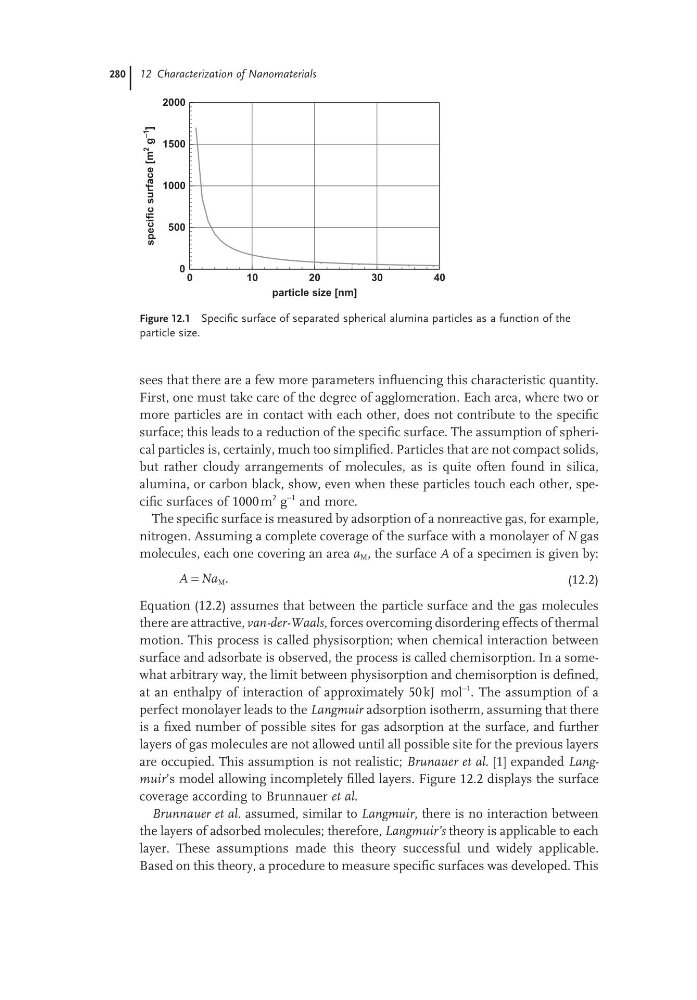
Figure 12.1 Specific surface of separated spherical alumina particles as a function of the
particle size.
0
10
20
30
40
particle size [nm]
0
500
1000
1500
2000
specific
surface
[m
2
g
–1
]
sees that there are a few more parameters influencing this characteristic quantity.
First, one must take care of the degree of agglomeration. Each area, where two or
more particles are in contact with each other, does not contribute to the specific
surface; this leads to a reduction of the specific surface. The assumption of spherical particles is, certainly, much too simplified. Particles that are not compact solids,
but rather cloudy arrangements of molecules, as is quite often found in silica,
alumina, or carbon black, show, even when these particles touch each other, specific surfaces of 1000 m
2 g
−1 and more.
The specific surface is measured by adsorption of a nonreactive gas, for example,
nitrogen. Assuming a complete coverage of the surface with a monolayer of N gas
molecules, each one covering an area a M , the surface A of a specimen is given by:
A Na
= M .
(12.2)
Equation (12.2) assumes that between the particle surface and the gas molecules
there are attractive, van-der-Waals, forces overcoming disordering effects of thermal
motion. This process is called physisorption; when chemical interaction between
surface and adsorbate is observed, the process is called chemisorption. In a somewhat arbitrary way, the limit between physisorption and chemisorption is defined,
at an enthalpy of interaction of approximately 50 kJ mol
−1 . The assumption of a
perfect monolayer leads to the Langmuir adsorption isotherm, assuming that there
is a fixed number of possible sites for gas adsorption at the surface, and further
layers of gas molecules are not allowed until all possible site for the previous layers
are occupied. This assumption is not realistic; Brunauer et al. [1] expanded Langmuir’s model allowing incompletely filled layers. Figure 12.2 displays the surface
coverage according to Brunnauer et al.
Brunnauer et al. assumed, similar to Langmuir, there is no interaction between
the layers of adsorbed molecules; therefore, Langmuir’s theory is applicable to each
layer. These assumptions made this theory successful und widely applicable.
Based on this theory, a procedure to measure specific surfaces was developed. This
Figure 12.1 Specific surface of separated spherical alumina particles as a function of the
particle size.
0
10
20
30
40
particle size [nm]
0
500
1000
1500
2000
specific
surface
[m
2
g
–1
]