

11.5 Filled Polymer Composites 277
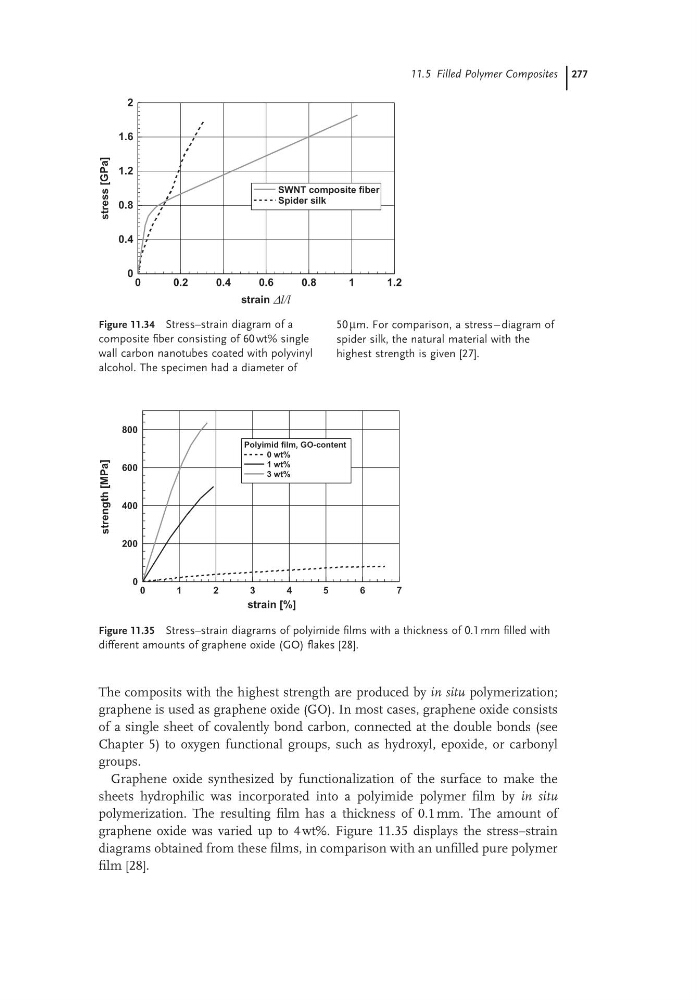
The composits with the highest strength are produced by in situ polymerization;
graphene is used as graphene oxide (GO). In most cases, graphene oxide consists
of a single sheet of covalently bond carbon, connected at the double bonds (see
Chapter 5) to oxygen functional groups, such as hydroxyl, epoxide, or carbonyl
groups.
Graphene oxide synthesized by functionalization of the surface to make the
sheets hydrophilic was incorporated into a polyimide polymer film by in situ
polymerization. The resulting film has a thickness of 0.1 mm. The amount of
graphene oxide was varied up to 4 wt%. Figure 11.35 displays the stress–strain
diagrams obtained from these films, in comparison with an unfilled pure polymer
film [28].
Figure 11.34 Stress–strain diagram of a
composite fiber consisting of 60 wt% single
wall carbon nanotubes coated with polyvinyl
alcohol. The specimen had a diameter of
50 μm. For comparison, a stress – diagram of
spider silk, the natural material with the
highest strength is given [27].
0
0.2
0.4
0.6
0.8
1
1.2
strain ∆l/l
0
0.4
0.8
1.2
1.6
2
stress
[GPa]
SWNT composite fiber
Spider silk
Figure 11.35 Stress–strain diagrams of polyimide films with a thickness of 0.1 mm filled with
different amounts of graphene oxide (GO) flakes [28].
0
1
2
3
4
5
6
7
strain [%]
0
200
400
600
800
strength
[MPa]
Polyimid film, GO-content
0 wt%
1 wt%
3 wt%
The composits with the highest strength are produced by in situ polymerization;
graphene is used as graphene oxide (GO). In most cases, graphene oxide consists
of a single sheet of covalently bond carbon, connected at the double bonds (see
Chapter 5) to oxygen functional groups, such as hydroxyl, epoxide, or carbonyl
groups.
Graphene oxide synthesized by functionalization of the surface to make the
sheets hydrophilic was incorporated into a polyimide polymer film by in situ
polymerization. The resulting film has a thickness of 0.1 mm. The amount of
graphene oxide was varied up to 4 wt%. Figure 11.35 displays the stress–strain
diagrams obtained from these films, in comparison with an unfilled pure polymer
film [28].
Figure 11.34 Stress–strain diagram of a
composite fiber consisting of 60 wt% single
wall carbon nanotubes coated with polyvinyl
alcohol. The specimen had a diameter of
50 μm. For comparison, a stress – diagram of
spider silk, the natural material with the
highest strength is given [27].
0
0.2
0.4
0.6
0.8
1
1.2
strain ∆l/l
0
0.4
0.8
1.2
1.6
2
stress
[GPa]
SWNT composite fiber
Spider silk
Figure 11.35 Stress–strain diagrams of polyimide films with a thickness of 0.1 mm filled with
different amounts of graphene oxide (GO) flakes [28].
0
1
2
3
4
5
6
7
strain [%]
0
200
400
600
800
strength
[MPa]
Polyimid film, GO-content
0 wt%
1 wt%
3 wt%