

11.5 Filled Polymer Composites 275
the stress–strain diagrams of a series of specimen with different contents of singlewall carbon-nanotube-containing composites. These specimen were fibers with a
diameter of 1.6 mm. Polypropylene was selected as matrix material.
Figure 11.31 shows a series of important facts: Even additions of only 1 wt%
(which is equivalent to ca. 0.75 vol%) carbon nanotubes lead to a doubling of the
strength, without losing the ability for plastic deformation. With the production
method applied by these authors, a maximum strength is obtained with 4 wt%
carbon nanotubes. Larger additions are without advantage. Additions of 4 wt%
carbon nanotubes increase the strength by a factor of 3.4; a remarkable success.
The Young’s modulus also increases with increasing content of carbon nanotubes.
This is understandable, as the Young’s modulus of carbon nanotubes is a few
orders of magnitude higher than that of polypropylene.
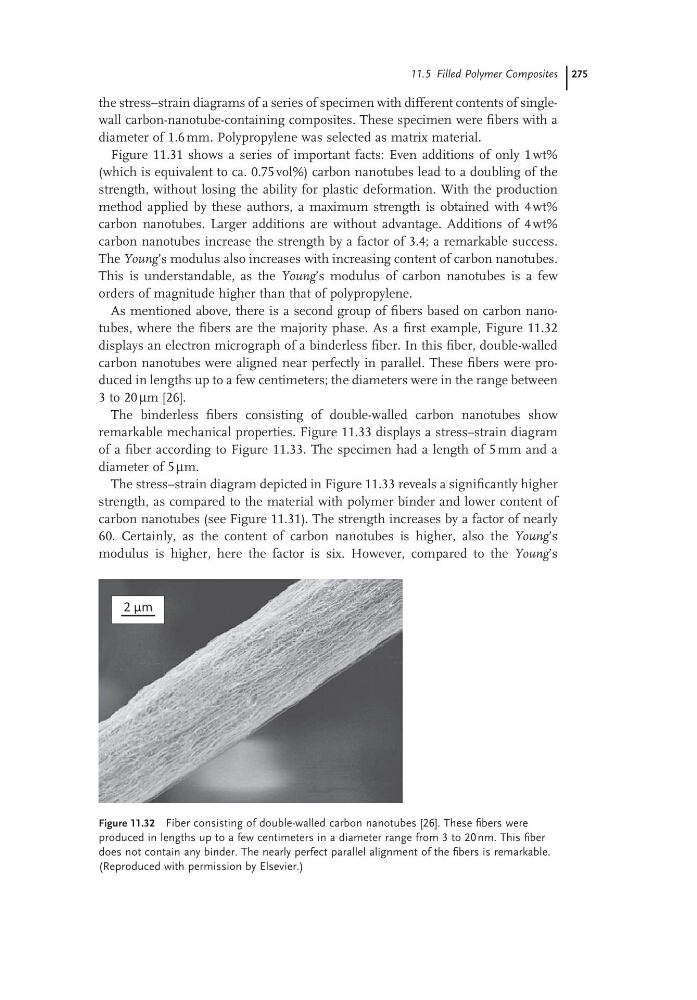
As mentioned above, there is a second group of fibers based on carbon nanotubes, where the fibers are the majority phase. As a first example, Figure 11.32
displays an electron micrograph of a binderless fiber. In this fiber, double-walled
carbon nanotubes were aligned near perfectly in parallel. These fibers were produced in lengths up to a few centimeters; the diameters were in the range between
3 to 20 μm [26].
The binderless fibers consisting of double-walled carbon nanotubes show
remarkable mechanical properties. Figure 11.33 displays a stress–strain diagram
of a fiber according to Figure 11.33. The specimen had a length of 5 mm and a
diameter of 5 μm.
The stress–strain diagram depicted in Figure 11.33 reveals a significantly higher
strength, as compared to the material with polymer binder and lower content of
carbon nanotubes (see Figure 11.31). The strength increases by a factor of nearly
60. Certainly, as the content of carbon nanotubes is higher, also the Young’s
modulus is higher, here the factor is six. However, compared to the Young’s
Figure 11.32 Fiber consisting of double-walled carbon nanotubes [26]. These fibers were
produced in lengths up to a few centimeters in a diameter range from 3 to 20 nm. This fiber
does not contain any binder. The nearly perfect parallel alignment of the fibers is remarkable.
(Reproduced with permission by Elsevier.)
2 µm
the stress–strain diagrams of a series of specimen with different contents of singlewall carbon-nanotube-containing composites. These specimen were fibers with a
diameter of 1.6 mm. Polypropylene was selected as matrix material.
Figure 11.31 shows a series of important facts: Even additions of only 1 wt%
(which is equivalent to ca. 0.75 vol%) carbon nanotubes lead to a doubling of the
strength, without losing the ability for plastic deformation. With the production
method applied by these authors, a maximum strength is obtained with 4 wt%
carbon nanotubes. Larger additions are without advantage. Additions of 4 wt%
carbon nanotubes increase the strength by a factor of 3.4; a remarkable success.
The Young’s modulus also increases with increasing content of carbon nanotubes.
This is understandable, as the Young’s modulus of carbon nanotubes is a few
orders of magnitude higher than that of polypropylene.
As mentioned above, there is a second group of fibers based on carbon nanotubes, where the fibers are the majority phase. As a first example, Figure 11.32
displays an electron micrograph of a binderless fiber. In this fiber, double-walled
carbon nanotubes were aligned near perfectly in parallel. These fibers were produced in lengths up to a few centimeters; the diameters were in the range between
3 to 20 μm [26].
The binderless fibers consisting of double-walled carbon nanotubes show
remarkable mechanical properties. Figure 11.33 displays a stress–strain diagram
of a fiber according to Figure 11.33. The specimen had a length of 5 mm and a
diameter of 5 μm.
The stress–strain diagram depicted in Figure 11.33 reveals a significantly higher
strength, as compared to the material with polymer binder and lower content of
carbon nanotubes (see Figure 11.31). The strength increases by a factor of nearly
60. Certainly, as the content of carbon nanotubes is higher, also the Young’s
modulus is higher, here the factor is six. However, compared to the Young’s
Figure 11.32 Fiber consisting of double-walled carbon nanotubes [26]. These fibers were
produced in lengths up to a few centimeters in a diameter range from 3 to 20 nm. This fiber
does not contain any binder. The nearly perfect parallel alignment of the fibers is remarkable.
(Reproduced with permission by Elsevier.)
2 µm