

274 11 Mechanical Properties
composite with nylon-6 as matrix material. Lastly, it is reduced to the same value
as was found with the nylon-6 based composite. Even when the strength of the
polypropylene matrix composites is significantly lower, the reduction of the
inflammability expands the variety of materials for technical applications.
11.5.4
Carbon-Nanotube- and Graphene-Filled Composites
Nanocomposites with carbon nanotubes or graphene as filler are very promising,
as both materials are extremely stiff; the Young’s modulus is around 1 TPa. Additionally, carbon nanotubes exhibit a maximum tensile strength close to 30 GPa
[24] and graphene 130 GPa [25]. However, these values are in dispute, other authors
report Young’s moduli for carbon nanotubes in the range from 0.64 to 1.8 TPa. In
any case, whatever the correct values are, carbon nanotubes and graphene are
stiffer and exhibit higher strength than any other material available in large quantities for reasonable prices. Additionally, it is not too difficult to distribute carbon
nanotubes or graphene in a polymer matrix. This makes these composites a highly
promising class of materials. Interestingly, to some extent predetermined, the
shape of the specimen is oriented on the habit of the filling material; this means,
carbon nanotubes are primarily tested as fibers, whereas graphene-filled specimens are, in general, films. In the case of carbon nanotubes, the technical application goes in two different directions: Composites with relatively small additions
of nanotubes and materials where the binding polymer is the minor phase and
the fibers are the majority phase.
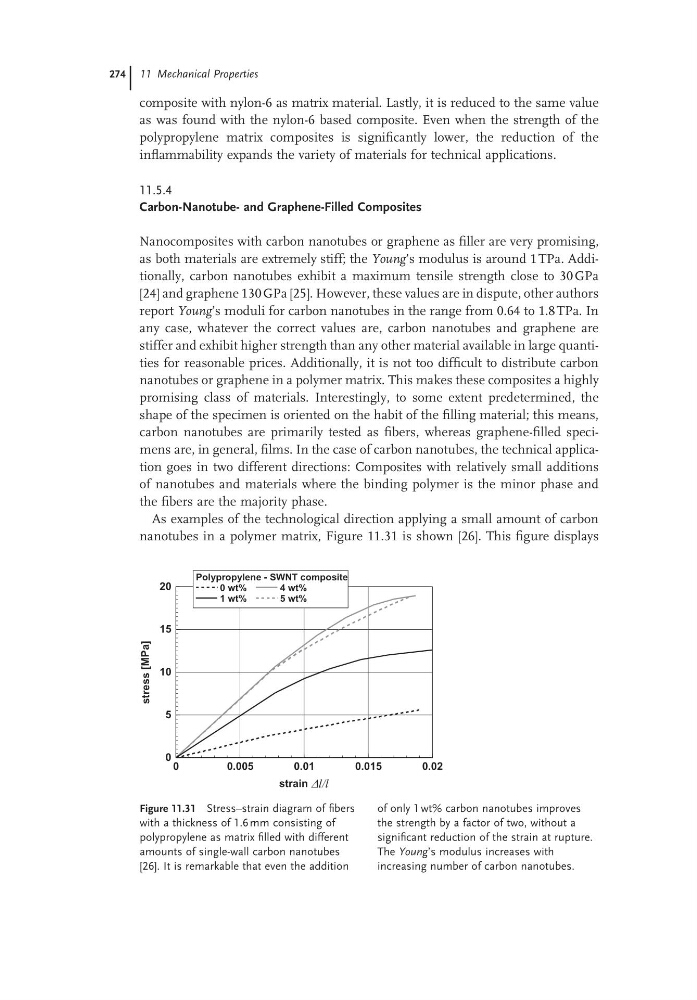
As examples of the technological direction applying a small amount of carbon
nanotubes in a polymer matrix, Figure 11.31 is shown [26]. This figure displays
Figure 11.31 Stress–strain diagram of fibers
with a thickness of 1.6 mm consisting of
polypropylene as matrix filled with different
amounts of single-wall carbon nanotubes
[26]. It is remarkable that even the addition
of only 1 wt% carbon nanotubes improves
the strength by a factor of two, without a
significant reduction of the strain at rupture.
The Young’s modulus increases with
increasing number of carbon nanotubes.
0
0.005
0.01
0.015
0.02
strain ∆l/l
0
5
10
15
20
stress
[MPa]
Polypropylene - SWNT composite
0 wt%
1 wt%
4 wt%
5 wt%
composite with nylon-6 as matrix material. Lastly, it is reduced to the same value
as was found with the nylon-6 based composite. Even when the strength of the
polypropylene matrix composites is significantly lower, the reduction of the
inflammability expands the variety of materials for technical applications.
11.5.4
Carbon-Nanotube- and Graphene-Filled Composites
Nanocomposites with carbon nanotubes or graphene as filler are very promising,
as both materials are extremely stiff; the Young’s modulus is around 1 TPa. Additionally, carbon nanotubes exhibit a maximum tensile strength close to 30 GPa
[24] and graphene 130 GPa [25]. However, these values are in dispute, other authors
report Young’s moduli for carbon nanotubes in the range from 0.64 to 1.8 TPa. In
any case, whatever the correct values are, carbon nanotubes and graphene are
stiffer and exhibit higher strength than any other material available in large quantities for reasonable prices. Additionally, it is not too difficult to distribute carbon
nanotubes or graphene in a polymer matrix. This makes these composites a highly
promising class of materials. Interestingly, to some extent predetermined, the
shape of the specimen is oriented on the habit of the filling material; this means,
carbon nanotubes are primarily tested as fibers, whereas graphene-filled specimens are, in general, films. In the case of carbon nanotubes, the technical application goes in two different directions: Composites with relatively small additions
of nanotubes and materials where the binding polymer is the minor phase and
the fibers are the majority phase.
As examples of the technological direction applying a small amount of carbon
nanotubes in a polymer matrix, Figure 11.31 is shown [26]. This figure displays
Figure 11.31 Stress–strain diagram of fibers
with a thickness of 1.6 mm consisting of
polypropylene as matrix filled with different
amounts of single-wall carbon nanotubes
[26]. It is remarkable that even the addition
of only 1 wt% carbon nanotubes improves
the strength by a factor of two, without a
significant reduction of the strain at rupture.
The Young’s modulus increases with
increasing number of carbon nanotubes.
0
0.005
0.01
0.015
0.02
strain ∆l/l
0
5
10
15
20
stress
[MPa]
Polypropylene - SWNT composite
0 wt%
1 wt%
4 wt%
5 wt%