

11.5 Filled Polymer Composites 273
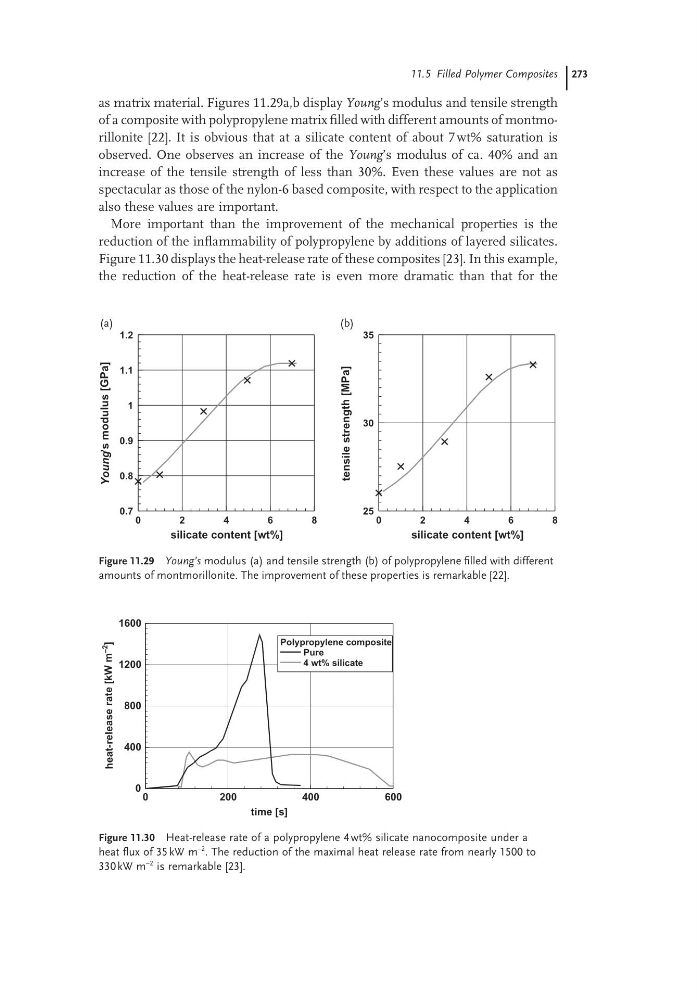
as matrix material. Figures 11.29a,b display Young’s modulus and tensile strength
of a composite with polypropylene matrix filled with different amounts of montmorillonite [22]. It is obvious that at a silicate content of about 7 wt% saturation is
observed. One observes an increase of the Young’s modulus of ca. 40% and an
increase of the tensile strength of less than 30%. Even these values are not as
spectacular as those of the nylon-6 based composite, with respect to the application
also these values are important.
More important than the improvement of the mechanical properties is the
reduction of the inflammability of polypropylene by additions of layered silicates.
Figure 11.30 displays the heat-release rate of these composites [23]. In this example,
the reduction of the heat-release rate is even more dramatic than that for the
Figure 11.29 Young’s modulus (a) and tensile strength (b) of polypropylene filled with different
amounts of montmorillonite. The improvement of these properties is remarkable [22].
0
2
4
6
8
silicate content [wt%]
0.7
0.8
0.9
1
1.1
1.2
Young's
modulus
[GPa]
0
2
4
6
8
silicate content [wt%]
25
30
35
tensile
strength
[MPa]
(a)
(b)
Figure 11.30 Heat-release rate of a polypropylene 4 wt% silicate nanocomposite under a
heat flux of 35 kW m
−2
. The reduction of the maximal heat release rate from nearly 1500 to
330 kW m
−2 is remarkable [23].
0
200
400
600
time [s]
0
400
800
1200
1600
heat-release
rate
[kW
m
–2
]
Polypropylene composite
Pure
4 wt% silicate
as matrix material. Figures 11.29a,b display Young’s modulus and tensile strength
of a composite with polypropylene matrix filled with different amounts of montmorillonite [22]. It is obvious that at a silicate content of about 7 wt% saturation is
observed. One observes an increase of the Young’s modulus of ca. 40% and an
increase of the tensile strength of less than 30%. Even these values are not as
spectacular as those of the nylon-6 based composite, with respect to the application
also these values are important.
More important than the improvement of the mechanical properties is the
reduction of the inflammability of polypropylene by additions of layered silicates.
Figure 11.30 displays the heat-release rate of these composites [23]. In this example,
the reduction of the heat-release rate is even more dramatic than that for the
Figure 11.29 Young’s modulus (a) and tensile strength (b) of polypropylene filled with different
amounts of montmorillonite. The improvement of these properties is remarkable [22].
0
2
4
6
8
silicate content [wt%]
0.7
0.8
0.9
1
1.1
1.2
Young's
modulus
[GPa]
0
2
4
6
8
silicate content [wt%]
25
30
35
tensile
strength
[MPa]
(a)
(b)
Figure 11.30 Heat-release rate of a polypropylene 4 wt% silicate nanocomposite under a
heat flux of 35 kW m
−2
. The reduction of the maximal heat release rate from nearly 1500 to
330 kW m
−2 is remarkable [23].
0
200
400
600
time [s]
0
400
800
1200
1600
heat-release
rate
[kW
m
–2
]
Polypropylene composite
Pure
4 wt% silicate