

11.5 Filled Polymer Composites 271
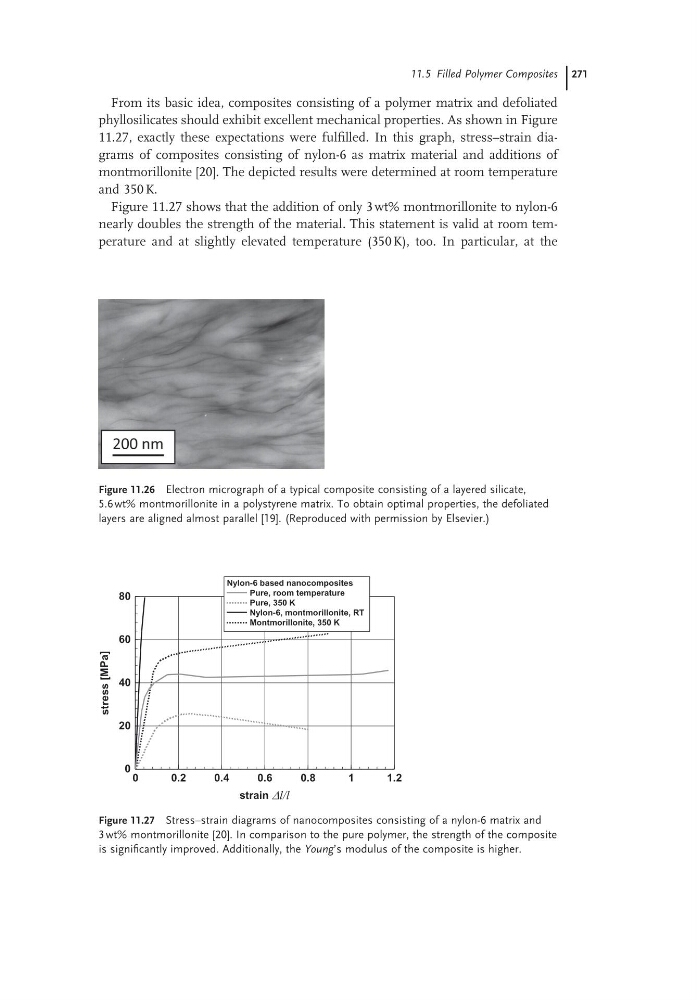
From its basic idea, composites consisting of a polymer matrix and defoliated
phyllosilicates should exhibit excellent mechanical properties. As shown in Figure
11.27, exactly these expectations were fulfilled. In this graph, stress–strain diagrams of composites consisting of nylon-6 as matrix material and additions of
montmorillonite [20]. The depicted results were determined at room temperature
and 350 K.
Figure 11.27 shows that the addition of only 3 wt% montmorillonite to nylon-6
nearly doubles the strength of the material. This statement is valid at room temperature and at slightly elevated temperature (350 K), too. In particular, at the
Figure 11.26 Electron micrograph of a typical composite consisting of a layered silicate,
5.6 wt% montmorillonite in a polystyrene matrix. To obtain optimal properties, the defoliated
layers are aligned almost parallel [19]. (Reproduced with permission by Elsevier.)
Figure 11.27 Stress–strain diagrams of nanocomposites consisting of a nylon-6 matrix and
3 wt% montmorillonite [20]. In comparison to the pure polymer, the strength of the composite
is significantly improved. Additionally, the Young’s modulus of the composite is higher.
0
0.2
0.4
0.6
0.8
1
1.2
strain ∆l/l
0
20
40
60
80
stress
[MPa]
Nylon-6 based nanocomposites
Pure, room temperature
Pure, 350 K
Nylon-6, montmorillonite, RT
Montmorillonite, 350 K
From its basic idea, composites consisting of a polymer matrix and defoliated
phyllosilicates should exhibit excellent mechanical properties. As shown in Figure
11.27, exactly these expectations were fulfilled. In this graph, stress–strain diagrams of composites consisting of nylon-6 as matrix material and additions of
montmorillonite [20]. The depicted results were determined at room temperature
and 350 K.
Figure 11.27 shows that the addition of only 3 wt% montmorillonite to nylon-6
nearly doubles the strength of the material. This statement is valid at room temperature and at slightly elevated temperature (350 K), too. In particular, at the
Figure 11.26 Electron micrograph of a typical composite consisting of a layered silicate,
5.6 wt% montmorillonite in a polystyrene matrix. To obtain optimal properties, the defoliated
layers are aligned almost parallel [19]. (Reproduced with permission by Elsevier.)
Figure 11.27 Stress–strain diagrams of nanocomposites consisting of a nylon-6 matrix and
3 wt% montmorillonite [20]. In comparison to the pure polymer, the strength of the composite
is significantly improved. Additionally, the Young’s modulus of the composite is higher.
0
0.2
0.4
0.6
0.8
1
1.2
strain ∆l/l
0
20
40
60
80
stress
[MPa]
Nylon-6 based nanocomposites
Pure, room temperature
Pure, 350 K
Nylon-6, montmorillonite, RT
Montmorillonite, 350 K