

270 11 Mechanical Properties
reduced inflammability. The latter property makes this composite material important for the automobile and aerospace industry. Lastly, because of these special
properties, polymers filled with silicate platelets, are a billion-dollar business.
Originally, these composites were developed by Toyota in 1989, intended for use
in the automotive industry.
As silicate platelets, defoliated (also called delaminated) layered silicates (phyllosilicates), such as montmorillonite, are in use. Such layered silicates can be split
by mechanical methods and defoliated to single layers by chemical processes.
Before looking at processes for the production, first it is necessary to understand
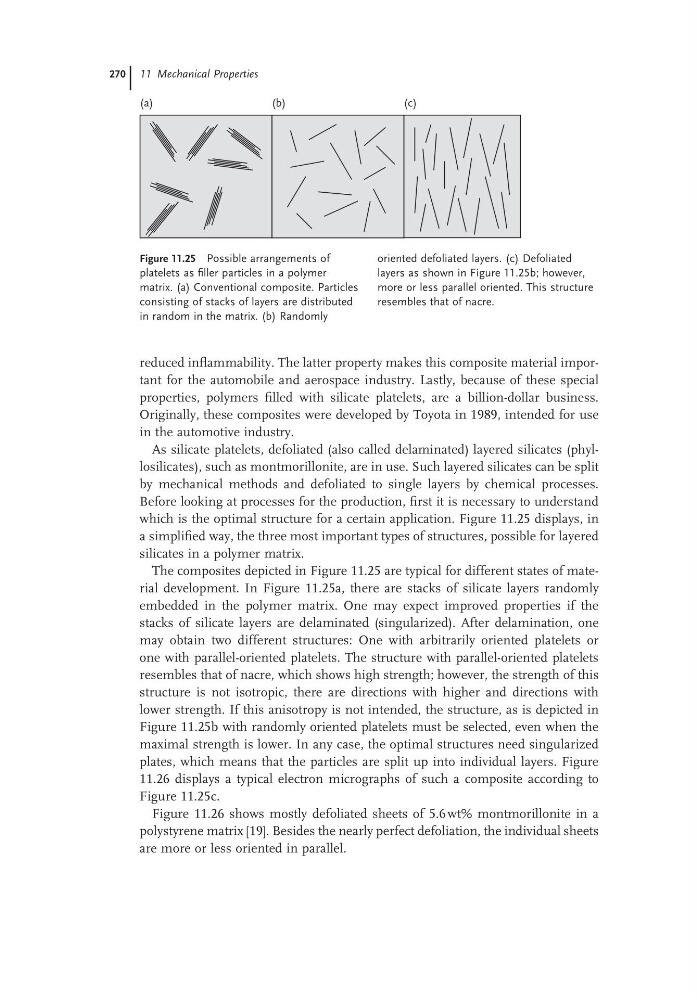
which is the optimal structure for a certain application. Figure 11.25 displays, in
a simplified way, the three most important types of structures, possible for layered
silicates in a polymer matrix.
The composites depicted in Figure 11.25 are typical for different states of material development. In Figure 11.25a, there are stacks of silicate layers randomly
embedded in the polymer matrix. One may expect improved properties if the
stacks of silicate layers are delaminated (singularized). After delamination, one
may obtain two different structures: One with arbitrarily oriented platelets or
one with parallel-oriented platelets. The structure with parallel-oriented platelets
resembles that of nacre, which shows high strength; however, the strength of this
structure is not isotropic, there are directions with higher and directions with
lower strength. If this anisotropy is not intended, the structure, as is depicted in
Figure 11.25b with randomly oriented platelets must be selected, even when the
maximal strength is lower. In any case, the optimal structures need singularized
plates, which means that the particles are split up into individual layers. Figure
11.26 displays a typical electron micrographs of such a composite according to
Figure 11.25c.
Figure 11.26 shows mostly defoliated sheets of 5.6 wt% montmorillonite in a
polystyrene matrix [19]. Besides the nearly perfect defoliation, the individual sheets
are more or less oriented in parallel.
Figure 11.25 Possible arrangements of
platelets as filler particles in a polymer
matrix. (a) Conventional composite. Particles
consisting of stacks of layers are distributed
in random in the matrix. (b) Randomly
oriented defoliated layers. (c) Defoliated
layers as shown in Figure 11.25b; however,
more or less parallel oriented. This structure
resembles that of nacre.
(a)
(b)
(c)
reduced inflammability. The latter property makes this composite material important for the automobile and aerospace industry. Lastly, because of these special
properties, polymers filled with silicate platelets, are a billion-dollar business.
Originally, these composites were developed by Toyota in 1989, intended for use
in the automotive industry.
As silicate platelets, defoliated (also called delaminated) layered silicates (phyllosilicates), such as montmorillonite, are in use. Such layered silicates can be split
by mechanical methods and defoliated to single layers by chemical processes.
Before looking at processes for the production, first it is necessary to understand
which is the optimal structure for a certain application. Figure 11.25 displays, in
a simplified way, the three most important types of structures, possible for layered
silicates in a polymer matrix.
The composites depicted in Figure 11.25 are typical for different states of material development. In Figure 11.25a, there are stacks of silicate layers randomly
embedded in the polymer matrix. One may expect improved properties if the
stacks of silicate layers are delaminated (singularized). After delamination, one
may obtain two different structures: One with arbitrarily oriented platelets or
one with parallel-oriented platelets. The structure with parallel-oriented platelets
resembles that of nacre, which shows high strength; however, the strength of this
structure is not isotropic, there are directions with higher and directions with
lower strength. If this anisotropy is not intended, the structure, as is depicted in
Figure 11.25b with randomly oriented platelets must be selected, even when the
maximal strength is lower. In any case, the optimal structures need singularized
plates, which means that the particles are split up into individual layers. Figure
11.26 displays a typical electron micrographs of such a composite according to
Figure 11.25c.
Figure 11.26 shows mostly defoliated sheets of 5.6 wt% montmorillonite in a
polystyrene matrix [19]. Besides the nearly perfect defoliation, the individual sheets
are more or less oriented in parallel.
Figure 11.25 Possible arrangements of
platelets as filler particles in a polymer
matrix. (a) Conventional composite. Particles
consisting of stacks of layers are distributed
in random in the matrix. (b) Randomly
oriented defoliated layers. (c) Defoliated
layers as shown in Figure 11.25b; however,
more or less parallel oriented. This structure
resembles that of nacre.
(a)
(b)
(c)