

11.5 Filled Polymer Composites 269
striking: The filled polymer shows an, up to 15%, improved fracture stress, where
the better improvement is obtained with the smallest particles. Having Figure
11.21 with its related explanations in mind, this result was as expected. Certainly,
there is no advantage without disadvantages; for both composites, the strain at
rupture is reduced significantly. However, this does not necessarily reduce the
fields of applications, as a strain at fracture of 0.17 (=17%) is sufficient for nearly
all possible applications. In spite of all the problems connected to production and
applications, one must bear in mind that an increase of the strength means a
reduction in the consumption of materials.
As was explained in the previous section, bonding in-between the ceramic particles and the polymer matrix is essential for the quality and the properties of the
composite. If the bonding is insufficient, the filler particles will act as flaws and
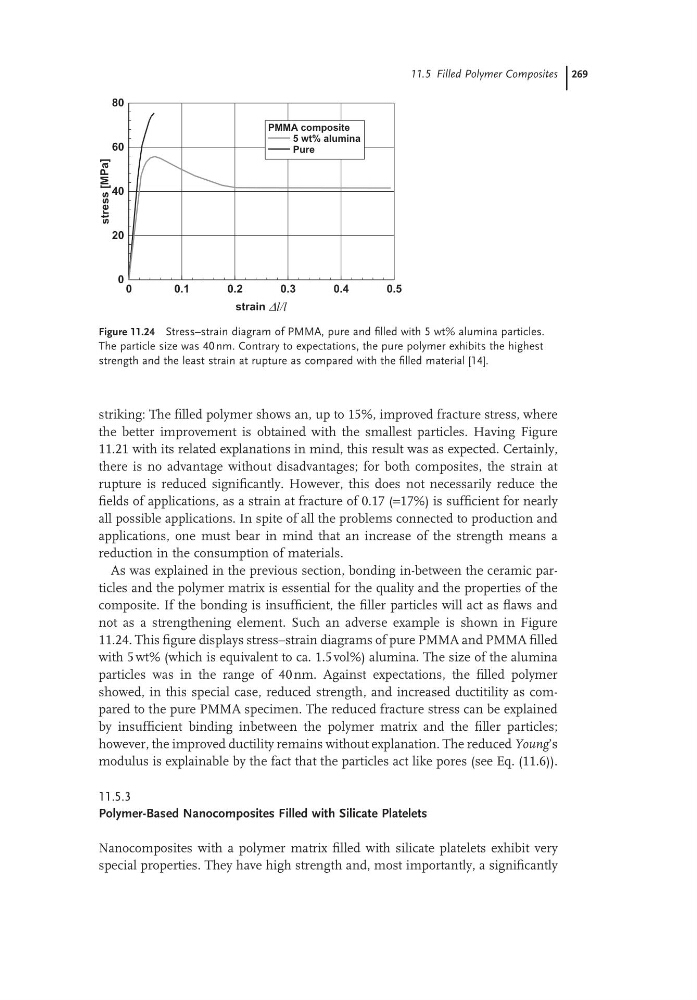
not as a strengthening element. Such an adverse example is shown in Figure
11.24. This figure displays stress–strain diagrams of pure PMMA and PMMA filled
with 5 wt% (which is equivalent to ca. 1.5 vol%) alumina. The size of the alumina
particles was in the range of 40 nm. Against expectations, the filled polymer
showed, in this special case, reduced strength, and increased ductitility as compared to the pure PMMA specimen. The reduced fracture stress can be explained
by insufficient binding inbetween the polymer matrix and the filler particles;
however, the improved ductility remains without explanation. The reduced Young’s
modulus is explainable by the fact that the particles act like pores (see Eq. (11.6)).
11.5.3
Polymer-Based Nanocomposites Filled with Silicate Platelets
Nanocomposites with a polymer matrix filled with silicate platelets exhibit very
special properties. They have high strength and, most importantly, a significantly
Figure 11.24 Stress–strain diagram of PMMA, pure and filled with 5 wt% alumina particles.
The particle size was 40 nm. Contrary to expectations, the pure polymer exhibits the highest
strength and the least strain at rupture as compared with the filled material [14].
0
0.1
0.2
0.3
0.4
0.5
strain ∆l/l
0
20
40
60
80
stress
[MPa]
PMMA composite
5 wt% alumina
Pure
striking: The filled polymer shows an, up to 15%, improved fracture stress, where
the better improvement is obtained with the smallest particles. Having Figure
11.21 with its related explanations in mind, this result was as expected. Certainly,
there is no advantage without disadvantages; for both composites, the strain at
rupture is reduced significantly. However, this does not necessarily reduce the
fields of applications, as a strain at fracture of 0.17 (=17%) is sufficient for nearly
all possible applications. In spite of all the problems connected to production and
applications, one must bear in mind that an increase of the strength means a
reduction in the consumption of materials.
As was explained in the previous section, bonding in-between the ceramic particles and the polymer matrix is essential for the quality and the properties of the
composite. If the bonding is insufficient, the filler particles will act as flaws and
not as a strengthening element. Such an adverse example is shown in Figure
11.24. This figure displays stress–strain diagrams of pure PMMA and PMMA filled
with 5 wt% (which is equivalent to ca. 1.5 vol%) alumina. The size of the alumina
particles was in the range of 40 nm. Against expectations, the filled polymer
showed, in this special case, reduced strength, and increased ductitility as compared to the pure PMMA specimen. The reduced fracture stress can be explained
by insufficient binding inbetween the polymer matrix and the filler particles;
however, the improved ductility remains without explanation. The reduced Young’s
modulus is explainable by the fact that the particles act like pores (see Eq. (11.6)).
11.5.3
Polymer-Based Nanocomposites Filled with Silicate Platelets
Nanocomposites with a polymer matrix filled with silicate platelets exhibit very
special properties. They have high strength and, most importantly, a significantly
Figure 11.24 Stress–strain diagram of PMMA, pure and filled with 5 wt% alumina particles.
The particle size was 40 nm. Contrary to expectations, the pure polymer exhibits the highest
strength and the least strain at rupture as compared with the filled material [14].
0
0.1
0.2
0.3
0.4
0.5
strain ∆l/l
0
20
40
60
80
stress
[MPa]
PMMA composite
5 wt% alumina
Pure