

268 11 Mechanical Properties
at Figure 11.22b, where the flow of stresses is marked. It was assumed that the
stress was so high that the soft binder in-between the ceramic platelets is broken.
However, the bonding between polymer and ceramic remains intact and, therefore, the part itself did not break. The simplified model shows the ceramic structure carrying most of the load, which is transferred via the high-shear zones
between the ceramic platelets. The part will break when the stress reaches a level
where either the ceramic platelets will break or, more probably, the shear stress
between the organic binder and the ceramic filler leads to debonding [17]. The
electron micrograph of nacre depicted in Figure 11.22c shows that there is not too
much idealization in the model structure. It can be shown theoretically that there
exists an optimum aspect ratio of the ceramic bricks corresponding to the condition that protein and mineral fail at the same load [17]. Certainly, such an idealized
structure has disadvantages, too. It is important to note that the good properties
of the structure depicted in Figure 11.22 are not observed in the direction perpendicular to the platelets. This fact must be considered when designing optimal
structures of composites with platelet-shaped fillers.
11.5.2
Particle-Filled Polymers
Polymers filled with ceramic particles show some improvement of their mechanical properties. Therefore, based on theoretical considerations, the expectations
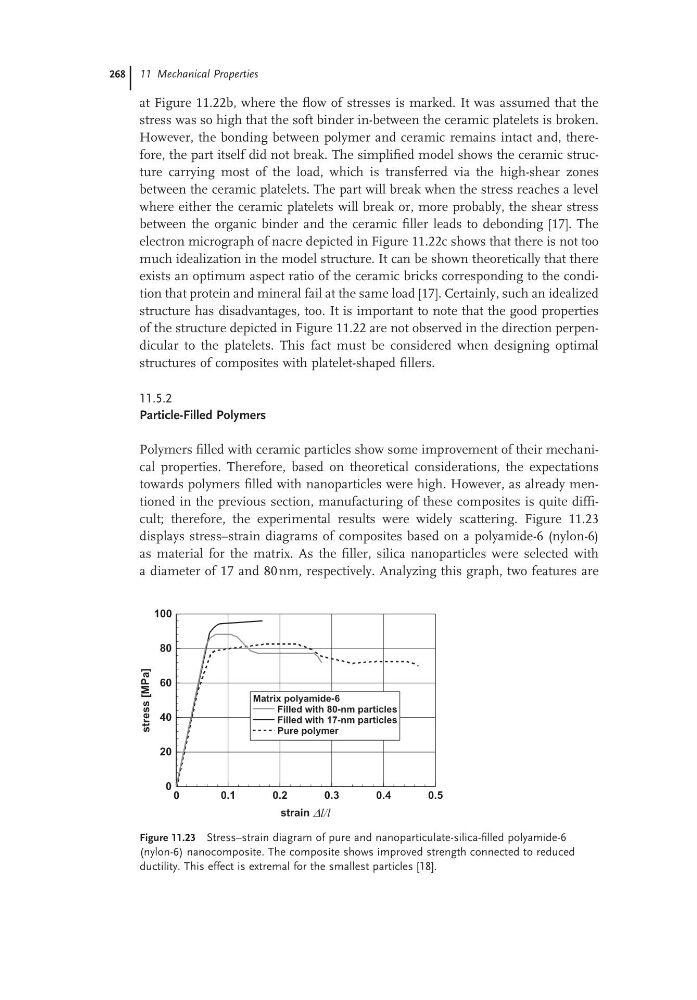
towards polymers filled with nanoparticles were high. However, as already mentioned in the previous section, manufacturing of these composites is quite difficult; therefore, the experimental results were widely scattering. Figure 11.23
displays stress–strain diagrams of composites based on a polyamide-6 (nylon-6)
as material for the matrix. As the filler, silica nanoparticles were selected with
a diameter of 17 and 80 nm, respectively. Analyzing this graph, two features are
Figure 11.23 Stress–strain diagram of pure and nanoparticulate-silica-filled polyamide-6
(nylon-6) nanocomposite. The composite shows improved strength connected to reduced
ductility. This effect is extremal for the smallest particles [18].
0
0.1
0.2
0.3
0.4
0.5
strain ∆l/l
0
20
40
60
80
100
stress
[MPa]
Matrix polyamide-6
Filled with 80-nm particles
Filled with 17-nm particles
Pure polymer
at Figure 11.22b, where the flow of stresses is marked. It was assumed that the
stress was so high that the soft binder in-between the ceramic platelets is broken.
However, the bonding between polymer and ceramic remains intact and, therefore, the part itself did not break. The simplified model shows the ceramic structure carrying most of the load, which is transferred via the high-shear zones
between the ceramic platelets. The part will break when the stress reaches a level
where either the ceramic platelets will break or, more probably, the shear stress
between the organic binder and the ceramic filler leads to debonding [17]. The
electron micrograph of nacre depicted in Figure 11.22c shows that there is not too
much idealization in the model structure. It can be shown theoretically that there
exists an optimum aspect ratio of the ceramic bricks corresponding to the condition that protein and mineral fail at the same load [17]. Certainly, such an idealized
structure has disadvantages, too. It is important to note that the good properties
of the structure depicted in Figure 11.22 are not observed in the direction perpendicular to the platelets. This fact must be considered when designing optimal
structures of composites with platelet-shaped fillers.
11.5.2
Particle-Filled Polymers
Polymers filled with ceramic particles show some improvement of their mechanical properties. Therefore, based on theoretical considerations, the expectations
towards polymers filled with nanoparticles were high. However, as already mentioned in the previous section, manufacturing of these composites is quite difficult; therefore, the experimental results were widely scattering. Figure 11.23
displays stress–strain diagrams of composites based on a polyamide-6 (nylon-6)
as material for the matrix. As the filler, silica nanoparticles were selected with
a diameter of 17 and 80 nm, respectively. Analyzing this graph, two features are
Figure 11.23 Stress–strain diagram of pure and nanoparticulate-silica-filled polyamide-6
(nylon-6) nanocomposite. The composite shows improved strength connected to reduced
ductility. This effect is extremal for the smallest particles [18].
0
0.1
0.2
0.3
0.4
0.5
strain ∆l/l
0
20
40
60
80
100
stress
[MPa]
Matrix polyamide-6
Filled with 80-nm particles
Filled with 17-nm particles
Pure polymer