

11.3 Deformation Mechanisms of Nanocrystalline Materials 261
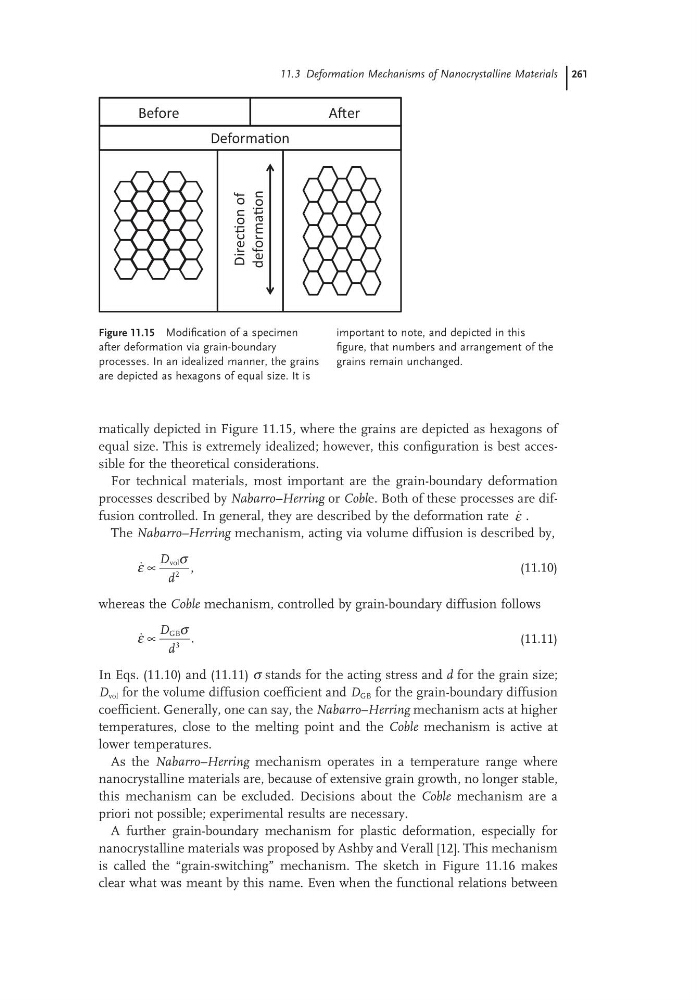
matically depicted in Figure 11.15, where the grains are depicted as hexagons of
equal size. This is extremely idealized; however, this configuration is best accessible for the theoretical considerations.
For technical materials, most important are the grain-boundary deformation
processes described by Nabarro–Herring or Coble. Both of these processes are diffusion controlled. In general, they are described by the deformation rate
ε .
The Nabarro–Herring mechanism, acting via volume diffusion is described by,
ε
σ
∝
D
d
vol
2
,
(11.10)
whereas the Coble mechanism, controlled by grain-boundary diffusion follows
ε
σ
∝
D
d
GB
3
.
(11.11)
In Eqs. (11.10) and (11.11) σ stands for the acting stress and d for the grain size;
D vol for the volume diffusion coefficient and D GB for the grain-boundary diffusion
coefficient. Generally, one can say, the Nabarro–Herring mechanism acts at higher
temperatures, close to the melting point and the Coble mechanism is active at
lower temperatures.
As the Nabarro–Herring mechanism operates in a temperature range where
nanocrystalline materials are, because of extensive grain growth, no longer stable,
this mechanism can be excluded. Decisions about the Coble mechanism are a
priori not possible; experimental results are necessary.
A further grain-boundary mechanism for plastic deformation, especially for
nanocrystalline materials was proposed by Ashby and Verall [12]. This mechanism
is called the “grain-switching” mechanism. The sketch in Figure 11.16 makes
clear what was meant by this name. Even when the functional relations between
Figure 11.15 Modification of a specimen
after deformation via grain-boundary
processes. In an idealized manner, the grains
are depicted as hexagons of equal size. It is
important to note, and depicted in this
figure, that numbers and arrangement of the
grains remain unchanged.
DeformaƟon
Before
AŌer
DirecƟon of
deformaƟon
matically depicted in Figure 11.15, where the grains are depicted as hexagons of
equal size. This is extremely idealized; however, this configuration is best accessible for the theoretical considerations.
For technical materials, most important are the grain-boundary deformation
processes described by Nabarro–Herring or Coble. Both of these processes are diffusion controlled. In general, they are described by the deformation rate
ε .
The Nabarro–Herring mechanism, acting via volume diffusion is described by,
ε
σ
∝
D
d
vol
2
,
(11.10)
whereas the Coble mechanism, controlled by grain-boundary diffusion follows
ε
σ
∝
D
d
GB
3
.
(11.11)
In Eqs. (11.10) and (11.11) σ stands for the acting stress and d for the grain size;
D vol for the volume diffusion coefficient and D GB for the grain-boundary diffusion
coefficient. Generally, one can say, the Nabarro–Herring mechanism acts at higher
temperatures, close to the melting point and the Coble mechanism is active at
lower temperatures.
As the Nabarro–Herring mechanism operates in a temperature range where
nanocrystalline materials are, because of extensive grain growth, no longer stable,
this mechanism can be excluded. Decisions about the Coble mechanism are a
priori not possible; experimental results are necessary.
A further grain-boundary mechanism for plastic deformation, especially for
nanocrystalline materials was proposed by Ashby and Verall [12]. This mechanism
is called the “grain-switching” mechanism. The sketch in Figure 11.16 makes
clear what was meant by this name. Even when the functional relations between
Figure 11.15 Modification of a specimen
after deformation via grain-boundary
processes. In an idealized manner, the grains
are depicted as hexagons of equal size. It is
important to note, and depicted in this
figure, that numbers and arrangement of the
grains remain unchanged.
DeformaƟon
Before
AŌer
DirecƟon of
deformaƟon