

260 11 Mechanical Properties
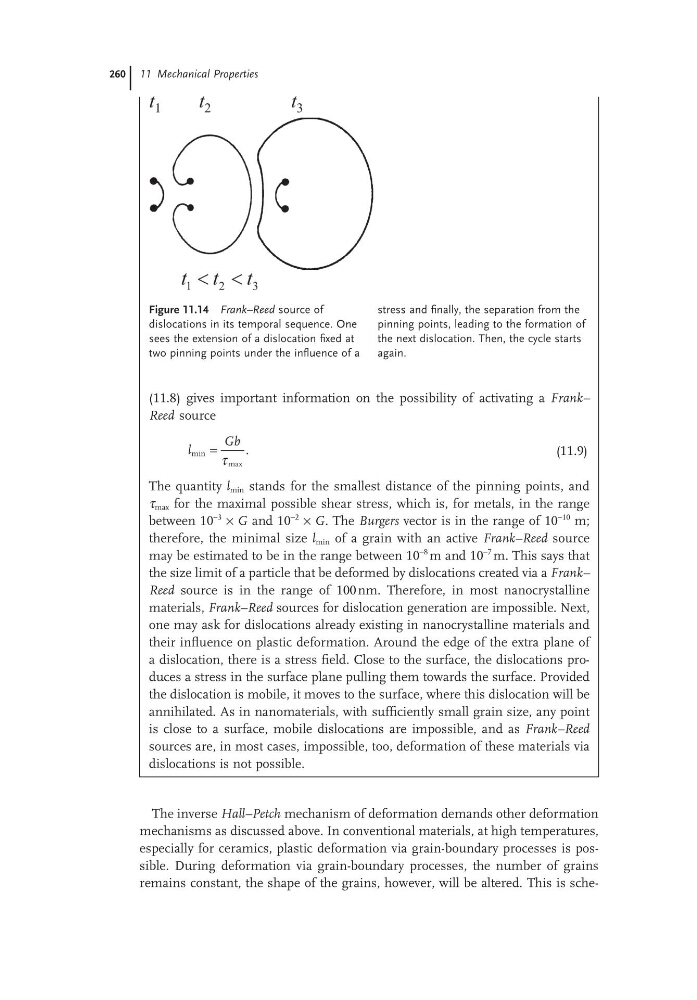
Figure 11.14 Frank–Reed source of
dislocations in its temporal sequence. One
sees the extension of a dislocation fixed at
two pinning points under the influence of a
stress and finally, the separation from the
pinning points, leading to the formation of
the next dislocation. Then, the cycle starts
again.
(11.8) gives important information on the possibility of activating a Frank–
Reed source
l
Gb
min
max
.
= τ
(11.9)
The quantity l min stands for the smallest distance of the pinning points, and
τ max for the maximal possible shear stress, which is, for metals, in the range
between 10
−3
× G and 10
−2
× G. The Burgers vector is in the range of 10
−10 m;
therefore, the minimal size l min of a grain with an active Frank–Reed source
may be estimated to be in the range between 10
−8 m and 10
−7 m. This says that
the size limit of a particle that be deformed by dislocations created via a Frank–
Reed source is in the range of 100 nm. Therefore, in most nanocrystalline
materials, Frank–Reed sources for dislocation generation are impossible. Next,
one may ask for dislocations already existing in nanocrystalline materials and
their influence on plastic deformation. Around the edge of the extra plane of
a dislocation, there is a stress field. Close to the surface, the dislocations produces a stress in the surface plane pulling them towards the surface. Provided
the dislocation is mobile, it moves to the surface, where this dislocation will be
annihilated. As in nanomaterials, with sufficiently small grain size, any point
is close to a surface, mobile dislocations are impossible, and as Frank–Reed
sources are, in most cases, impossible, too, deformation of these materials via
dislocations is not possible.
The inverse Hall–Petch mechanism of deformation demands other deformation
mechanisms as discussed above. In conventional materials, at high temperatures,
especially for ceramics, plastic deformation via grain-boundary processes is possible. During deformation via grain-boundary processes, the number of grains
remains constant, the shape of the grains, however, will be altered. This is sche-
Figure 11.14 Frank–Reed source of
dislocations in its temporal sequence. One
sees the extension of a dislocation fixed at
two pinning points under the influence of a
stress and finally, the separation from the
pinning points, leading to the formation of
the next dislocation. Then, the cycle starts
again.
(11.8) gives important information on the possibility of activating a Frank–
Reed source
l
Gb
min
max
.
= τ
(11.9)
The quantity l min stands for the smallest distance of the pinning points, and
τ max for the maximal possible shear stress, which is, for metals, in the range
between 10
−3
× G and 10
−2
× G. The Burgers vector is in the range of 10
−10 m;
therefore, the minimal size l min of a grain with an active Frank–Reed source
may be estimated to be in the range between 10
−8 m and 10
−7 m. This says that
the size limit of a particle that be deformed by dislocations created via a Frank–
Reed source is in the range of 100 nm. Therefore, in most nanocrystalline
materials, Frank–Reed sources for dislocation generation are impossible. Next,
one may ask for dislocations already existing in nanocrystalline materials and
their influence on plastic deformation. Around the edge of the extra plane of
a dislocation, there is a stress field. Close to the surface, the dislocations produces a stress in the surface plane pulling them towards the surface. Provided
the dislocation is mobile, it moves to the surface, where this dislocation will be
annihilated. As in nanomaterials, with sufficiently small grain size, any point
is close to a surface, mobile dislocations are impossible, and as Frank–Reed
sources are, in most cases, impossible, too, deformation of these materials via
dislocations is not possible.
The inverse Hall–Petch mechanism of deformation demands other deformation
mechanisms as discussed above. In conventional materials, at high temperatures,
especially for ceramics, plastic deformation via grain-boundary processes is possible. During deformation via grain-boundary processes, the number of grains
remains constant, the shape of the grains, however, will be altered. This is sche-