

256 11 Mechanical Properties
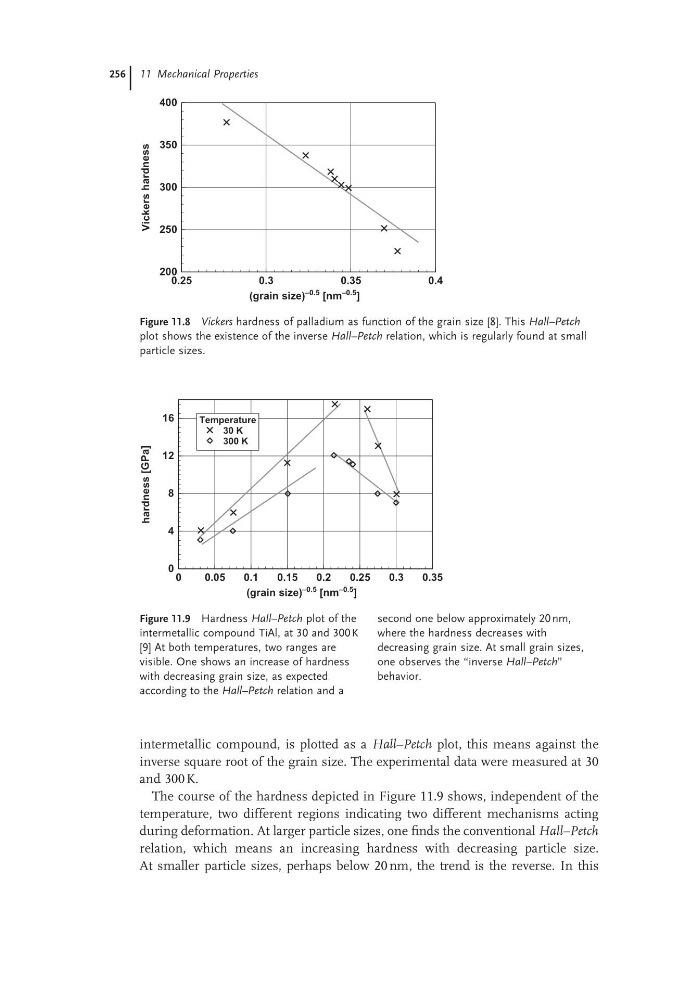
intermetallic compound, is plotted as a Hall–Petch plot, this means against the
inverse square root of the grain size. The experimental data were measured at 30
and 300 K.
The course of the hardness depicted in Figure 11.9 shows, independent of the
temperature, two different regions indicating two different mechanisms acting
during deformation. At larger particle sizes, one finds the conventional Hall–Petch
relation, which means an increasing hardness with decreasing particle size.
At smaller particle sizes, perhaps below 20 nm, the trend is the reverse. In this
Figure 11.8 Vickers hardness of palladium as function of the grain size [8]. This Hall–Petch
plot shows the existence of the inverse Hall–Petch relation, which is regularly found at small
particle sizes.
0.25
0.3
0.35
0.4
(grain size)
–0.5 [nm
–0.5
]
200
250
300
350
400
Vickers
hardness
Figure 11.9 Hardness Hall–Petch plot of the
intermetallic compound TiAl, at 30 and 300 K
[9] At both temperatures, two ranges are
visible. One shows an increase of hardness
with decreasing grain size, as expected
according to the Hall–Petch relation and a
second one below approximately 20 nm,
where the hardness decreases with
decreasing grain size. At small grain sizes,
one observes the “inverse Hall–Petch”
behavior.
0
0.05
0.1
0.15
0.2
0.25
0.3
0.35
(grain size)
–0.5 [nm
–0.5 ]
0
4
8
12
16
hardness
[GPa]
Temperature
30 K
300 K
intermetallic compound, is plotted as a Hall–Petch plot, this means against the
inverse square root of the grain size. The experimental data were measured at 30
and 300 K.
The course of the hardness depicted in Figure 11.9 shows, independent of the
temperature, two different regions indicating two different mechanisms acting
during deformation. At larger particle sizes, one finds the conventional Hall–Petch
relation, which means an increasing hardness with decreasing particle size.
At smaller particle sizes, perhaps below 20 nm, the trend is the reverse. In this
Figure 11.8 Vickers hardness of palladium as function of the grain size [8]. This Hall–Petch
plot shows the existence of the inverse Hall–Petch relation, which is regularly found at small
particle sizes.
0.25
0.3
0.35
0.4
(grain size)
–0.5 [nm
–0.5
]
200
250
300
350
400
Vickers
hardness
Figure 11.9 Hardness Hall–Petch plot of the
intermetallic compound TiAl, at 30 and 300 K
[9] At both temperatures, two ranges are
visible. One shows an increase of hardness
with decreasing grain size, as expected
according to the Hall–Petch relation and a
second one below approximately 20 nm,
where the hardness decreases with
decreasing grain size. At small grain sizes,
one observes the “inverse Hall–Petch”
behavior.
0
0.05
0.1
0.15
0.2
0.25
0.3
0.35
(grain size)
–0.5 [nm
–0.5 ]
0
4
8
12
16
hardness
[GPa]
Temperature
30 K
300 K