

11.3 Deformation Mechanisms of Nanocrystalline Materials 255
connected to sintered nanomaterials explains the reduced Young’s modulus of the
nanocrystalline specimen in comparison to the coarse-grained one in Figure 11.3.
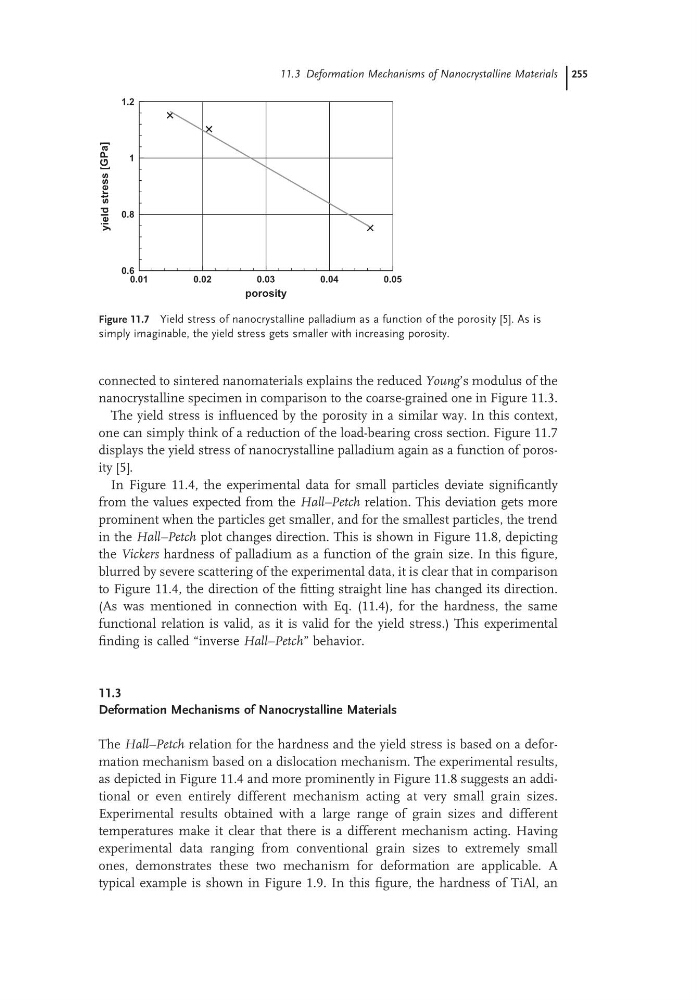
The yield stress is influenced by the porosity in a similar way. In this context,
one can simply think of a reduction of the load-bearing cross section. Figure 11.7
displays the yield stress of nanocrystalline palladium again as a function of porosity [5].
In Figure 11.4, the experimental data for small particles deviate significantly
from the values expected from the Hall–Petch relation. This deviation gets more
prominent when the particles get smaller, and for the smallest particles, the trend
in the Hall–Petch plot changes direction. This is shown in Figure 11.8, depicting
the Vickers hardness of palladium as a function of the grain size. In this figure,
blurred by severe scattering of the experimental data, it is clear that in comparison
to Figure 11.4, the direction of the fitting straight line has changed its direction.
(As was mentioned in connection with Eq. (11.4), for the hardness, the same
functional relation is valid, as it is valid for the yield stress.) This experimental
finding is called “inverse Hall–Petch” behavior.
11.3
Deformation Mechanisms of Nanocrystalline Materials
The Hall–Petch relation for the hardness and the yield stress is based on a deformation mechanism based on a dislocation mechanism. The experimental results,
as depicted in Figure 11.4 and more prominently in Figure 11.8 suggests an additional or even entirely different mechanism acting at very small grain sizes.
Experimental results obtained with a large range of grain sizes and different
temperatures make it clear that there is a different mechanism acting. Having
experimental data ranging from conventional grain sizes to extremely small
ones, demonstrates these two mechanism for deformation are applicable. A
typical example is shown in Figure 1.9. In this figure, the hardness of TiAl, an
Figure 11.7 Yield stress of nanocrystalline palladium as a function of the porosity [5]. As is
simply imaginable, the yield stress gets smaller with increasing porosity.
0.01
0.02
0.03
0.04
0.05
porosity
0.6
0.8
1
1.2
yield
stress
[GPa]
connected to sintered nanomaterials explains the reduced Young’s modulus of the
nanocrystalline specimen in comparison to the coarse-grained one in Figure 11.3.
The yield stress is influenced by the porosity in a similar way. In this context,
one can simply think of a reduction of the load-bearing cross section. Figure 11.7
displays the yield stress of nanocrystalline palladium again as a function of porosity [5].
In Figure 11.4, the experimental data for small particles deviate significantly
from the values expected from the Hall–Petch relation. This deviation gets more
prominent when the particles get smaller, and for the smallest particles, the trend
in the Hall–Petch plot changes direction. This is shown in Figure 11.8, depicting
the Vickers hardness of palladium as a function of the grain size. In this figure,
blurred by severe scattering of the experimental data, it is clear that in comparison
to Figure 11.4, the direction of the fitting straight line has changed its direction.
(As was mentioned in connection with Eq. (11.4), for the hardness, the same
functional relation is valid, as it is valid for the yield stress.) This experimental
finding is called “inverse Hall–Petch” behavior.
11.3
Deformation Mechanisms of Nanocrystalline Materials
The Hall–Petch relation for the hardness and the yield stress is based on a deformation mechanism based on a dislocation mechanism. The experimental results,
as depicted in Figure 11.4 and more prominently in Figure 11.8 suggests an additional or even entirely different mechanism acting at very small grain sizes.
Experimental results obtained with a large range of grain sizes and different
temperatures make it clear that there is a different mechanism acting. Having
experimental data ranging from conventional grain sizes to extremely small
ones, demonstrates these two mechanism for deformation are applicable. A
typical example is shown in Figure 1.9. In this figure, the hardness of TiAl, an
Figure 11.7 Yield stress of nanocrystalline palladium as a function of the porosity [5]. As is
simply imaginable, the yield stress gets smaller with increasing porosity.
0.01
0.02
0.03
0.04
0.05
porosity
0.6
0.8
1
1.2
yield
stress
[GPa]