

254 11 Mechanical Properties
In Eq. (11.5) the quantity ρ specimen stands for the actual, experimentally determined
density of the specimen and ρ theor is the theoretical density of the fully dense
material.
Figure 11.5 makes it clear that on analyzing the mechanical properties of nanocrystalline materials the influence of porosity and grain size have to be taken into
account. This means that whenever one analyzes, for example, the Young’s
modulus as a function of the grain size, one must be aware that these measurements were obtained on specimens with different porosities and vice versa. The
influence of the porosity on Young’s modulus has often been analyzed. An empirical approach to describe the influence of the porosity p, using a Taylor series
development for the Young’s modulus E was made by MacKenzie [6].
E E
p
p
=
+
+
+
(
)
0
1
2
2
1 α
α
...... .
(11.6)
In Eq. (11.6), E 0 is the Young’s modulus of the full dense material at p = 0 and α 1 ,
α 2 , etc. are fitting parameters. For small values of the porosity, the linear term is
sufficient. For higher porosities, an increasing number of series elements are
necessary. However, in the case of nanomaterials, because of the large scattering
of the results caused by problems with the grain size, a first-order approximation
is always sufficient.
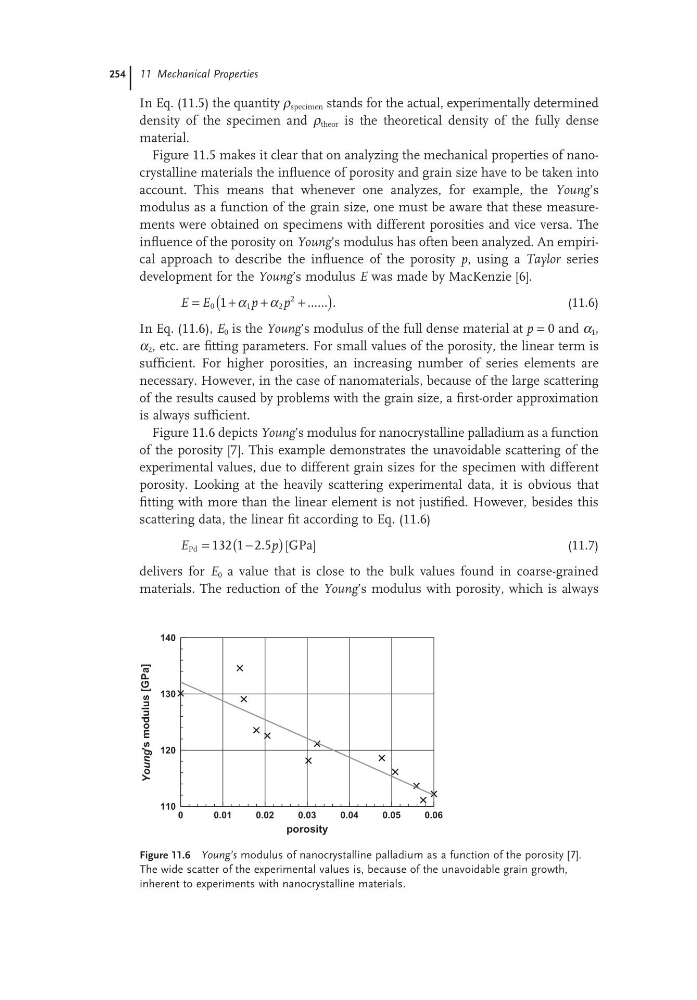
Figure 11.6 depicts Young’s modulus for nanocrystalline palladium as a function
of the porosity [7]. This example demonstrates the unavoidable scattering of the
experimental values, due to different grain sizes for the specimen with different
porosity. Looking at the heavily scattering experimental data, it is obvious that
fitting with more than the linear element is not justified. However, besides this
scattering data, the linear fit according to Eq. (11.6)
E
p
Pd
[GPa]
=
−
(
)
132 1 2 5
.
(11.7)
delivers for E 0 a value that is close to the bulk values found in coarse-grained
materials. The reduction of the Young’s modulus with porosity, which is always
Figure 11.6 Young’s modulus of nanocrystalline palladium as a function of the porosity [7].
The wide scatter of the experimental values is, because of the unavoidable grain growth,
inherent to experiments with nanocrystalline materials.
0
0.01
0.02
0.03
0.04
0.05
0.06
porosity
110
120
130
140
Young's
modulus
[GPa]
In Eq. (11.5) the quantity ρ specimen stands for the actual, experimentally determined
density of the specimen and ρ theor is the theoretical density of the fully dense
material.
Figure 11.5 makes it clear that on analyzing the mechanical properties of nanocrystalline materials the influence of porosity and grain size have to be taken into
account. This means that whenever one analyzes, for example, the Young’s
modulus as a function of the grain size, one must be aware that these measurements were obtained on specimens with different porosities and vice versa. The
influence of the porosity on Young’s modulus has often been analyzed. An empirical approach to describe the influence of the porosity p, using a Taylor series
development for the Young’s modulus E was made by MacKenzie [6].
E E
p
p
=
+
+
+
(
)
0
1
2
2
1 α
α
...... .
(11.6)
In Eq. (11.6), E 0 is the Young’s modulus of the full dense material at p = 0 and α 1 ,
α 2 , etc. are fitting parameters. For small values of the porosity, the linear term is
sufficient. For higher porosities, an increasing number of series elements are
necessary. However, in the case of nanomaterials, because of the large scattering
of the results caused by problems with the grain size, a first-order approximation
is always sufficient.
Figure 11.6 depicts Young’s modulus for nanocrystalline palladium as a function
of the porosity [7]. This example demonstrates the unavoidable scattering of the
experimental values, due to different grain sizes for the specimen with different
porosity. Looking at the heavily scattering experimental data, it is obvious that
fitting with more than the linear element is not justified. However, besides this
scattering data, the linear fit according to Eq. (11.6)
E
p
Pd
[GPa]
=
−
(
)
132 1 2 5
.
(11.7)
delivers for E 0 a value that is close to the bulk values found in coarse-grained
materials. The reduction of the Young’s modulus with porosity, which is always
Figure 11.6 Young’s modulus of nanocrystalline palladium as a function of the porosity [7].
The wide scatter of the experimental values is, because of the unavoidable grain growth,
inherent to experiments with nanocrystalline materials.
0
0.01
0.02
0.03
0.04
0.05
0.06
porosity
110
120
130
140
Young's
modulus
[GPa]