

11.2 Mechanical Properties of Bulk Nanocrystalline Materials 253
down to grain sizes of ca. 200 nm. For smaller grain sizes the experimentally
observed yield stresses are lower than predicted by Eq. (11.4); therefore, additional
or other deformation mechanisms must be assumed. The smallest grain sizes
used in the experiments were 15 nm. It is striking that the smaller the grain sizes
the larger was the scattering of the experimental data. This point needs additional
discussion.
Bulk nanostructured parts are made by means of powder metallurgical methods.
This means that the preparation starts with compression of the starting powder,
followed by a sintering process at elevated temperature. This route of manufacturing leads, unavoidably, to materials with residual porosity. As nanocrystalline
materials are, because of their high surface energy, far from thermodynamic
equilibrium; any sintering process leads to grain growth. This means that preparation of specimens with different grain sizes is an extremely difficult task. One has
to find a balance between grain growth to obtain the intended grain size and
densification to reduce residual porosity. Lastly, this manufacturing problem leads
to specimens that may have different porosities. Different porosity means different
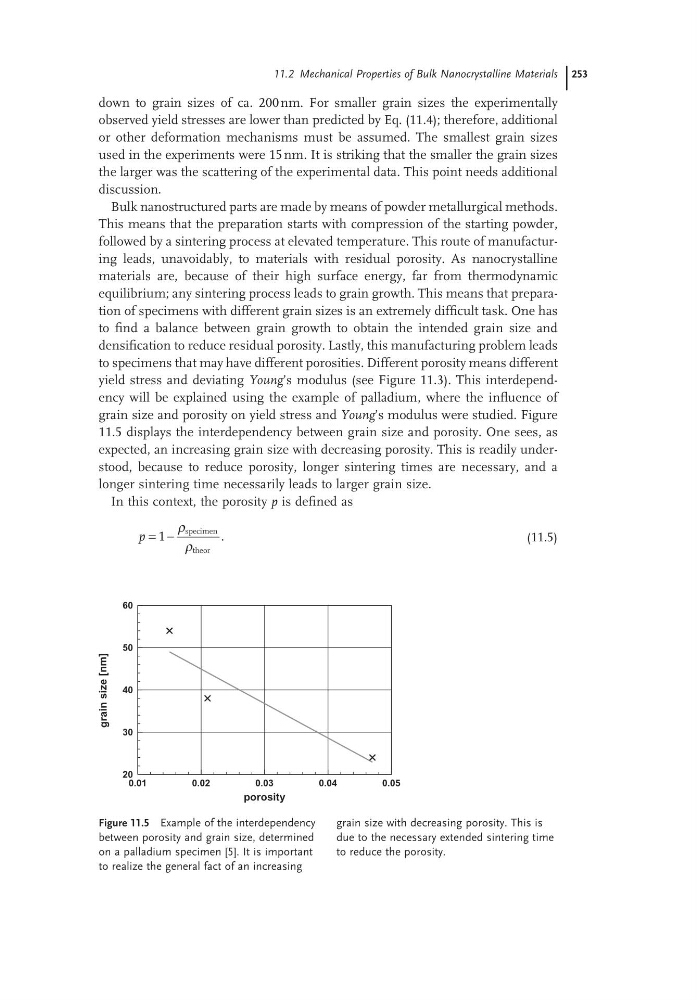
yield stress and deviating Young’s modulus (see Figure 11.3). This interdependency will be explained using the example of palladium, where the influence of
grain size and porosity on yield stress and Young’s modulus were studied. Figure
11.5 displays the interdependency between grain size and porosity. One sees, as
expected, an increasing grain size with decreasing porosity. This is readily understood, because to reduce porosity, longer sintering times are necessary, and a
longer sintering time necessarily leads to larger grain size.
In this context, the porosity p is defined as
p = −
1
ρ
ρ
specimen
theor
.
(11.5)
Figure 11.5 Example of the interdependency
between porosity and grain size, determined
on a palladium specimen [5]. It is important
to realize the general fact of an increasing
grain size with decreasing porosity. This is
due to the necessary extended sintering time
to reduce the porosity.
0.01
0.02
0.03
0.04
0.05
porosity
20
30
40
50
60
grain
size
[nm]
down to grain sizes of ca. 200 nm. For smaller grain sizes the experimentally
observed yield stresses are lower than predicted by Eq. (11.4); therefore, additional
or other deformation mechanisms must be assumed. The smallest grain sizes
used in the experiments were 15 nm. It is striking that the smaller the grain sizes
the larger was the scattering of the experimental data. This point needs additional
discussion.
Bulk nanostructured parts are made by means of powder metallurgical methods.
This means that the preparation starts with compression of the starting powder,
followed by a sintering process at elevated temperature. This route of manufacturing leads, unavoidably, to materials with residual porosity. As nanocrystalline
materials are, because of their high surface energy, far from thermodynamic
equilibrium; any sintering process leads to grain growth. This means that preparation of specimens with different grain sizes is an extremely difficult task. One has
to find a balance between grain growth to obtain the intended grain size and
densification to reduce residual porosity. Lastly, this manufacturing problem leads
to specimens that may have different porosities. Different porosity means different
yield stress and deviating Young’s modulus (see Figure 11.3). This interdependency will be explained using the example of palladium, where the influence of
grain size and porosity on yield stress and Young’s modulus were studied. Figure
11.5 displays the interdependency between grain size and porosity. One sees, as
expected, an increasing grain size with decreasing porosity. This is readily understood, because to reduce porosity, longer sintering times are necessary, and a
longer sintering time necessarily leads to larger grain size.
In this context, the porosity p is defined as
p = −
1
ρ
ρ
specimen
theor
.
(11.5)
Figure 11.5 Example of the interdependency
between porosity and grain size, determined
on a palladium specimen [5]. It is important
to realize the general fact of an increasing
grain size with decreasing porosity. This is
due to the necessary extended sintering time
to reduce the porosity.
0.01
0.02
0.03
0.04
0.05
porosity
20
30
40
50
60
grain
size
[nm]