

252 11 Mechanical Properties
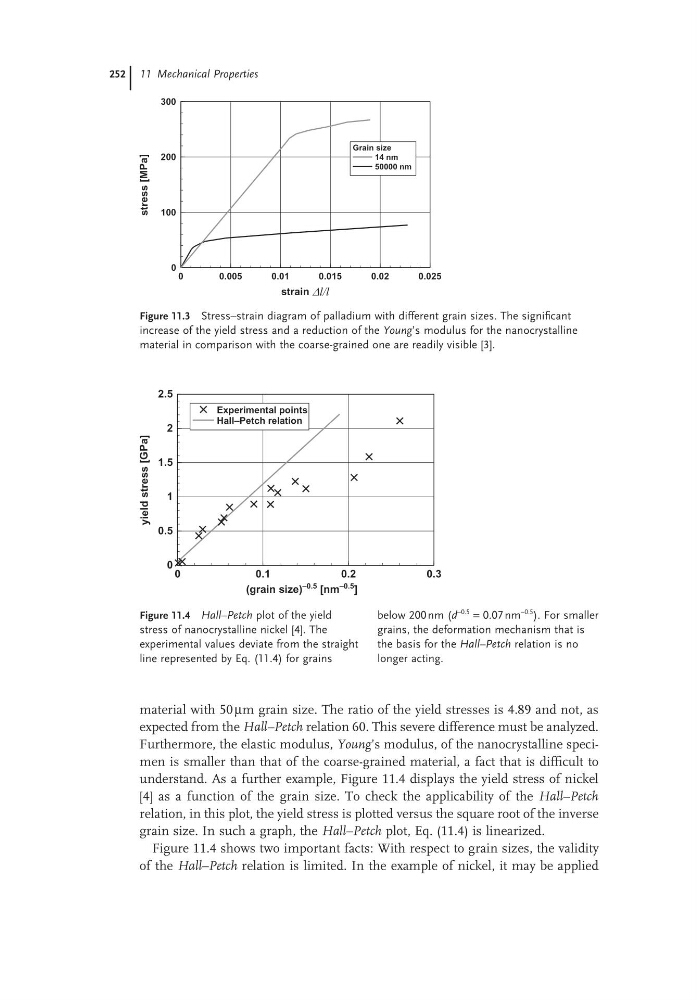
material with 50 μm grain size. The ratio of the yield stresses is 4.89 and not, as
expected from the Hall–Petch relation 60. This severe difference must be analyzed.
Furthermore, the elastic modulus, Young’s modulus, of the nanocrystalline specimen is smaller than that of the coarse-grained material, a fact that is difficult to
understand. As a further example, Figure 11.4 displays the yield stress of nickel
[4] as a function of the grain size. To check the applicability of the Hall–Petch
relation, in this plot, the yield stress is plotted versus the square root of the inverse
grain size. In such a graph, the Hall–Petch plot, Eq. (11.4) is linearized.
Figure 11.4 shows two important facts: With respect to grain sizes, the validity
of the Hall–Petch relation is limited. In the example of nickel, it may be applied
Figure 11.3 Stress–strain diagram of palladium with different grain sizes. The significant
increase of the yield stress and a reduction of the Young’s modulus for the nanocrystalline
material in comparison with the coarse-grained one are readily visible [3].
0
0.005
0.01
0.015
0.02
0.025
strain ∆l/l
0
100
200
300
stress
[MPa]
Grain size
14 nm
50000 nm
Figure 11.4 Hall–Petch plot of the yield
stress of nanocrystalline nickel [4]. The
experimental values deviate from the straight
line represented by Eq. (11.4) for grains
below 200 nm (d
−0.5 = 0.07 nm
−0.5
). For smaller
grains, the deformation mechanism that is
the basis for the Hall–Petch relation is no
longer acting.
0
0.1
0.2
0.3
(grain size)
–0.5 [nm
–0.5
]
0
0.5
1
1.5
2
2.5
yield
stress
[GPa]
Experimental points
Hall–Petch relation
material with 50 μm grain size. The ratio of the yield stresses is 4.89 and not, as
expected from the Hall–Petch relation 60. This severe difference must be analyzed.
Furthermore, the elastic modulus, Young’s modulus, of the nanocrystalline specimen is smaller than that of the coarse-grained material, a fact that is difficult to
understand. As a further example, Figure 11.4 displays the yield stress of nickel
[4] as a function of the grain size. To check the applicability of the Hall–Petch
relation, in this plot, the yield stress is plotted versus the square root of the inverse
grain size. In such a graph, the Hall–Petch plot, Eq. (11.4) is linearized.
Figure 11.4 shows two important facts: With respect to grain sizes, the validity
of the Hall–Petch relation is limited. In the example of nickel, it may be applied
Figure 11.3 Stress–strain diagram of palladium with different grain sizes. The significant
increase of the yield stress and a reduction of the Young’s modulus for the nanocrystalline
material in comparison with the coarse-grained one are readily visible [3].
0
0.005
0.01
0.015
0.02
0.025
strain ∆l/l
0
100
200
300
stress
[MPa]
Grain size
14 nm
50000 nm
Figure 11.4 Hall–Petch plot of the yield
stress of nanocrystalline nickel [4]. The
experimental values deviate from the straight
line represented by Eq. (11.4) for grains
below 200 nm (d
−0.5 = 0.07 nm
−0.5
). For smaller
grains, the deformation mechanism that is
the basis for the Hall–Petch relation is no
longer acting.
0
0.1
0.2
0.3
(grain size)
–0.5 [nm
–0.5
]
0
0.5
1
1.5
2
2.5
yield
stress
[GPa]
Experimental points
Hall–Petch relation